Making sense of complexity: an AI assistant for the IFS 03 August 2026 A new IFS Assistant helps users navigate the Integrated Forecasting System by connecting code, documentation and workflows through natural-language queries.
What operational use can tell us about forecasting human thermal stress 08 July 2026 As heat stress intensifies, what can we learn from real-world experience of thermal stress forecasting around the world?
Reanalysis: shedding light on the past, present and future of weather and climate prediction 22 June 2026 Reanalysis reconstructs Earth’s past by combining observations and models, underpinning climate science and AI weather forecasting, with ERA5 widely used today and ERA6 set to deliver improved capability and resolution.
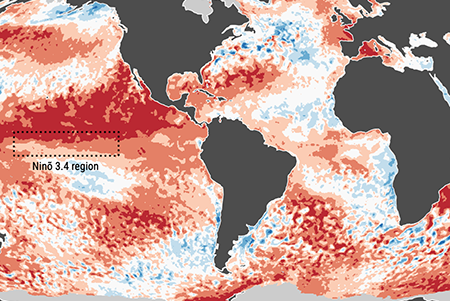
Measuring the strength of El Niño – introducing Relative Niño indices 10 June 2026 ECMWF introduces Relative Niño indices, developed with partners and supported by WMO, to better assess El Niño strength in a warming climate as forecasts suggest an unusually strong El Niño event in 2026.
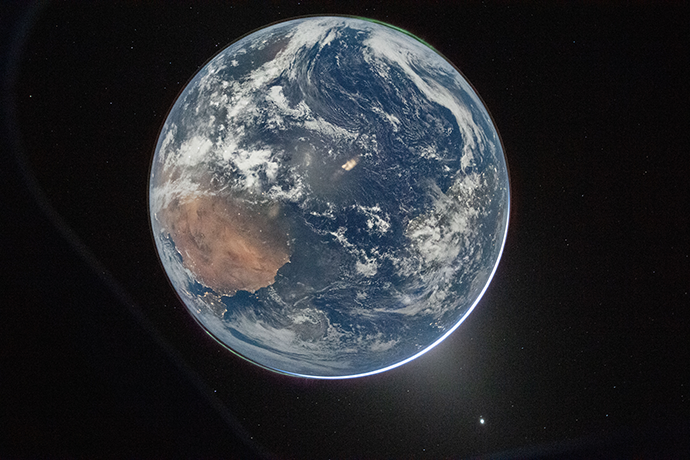
Forecasting views of Earth from Artemis II with the IFS 14 May 2026 Following NASA’s successful Artemis II mission to the Moon in April, Philippe Lopez explored how well ECMWF’s operational Integrated Forecasting System (IFS) could simulate some of the most iconic views of Earth taken by the crew from the Orion spacecraft.
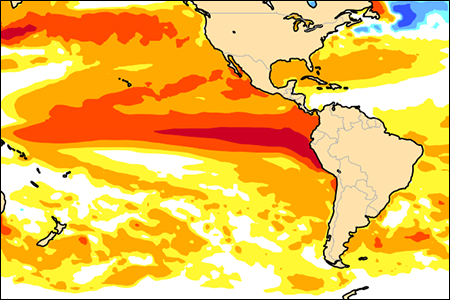
How confident should we be in a prediction of El Niño? 10 April 2026 Seasonal forecasts are fuelling headlines about El Niño, but uncertainty remains. This blog explains what the signals mean, where confidence is growing, and why caution is still essential.
Separating the signal from the noise 25 March 2026 Separating forecast errors into information and noise reveals true predictive skill, improves how weather models are evaluated, and enables fairer comparisons between traditional numerical and emerging machine learning approaches.
The AI Weather Quest: spotlighting the best of machine learning sub-seasonal prediction 13 March 2026 At the midpoint of its first competitive year, the AI Weather Quest brings together a global community advancing machine learning methods for sub‑seasonal forecasting.
Build your own probability of fire model 12 February 2026 The PoF-Toolbox is a lightweight, reproducible framework for building local machine learning probability of fire models using user-defined data, helping translate global fire signals into locally meaningful risk information.
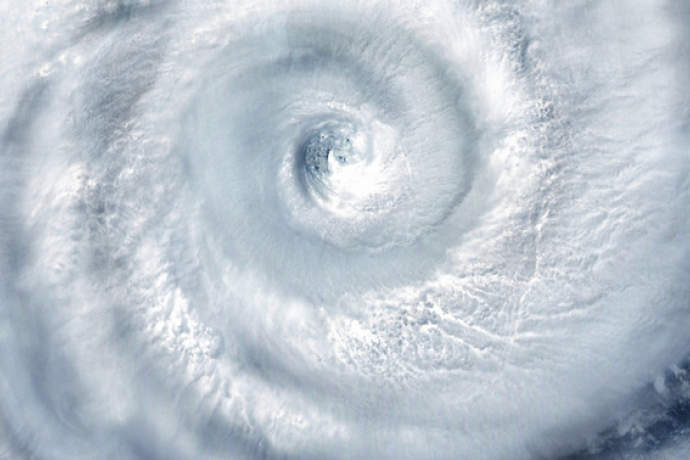
The eye of the storm: how EarthCARE is helping to evaluate hurricane physics in ECMWF forecasts 10 December 2025 EarthCARE’s overpass of Hurricane Humberto captured the first space-based view of vertical winds and precipitation inside an eyewall, offering unprecedented insight into storm structure and updrafts that will help ECMWF improve hurricane understanding, intensity prediction and forecasts.
Simplifying AI for weather forecasting with the European Weather Cloud 24 November 2025 Rising demand for AI and ML workloads on the EWC has driven ECMWF to develop ready-made templates that democratise access by simplifying setup and lowering technical barriers. Available through the EWC Community Hub, they help users focus on science over infrastructure.
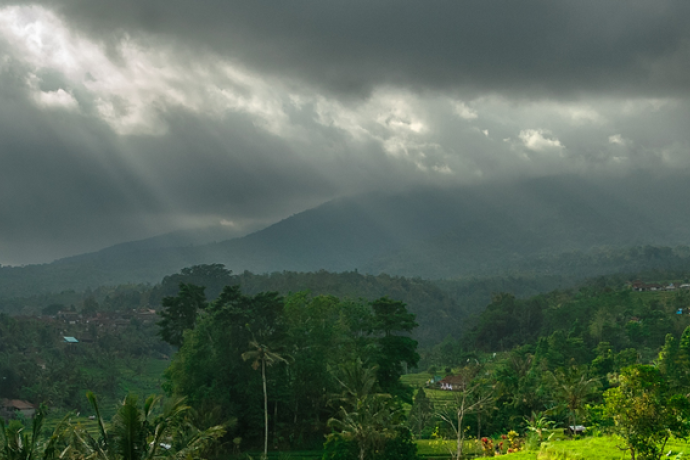
Forecasting of convective weather in Indonesia 11 November 2025 Ruth Mahubessy explores how Indonesia’s complex weather patterns challenge forecasters and how a new ECMWF–WMO Fellowship project aims to improve predictions of extreme rainfall and landspouts in the tropics.
Evaluating rainfall forecasts in Ecuador: Observations from AI and physical models 22 October 2025 WMO Fellow Angela Iza Wong explores the challenge of forecasting rainfall in Ecuador.
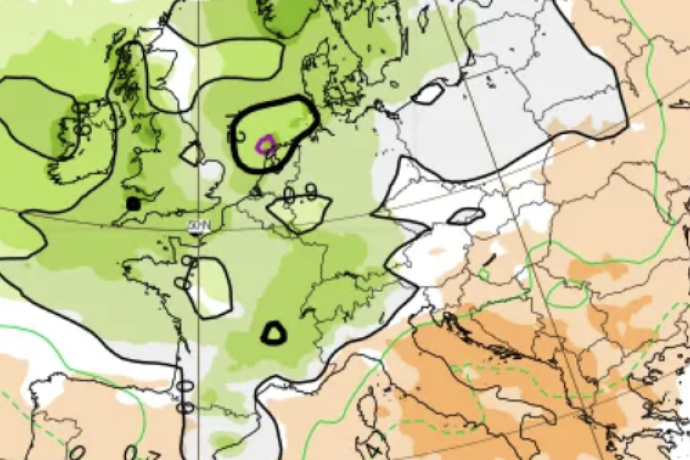
Getting the most out of ECMWF sub-seasonal forecasts 22 September 2025 Tim Hewson introduces a new type of forecast map which enables users to visualise the information content of sub-seasonal forecasts like never before.
The AI Weather Quest: uniting international expertise to advance sub-seasonal forecasting 18 August 2025 As the competition phase of the AI Weather Quest starts, the organisers introduce the competition framework and establish a baseline by assessing the skill of current dynamical sub-seasonal forecast models.
Small-but-mighty Arctic Weather Satellite now assimilated at ECMWF 15 August 2025 ECMWF has started operational assimilation of data from a trail-blazing small satellite launched by the European Space Agency (ESA) that provides new microwave sounding measurements from space. The new observations give a robust forecast improvement, complementing similar sensors from larger platforms.
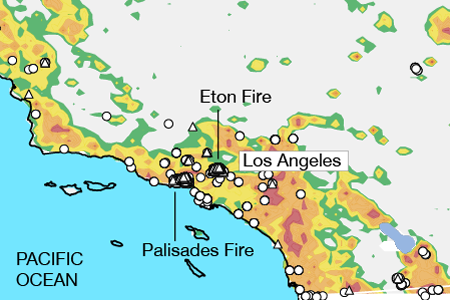
2025 California wildfires: insights from ECMWF forecasts 05 February 2025 On 7 January 2025, a series of devastating wildfires started in Los Angeles. ECMWF, which has been producing fire danger forecasts since 2018, has been exploring new approaches to fire forecasting in recent years.
Forecasting extreme events in Ecuador 04 November 2024 The challenge of forecasting extreme events across Ecuador is the focus for Angela Iza Wong, from the Ecuador Hydrometeorological Service, during her year at ECMWF as a WMO Fellow.
Reflections on the 4th ESA-ECMWF Workshop on Machine Learning for Earth System Observation and Prediction 21 May 2024 As one of the organisers of the joint ESA-ECMWF Workshop, Massimo Bonavita discusses some of the highlights and considers the future role of machine learning for weather and climate prediction.