Maldives Meteorological Service and ECMWF collaborate through the WMO Fellowship Scheme 17 February 2023 Ahmed Shabin from the Maldives Meteorological Service shares his plans for the year ahead at ECMWF as a WMO Fellow.
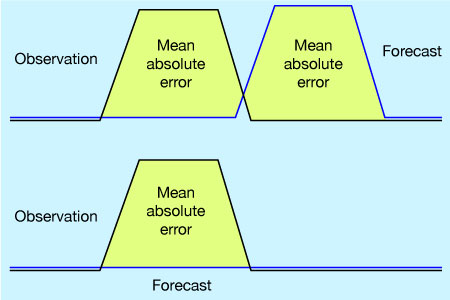
Verifying high-resolution forecasts 24 January 2023 Higher-resolution forecasts need different methods to assess their accuracy than lower-resolution forecasts. Thomas Haiden and Llorenç Lledó discuss some of their work in this field.
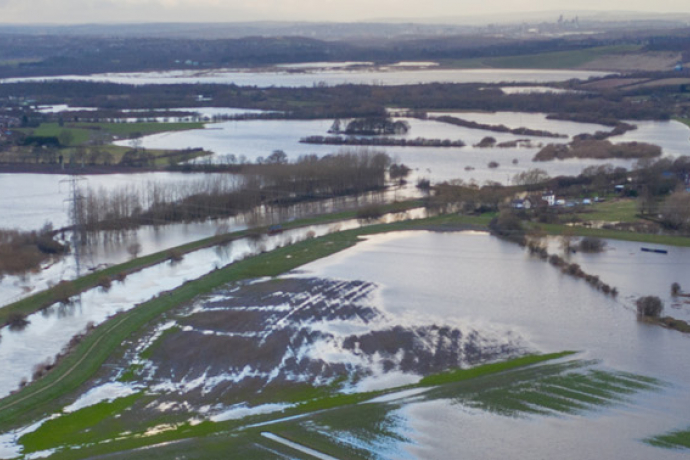
EFAS kilometre-scale flood forecasting: hydrology meets computer science 13 December 2022 Cinzia Mazzetti talks us through the upgrade of the European Flood Awareness System from 5 km to around 1.5 km, and how hydrologists, meteorologists and computer scientists are working together to achieve success.
ECMWF Summer of Weather Code 2022 07 November 2022 Now in its fifth year, ECMWF’s Summer of Weather Code continues to develop innovative software solutions which tackle a range of challenges in weather and climate, by bringing together external teams with ECMWF experts. Esperanza Cuartero and Julia Wagemann take us through this year’s projects.
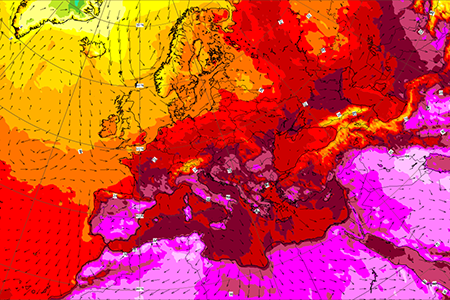
Progress in sub-seasonal forecasting of weather extremes 04 October 2022 As their work under the EU-funded CAFE project draws to a close, ECMWF scientists Emmanuel Rouges and Nikolaos Mastrantonas highlight the progress they’ve achieved in forecasting extreme conditions over Europe at the challenging sub-seasonal timescale.
Predicting the impact of new satellites on ECMWF’s forecasts 16 June 2022 ECMWF’s Ensemble of Data Assimilations is providing a novel and efficient way to assess the impact of new satellite observations and to help inform the development of the Global Observing System. Sean Healy and Katrin Lonitz discuss some of the latest work.
Radio Frequency Interference: an NWP perspective on the RFI 2022 workshop 14 March 2022 Radio frequency interference poses serious risks to numerical weather prediction and other fields. Stephen English takes us through the key issues discussed at the RFI 2022 workshop on monitoring, mitigation, and management.
ECMWF – a stimulating and diverse working environment 08 March 2022 On International Women’s Day, ECMWF’s Director-General Florence Rabier discusses working in the diverse environment of ECMWF, in a field that has fascinated her since childhood.
Secondment at ECMWF on the Maestro project 31 January 2022 Over his nine-month secondment at ECMWF, Miloš Lompar from the Serbian Met Service worked with Domokos Sármány and others in Production Services as part of the Maestro project looking at novel technologies for data input/output – currently one of the major bottlenecks in ECMWF’s Integrated Forecasting System.
Machine learning to emulate components of ECMWF’s Integrated Forecasting System 13 December 2021 Matthew Chantry and Peter Dueben look at the expanding range of projects exploring the use of machine learning within the Centre’s forecasting system.
ECMWF Summer of Weather Code 2021 01 November 2021 Julia Wagemann and Esperanza Cuartero discuss the cutting-edge innovations and high-quality open-source developments from this year’s Summer of Weather Code.
Advancing high-performance data management in the EuroHPC ACROSS project 13 October 2021 Following the opening of ECMWF's data centre in Bologna and offices in Bonn, Emanuele Danovaro highlights the opportunities this brings for collaboration in the EuroHPC ACROSS project.
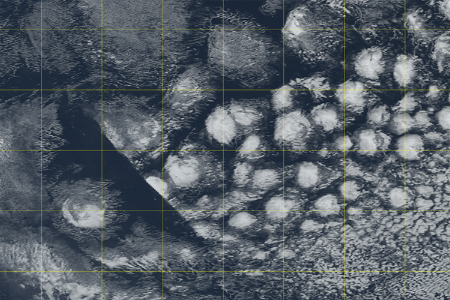
CALIPSO: 15 years of cloud and aerosol lidar data from space 28 June 2021 For the last 15 years, the CALIPSO satellite has been providing a unique, three-dimensional view of clouds and aerosols. Our scientists look back at its contribution to weather forecasting and atmospheric monitoring.
Better glimpses of the future with global storm-resolving simulations 02 June 2021 Irina Sandu and Bjorn Stevens present a European effort to build the next generation of Earth system models in the H2020 project NextGEMS.
Assimilating soil moisture scatterometer data using neural networks 26 April 2021 Patricia De Rosnay and colleagues discuss a recent study which uses neural network techniques to derive soil moisture from satellite observations. Neural networks are shown to outperform operational methods in some regions.
Large-scale machine learning applications for weather and climate 12 April 2021 The machine learning for scalable meteorology and climate (MAELSTROM) project began in April 2021. Peter Dueben, project coordinator, talks about its aims and the importance of co-design projects for concerted developments of applications, software, and hardware design.
The importance of additional surface-based observations in data-sparse regions 22 March 2021 Data from surface-based observations are vital for skilful forecasts, but significant areas of the globe remain comparatively poorly observed. Bruce Ingleby looks at the role that surface-based observations play and the impact of gaps in coverage.
Extreme precipitation and large-scale flow patterns in the Mediterranean 01 March 2021 Following a recent publication, Nikolaos Mastrantonas discusses the spatio-temporal characteristics of extreme precipitation events across the Mediterranean and their connection to large-scale atmospheric flow patterns.
New insights into polar observing systems using numerical models 08 January 2021 Irina Sandu and François Massonnet (Université Catholique de Louvain) discuss polar observations, their impact on forecasting, and how the development of observing systems goes hand in hand with the development of numerical prediction systems.