Powering the AI weather revolution: from ERA5 to AI-ready pipelines 16 March 2026 AI is transforming weather and climate prediction and Europe is leading the way with high-quality datasets, shared infrastructure, and operational frameworks.
ECMWF's data infrastructure and services: ready for the era of Common European Data Spaces 3 March 2026 Umberto Modigliani, Emma Pidduck and Stephan Siemen explain how ECMWF’s modern data infrastructure, open services and cloud‑based systems position the Centre to support and lead Europe’s emerging Common European Data Spaces.
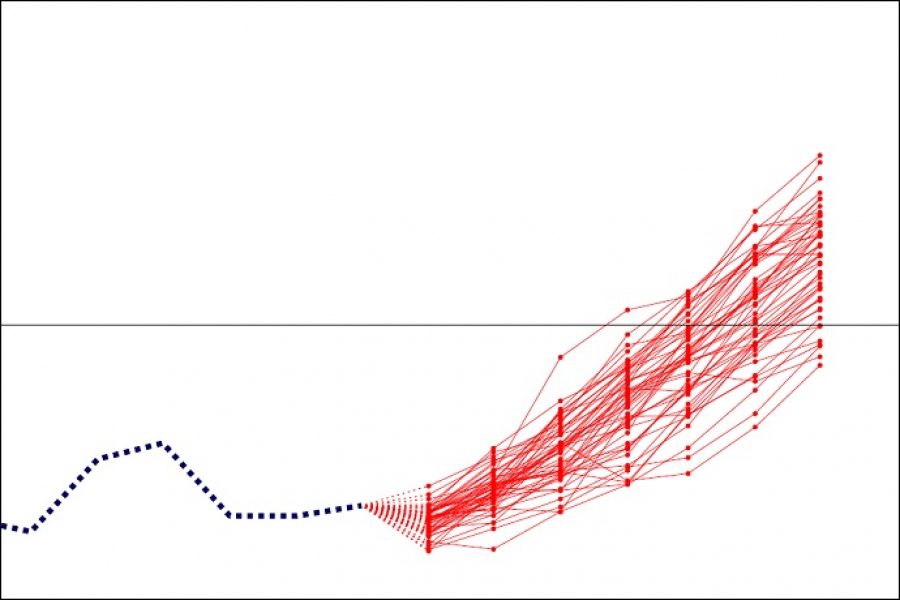
Fact sheet: Sub-seasonal and seasonal predictions 22 July 2025 ECMWF issues sub-seasonal weather predictions up to 46 days ahead. They are ensemble forecasts, and they show predicted week-to-week changes in the weather. Seasonal predictions are ensemble forecasts, too, and they are mainly issued up to seven months ahead.
Unlocking the black box: the potential of explainable AI in geoscience 21 July 2025 The lack of transparency in many AI models in geoscience poses a barrier to their adoption. Revealing the factors that influence their actions, referred to as ‘Explainable Artificial Intelligence’ (XAI), demystifies how they work.
Fact sheet: Earth system data assimilation 15 July 2025 The quality of weather forecasts crucially depends on our ability to accurately estimate the current state of the Earth system. This Q&A explains how Earth system data assimilation enables us to make such estimates.
ECMWF at the Living Planet Symposium 2025 20 June 2025 We are participating in the 2025 Living Planet Symposium from 23 to 27 June. Find out about our booth and which sessions our staff are involved in as speakers, poster presenters and conveners.
ECMWF at the EGU General Assembly 2025 25 April 2025 We are participating in the European Geosciences Union (EGU) General Assembly from 27 April to 2 May. Find out which sessions our staff are involved in as speakers, poster presenters and conveners.
Fact sheet: ECMWF and the EU’s Destination Earth initiative 18 December 2024 Destination Earth (DestinE) is an ambitious initiative of the European Union to develop a highly accurate digital twin of the Earth system by 2030. ECMWF is one of three entrusted entities to implement it by delivering digital twins and the Digital Twin Engine.
Storm Boris and European flooding September 2024 23 October 2024 In this article we look at the exceptional rainfall and flooding associated with storm Boris and discuss how well the forecasts from ECMWF and the European Flood Awareness System anticipated the event.
Monitoring the ozone layer – the role of the Copernicus Atmosphere Monitoring Service 16 September 2024 On World Ozone Day, we look at the crucial role played by the Copernicus Atmosphere Monitoring Service in tracking the Antarctic ozone hole and providing vital data to help assess its path to recovery.
Machine learning and physics in weather forecasting: a discussion between Alan Thorpe and Florian Pappenberger 17 June 2024 Alan Thorpe, former Director-General at ECMWF, and Florian Pappenberger, our current Deputy Director-General and Director of Forecasts and Services, discuss the enormous opportunities and challenging issues for machine learning and weather forecasting.
Migration to GRIB2 data format: implications for users 10 April 2024 For some time, ECMWF has been working towards using GRIB2 as the format for data output, bringing numerous benefits. Here we explore the advantages, the impact on users, and how to stay up-to-date with the migration progress.
Plans for high-resolution forecast (HRES) and ensemble forecast (ENS) control run 5 March 2024 Since ECMWF medium-range ensemble (ENS) and high-resolution (HRES) forecasts now have the same horizontal resolution, we plan to stop using the term ‘HRES’. Find out about the time frame for this change.
ECMWF at the AMS Annual Meeting 2024 22 January 2024 At the American Meteorological Society (AMS) Annual Meeting 2024, ECMWF will present developments in areas including forecasting system improvements, data assimilation, our new AIFS data-driven model, data storage and extraction, open data, and global fire activity and emissions.
ECMWF at the AGU Fall Meeting 2023 8 December 2023 At the American Geophysical Union Fall Meeting, ECMWF will present developments in modelling for numerical weather prediction and fire risk, the Copernicus Climate and Atmosphere Data Store, data from the Year of Polar Prediction (YOPP), and work towards the European Green Deal Data Space.
ECMWF at COP28 28 November 2023 At COP28, ECMWF will discuss how, in collaboration with Member States and international partners, we can find new routes to better weather forecasts and early warning systems. We will also highlight how quality-assured data from the EU Copernicus services we run support national and global policy-making and climate action.
Fact sheet: ECMWF and the EU’s Copernicus programme 11 September 2023 ECMWF contributes to the EU's Copernicus Earth observation programme by running the Copernicus Atmosphere Monitoring Service and the Copernicus Climate Change Service, and by contributing to the Copernicus Emergency Management Service.
ECMWF at the EMS Annual Meeting 2023 1 September 2023 An overview of ECMWF participation at the Annual Meeting of the European Meteorological Society (3–8 September 2023). Our scientists will discuss topics including probabilistic forecasting, weather and climate modelling, open data, machine learning, and the EU Destination Earth initiative.
Fact sheet: Reanalysis 23 August 2023 Reanalysis data provide the most complete picture currently possible of past weather and climate. This fact sheet explains what reanalysis is and what it is used for.