
The era of artificial intelligence (AI) and machine learning (ML)-powered weather forecasting is here to stay.
But far from making traditional approaches such as reanalysis irrelevant, AI/ML weather models have instead brought reanalysis back to the spotlight, highlighting their importance as the “memory” of the Earth system and helping us understand both the present and the future.
An AI/ML model is only as good as the data it is trained with, and ECMWF’s fifth-generation reanalysis (ERA5) has been widely used to train data-driven weather models around the world. ECMWF is now engaged in the production of the next generation, ERA6, which will provide enhanced capabilities.
But what exactly is reanalysis, and why does it matter for climate and weather science?
Connecting the dots
Our collective memory of the Earth’s past weather relies on incomplete and often fragmented observation records. Reanalysis consists of building the past, step by step, by filling in gaps between observations. It does so by spreading observational information using a physical model of the atmosphere and detailed knowledge of its error covariance, which is the degree of uncertainty of the variables and how they correlate to one another. Along with other relevant components, the reanalysis process effectively ‘connects the dots.’
Ingesting around 800 million observations daily as of 2026, ECMWF’s Earth system model is one of the most comprehensive in the world, and ERA5 is widely regarded as the gold standard for reanalysis. Data rescue provides an additional boost to this process, recovering observations that were previously unavailable digitally, from both manual and old satellite records.
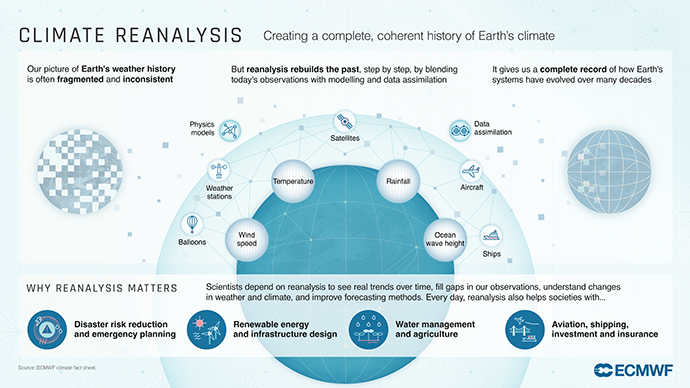
Figure 1: By integrating observations from satellites, weather stations, aircraft, ships, and balloons with model data through data assimilation, climate reanalysis reconstructs a coherent, continuous record of Earth’s climate over time.
The illustration in Figure 1 shows how reanalysis blends available observations with model information, using data assimilation and modern modelling to reconstruct our past by filling the gaps. This method provides a comprehensive and consistent record of how the Earth system has evolved over many decades.
The data available includes many significant variables and components (atmosphere, land, ocean, etc.), which is why we refer to the “Earth system” rather than just the atmosphere or weather.
Among many other applications, scientists rely on reanalysis to analyse trends, fill observational gaps, understand changes in weather and climate, and improve forecasting methods.
Reanalysis not only helps science, but is also behind many of the applications we use in our daily life, from forecasts to renewable energy and infrastructures, and much more.
Reanalysis: what is it and who is it for?
Reanalysis is therefore a long-term, physically consistent climate record enabling us to observe the evolution of our weather and climate. Over time, this tool created by scientists for scientists half a century ago, has become widely accessible contributing to the democratisation of weather and climate data.
These “maps without gaps” serve, for example, the monitoring activities of the European Union's Copernicus Climate Change Service (C3S), implemented by ECMWF. Based on this data, the service can determine how a particular period in a determined area ranks. For example, the year 2025 was the third warmest for Europe since 1940, as stated in the recent European State of the Climate 2025 report.
C3S is also building powerful applications based on reanalysis data, such as:
- The recent Weather Replay, which enables to replay the weather for any date and any location since 1940
- ERA Explorer, which provides climatological data for any location
- Climate Pulse, which monitors the land and sea surface temperature records
To name a few, and more are underway (visit the applications page).
As mentioned above, the reliability and robustness of ERA5 have been instrumental in the rapid development of AI/ML based weather models. The data has served to train most of the models currently available, including our own Artificial Intelligence Forecasting System (AIFS). It also supports external model development in Anemoi, the European collaborative framework between ECMWF and several national meteorological services. ECMWF has recently released an AI/ML training ready version of ERA5 in Zarr format. Since it’s under a permissive CC-BY-4.0 license, it enables anyone to train models, fostering the European AI/ML weather forecasting ecosystem.
Reanalysis at ECMWF: from ERA-Interim to ERA6
Reanalysis is practically as old as ECMWF, one of the pioneering organisations in the discipline. In the 1980s, concerned by the gaps in global observations for climate and weather studies, scientists began putting together a methodology to use a fixed and consistent data assimilation system and to openly exchange and reprocess past observations.
- 1979 – FGGE: The First GARP (Global Atmospheric Research Program) Global Experiment (FGGE), completed in 1979, is considered a pioneer of modern meteorological reanalysis. It served to test global data assimilation and the use of new observational data.
- 1995 – ERA-15: Covering the period 1979 – 1993, ERA-15 demonstrated the feasibility for global climate monitoring. Other reanalyses available at the time included NASA’s Data Assimilation Office and the NCEP/NCAR reanalysis of the National Centers for Environmental Prediction (NCEP) and the National Center for Atmospheric Research (NCAR). ERA-15 included only atmosphere and land data; subsequent generations integrated ocean waves and atmospheric composition.
- 2002 – ERA-40: This major upgrade covered the period 1957-2002 and included more observations alongside better modelling and data assimilation. It became a substantial tool for climate research and subseasonal prediction, supporting several ocean reanalyses such as ECMWF Ocean Reanalysis system 3 (ORA-S3). This period also kick-started the first global atmospheric composition reanalysis at ECMWF with the GEMS reanalysis. The Japan Meteorological Agency (JMA) released the Japanese 25-year Reanalysis (JRA-25) starting from 1958 in 2006.
- 2009 – ERA-Interim: Covering the period from 1979 onwards, ERA-Interim improved data assimilation and model physics. Along with pilot reanalyses of the 20th century, it served as a bridge to prepare the next generation. It also supported improved ocean reanalyses (ORA-S4 and ORA-S5) and atmospheric composition reanalyses such as MACC and the CAMS interim reanalysis (EAC3) from 2010. At this time, the main reanalyses globally were still in the USA (with MERRA2) and Japan’s JRA-55.
- 2019 – ERA5: The flagship fifth generation of ECMWF reanalysis extends back to 1940 at a resolution of approximately 30 km. It is a backbone of global climate research with countless citations in the specialised literature and has paved the way for the AI/ML weather and climate model revolution. It powers the ocean reanalysis ORA-S6 in collaboration with the EU's Copernicus Marine Service, implemented by Mercator Ocean International. The ECMWF Atmospheric Composition Reanalysis 4 (EAC4) is the flagship reanalysis of the EU's Copernicus Atmosphere Monitoring Service (CAMS), implemented by ECMWF. Other developments include JMA's JRA-3Q (released in 2023) and the China Meteorological Administration's (CMA) first global reanalysis (CRA-40), also released in 2023.
- 2027 – ERA6: The future generation of ECMWF reanalysis, currently under production, will provide higher resolution, improved observations and other advances, many of them driven by user needs. The next-generation ECMWF atmospheric composition reanalysis (EAC5) is also in preparation.
Back to the future of reanalysis
So what lies ahead for reanalysis? Global agencies, including ECMWF, are engaged in a healthy competition to build reanalyses at higher resolution, which are more accurate and have better physics and models. As ECMWF develops ERA6, NASA and the CMA are working towards global reanalyses at resolutions of around 5 km, while NASA is also developing the MERRA-3 reanalysis.
Artificial intelligence and machine learning will probably play a role in the future of reanalysis. What is clear, however, is that reanalysis will remain essential – both for building new AI models and for advancing climate and weather science.