


Authors: Umberto Modigliani and Irina Sandu
The European meteorological community is currently at the forefront of a technological shift in weather and climate prediction, driven by artificial intelligence (AI).
Artificial intelligence is reshaping weather and climate prediction at a pace few anticipated even a few years ago. Around the world, machine learning systems are now capable of generating skilful global forecasts in minutes – a remarkable development that reflects not only advances in AI models but also the availability of high-quality, well-documented freely and openly accessible Earth system data.
Europe is playing a leading role in this transformation. Thanks to decades of investment in trusted reanalysis datasets, operational infrastructure, and close cooperation between ECMWF and its Member States, the European meteorological community has made rapid, scientifically grounded progress in the emerging field of AI-based forecasting.
Umberto Modigliani, Acting Director of Forecasts and Services at ECMWF, said: “The rapid progress we are seeing isn’t just about better algorithms; it’s about the decades of trusted data and shared infrastructure that allow us to turn research into operational reality.”
At the heart of this progress lie two pillars:
1. Reference datasets for AI training – such as the ERA5 reanalysis produced in the framework of the EU's Copernicus Climate Change service (C3S) implemented by ECMWF, the Copernicus European Regional Reanalysis (CERRA) and the Copernicus Arctic Regional Reanalysis (CARRA).
2. Anemoi – a shared, open-source framework co-developed by ECMWF and Member States to support machine learning research and operational innovation. This collaborative initiative enables rapid innovation while maintaining the scientific rigour and transparency required for public safety.
ERA5: the global reference dataset for AI forecasting
ERA5, produced by ECMWF within the EU's C3S, has become one of the most influential datasets in modern weather prediction. Its combination of:
• long-term temporal coverage (1940–present),
• global spatial completeness,
• physical consistency across variables, and
• comprehensive documentation and support
makes it uniquely suited for machine learning applications.
As AI forecasting has rapidly evolved, ERA5 has emerged as the default training corpus for the majority of the world’s leading AI models used across research groups, national meteorological services, and industry.
Carlo Buontempo, Director of C3S at ECMWF said: "This widespread adoption is not accidental. It reflects the scientific quality of ERA5, supported by ECMWF’s operational experience in Earth system modelling, data assimilation, quality control and large-scale reanalysis production. As production of ERA5’s successor dataset, ERA6 begins, the demand for stable, well-understood reanalysis data continues to increase, underscoring Europe’s essential contribution to the global AI weather ecosystem."
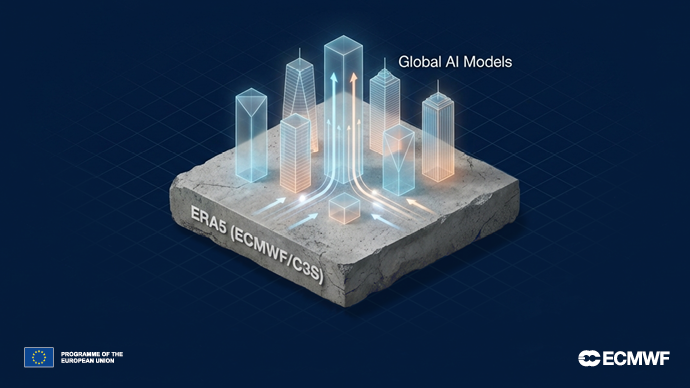
ERA5 underpins the global AI weather revolution. High quality, physically consistent data make it the worldwide reference for training AI models.
Preparing data for AI: operational strengths as enablers
The shift toward AI forecasting has also highlighted an important reality: access to large volumes of data is not sufficient. Machine learning workflows require efficient, reliable and reproducible ways to explore and transform data – particularly when working with petabytes of reanalyses, forecasts and observations.
ECMWF’s operational data, software, and service infrastructure have become a natural foundation for this work. Originally built to support numerical weather prediction, they are proving equally valuable for AI, thanks to characteristics such as:
- a “living” archive, containing 1.5 exabytes of data, with high-frequency access by hundreds of thousands of users,
- robust indexing and metadata systems, facilitating findability and accessibility,
- mature post-processing workflows, and
- decades of operational data stewardship.
To support researchers and Member States, ECMWF has also developed earthkit, a modular Python ecosystem that provides consistent tools for retrieving, manipulating and analysing Earth system data. Earthkit builds on the principles used in ECMWF’s operations, ensuring that users preparing AI training datasets benefit from the same reliability and transparency that underpin ECMWF’s daily forecasts.
Together, these capabilities reduce duplication of effort and provide a clear path from raw observations or model output to AI-ready datasets – a crucial requirement for scaling machine learning work across institutions.

Machine learning pipelines: optimal performance relies on placing large datasets close to Graphics Processing Units (GPUs) within HPC environments, ensuring efficient machine learning workflows. Credit: generated with Gemini Canvas.
Anemoi: a shared European framework for AI weather prediction
While datasets and processing tools are essential, the rapid progress in AI weather forecasting across Europe is also due to shared software frameworks that support collaboration.
A major reason Europe has advanced so quickly in AI-based weather and climate prediction is the emergence of Anemoi, a jointly developed, open-source framework created by ECMWF together with several national meteorological services. Anemoi provides a coherent, shared foundation that supports the full lifecycle of developing machine learning models, from data preparation to model training, inference and operational use.
At its core, Anemoi offers three essential capabilities:
- AI-ready datasets: production, cataloguing and distribution of more than 150 curated training datasets derived from ERA5, operational ECMWF data, satellite and in situ observations, and Member State archives. These datasets are prepared using domain expertise and deployed across multiple HPC systems across Europe.
- Training and ML operations: tools for large-scale, distributed model training, experiment tracking and workflow reproducibility, enabling consistent development across institutions and HPC environments, including the world-class EuroHPC supercomputers.
- Inference and applications: components that support scalable model execution for weather and climate applications across both timescales and spatial scales. Examples include nowcasting, limited-area ML models, ECMWF’s own Artificial Intelligence Forecasting System (AIFS) and the AI Earth system components and climate emulator developed within the Destination Earth initiative of the European Commission.
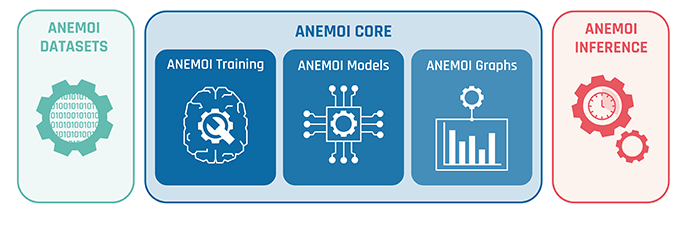
Overview of the Anemoi pipeline, from datasets through core components – training, models, and graphs – to inference.
Matthew Chantry, Strategic Lead for Machine Learning at ECMWF, said: "By providing an end-to-end, operationally aligned framework, Anemoi enables ECMWF and its Member States to build, operationalise and improve AI models in a consistent way. This shared framework ensures the rapid progress in AI prediction, while ensuring transparency, scientific robustness and a clear pathway from research to operational implementation."
In 2025, Anemoi received two major international recognitions. It was awarded the Technology Achievement Award by the European Meteorological Society (EMS) for its collaborative approach to machine learning, and also the 2025 HPCwire Readers’ and Editors’ Choice Award for “Best Use of AI Methods for Augmenting HPC Applications”.
AIFS: operationalising AI models
ECMWF’s Artificial Intelligence Forecasting System (AIFS), which is operationally run daily since 2025, demonstrates how machine learning models can be integrated into a rigorous operational environment. Running the AIFS alongside the Integrated Forecasting System (IFS) allows ECMWF and its Member States to:
- evaluate AI forecasts with established verification methods,
- analyse strengths and limitations under diverse conditions, and
- explore the complementarity of physics and machine learning forecasting approaches.
This side-by-side exploration ensures that emerging AI methods can be assessed transparently and responsibly, in line with ECMWF’s commitment to scientific trust, quality, and reliability.
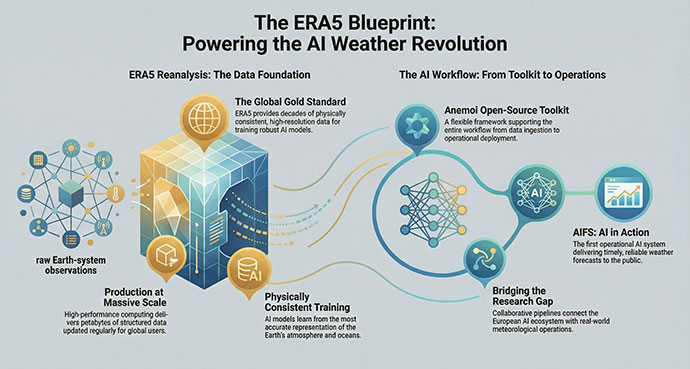
The ERA5 Blueprint illustrates the journey from raw Earth observations to next‑generation AI weather forecasts. Credit: generated by NotebookLM.
Europe’s collective momentum
Across Europe, interest in AI-enabled forecasting is growing, with ECMWF, national meteorological services, research institutes and private actors exploring applications from post-processing and downscaling to nowcasting and regional and global prediction. One example is the recent operationalisation of AICON by the German Meteorological Service (DWD) utilising Anemoi.
Building on shared foundations such as ERA5, earthkit and Anemoi allows ECMWF and its Member States to develop these methods in a consistent way, supporting joint approaches to model development and evaluation.
This collective momentum is one of Europe’s strengths, helping establish a coherent and scientifically robust pathway for AI-enabled weather prediction, strengthening the capacity of the European meteorological infrastructure.
A European contribution to the AI weather revolution
The AI revolution in weather and climate prediction is well under way. Rapid progress in machine learning models has opened new opportunities, from faster global forecasts to expanded ensemble exploration and improved downstream applications.
By prioritising open-source collaboration and high-quality data stewardship, Europe has established the global blueprint for integrating AI into critical public infrastructure.
ECMWF and its Member States are contributing strongly to this transformation, not only by producing the datasets that underpin much of today’s AI research, but also by developing the shared tools, workflows, models and operational pathways needed to use AI responsibly and effectively.
Through ERA5, earthkit, and especially Anemoi, Europe is building the foundations of reliable, transparent and operationally relevant machine learning workflows and models. This work strengthens both research excellence and the delivery of high-quality weather and climate services – ensuring that the benefits of the AI revolution are realised in support of societies across Europe and beyond.
As we look toward the next decade of increasingly volatile weather patterns, these foundations will be tested as never before. The question we must now ask is: How will our newfound ability to generate global, high-fidelity forecasts in mere minutes fundamentally change our capacity to protect lives and property in a rapidly changing climate?
Further reading
This article is part of ECMWF’s In Focus series on data, exploring how evolving infrastructure, open data, and AI-ready systems are reshaping access to weather and climate information:
- Data sovereignty in practice: ECMWF infrastructure for European services
- Minutes matter: how ECMWF delivers time-critical data at global scale
- Data friction and the user experience: a framework for improvement
- The living archive: inside ECMWF's exabyte-scale meteorological data repository
- Powering the AI weather revolution: from ERA5 to AI-ready pipelines
- ECMWF's data infrastructure and services: ready for the era of Common European Data Spaces