


Image: © Ketut Agus Suardika / iStock / Getty Images Plus
Authors: Umberto Modigliani, Emma Pidduck and Stephan Siemen
Across Europe, organisations are being encouraged to share and use data in new ways across borders and sectors to support innovation and improve services.
The European Union’s (EU) Common European Data Spaces aim to make this possible by creating secure digital environments where data can be reliably accessed, exchanged and reused across borders and strategic sectors.
This ambition is set out in the EU's Data Strategy, first published in 2020 and reinforced by the Data Union Strategy adopted in November 2025. Supported by significant EU investment, Common European Data Spaces are being developed across 14 sectors to enable innovation, support artificial intelligence (AI) development, and strengthen European competitiveness. These include the Green Deal Data Space, which will integrate vast quantities of environmental and climate data to support the EU's 2030 goals.
For ECMWF, this vision reflects an approach embedded in operations for many years. The Centre already provides open, interoperable and federated access to vast volumes of data and its long-standing investment in data infrastructure, governance and cloud-based processing positions it to play a key role as Europe accelerates the rollout of Common European Data Spaces.
Umberto Modigliani, Acting Director of Forecasts and Services at ECMWF, said: "The principles that underpin Common European Data Spaces, such as openness, interoperability, federation and trusted governance, are principles that ECMWF has been putting into practice for many years. Our data infrastructure and services are not just compatible with the Data Spaces vision; in many respects, they helped pioneer its implementation."
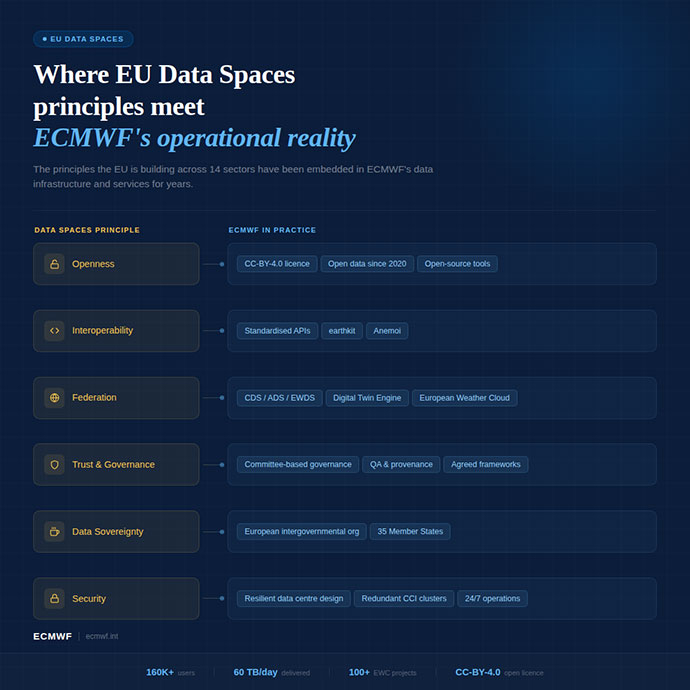
How ECMWF's operations align with the principles of EU Data Spaces.
A track record in open, federated data provision
ECMWF has been providing weather and climate data to its Member and Co-operating States for five decades. In 2020, ECMWF formally adopted an open data policy, opening its vast Meteorological Archival and Retrieval System (MARS), which is one of the largest archives of numerical weather prediction data in the world, for broader use and reuse. While this was part of a wider European shift encouraged by the EU's Open Data Directive, ECMWF was among the first intergovernmental organisations in the environmental sector to make such a comprehensive commitment.
The Copernicus Climate Data Store (CDS), developed and operated by ECMWF on behalf of the European Commission since 2018, embodies many of the characteristics now being sought for Common European Data Spaces. It provides a single point of access to petabytes of distributed, quality-assured climate data from multiple providers, with open and free access for all users. The CDS integrates observations, reanalyses, seasonal forecasts and climate projections through a unified web interface and application programming interface (API), enabling users to discover, retrieve, process and visualise data seamlessly.
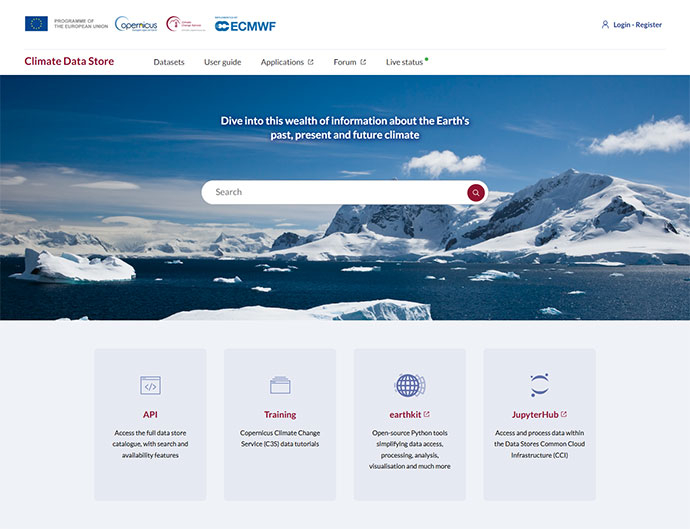
The Copernicus Climate Data Store (CDS) is a one-stop shop for information about the climate: past, present and future.
Its companion, the Atmosphere Data Store (ADS), extends the same model to air quality and atmospheric composition data for the Copernicus Atmosphere Monitoring Service (CAMS). Both data stores fully adhere to the FAIR principles, meaning that data are designed to be Findable, Accessible, Interoperable, and Reusable. This approach represents a strategic step toward maximising the impact of the Centre’s data catalogues and serving a broader and more diverse user community. ECMWF is not only enhancing access to climate and atmospheric data for researchers and policymakers but also laying the groundwork to support the next generation of machine-learning weather and climate applications and European-wide federated data platforms.
Together, these data stores now serve hundreds of thousands of registered users, delivering about 100 terabytes of data per day.
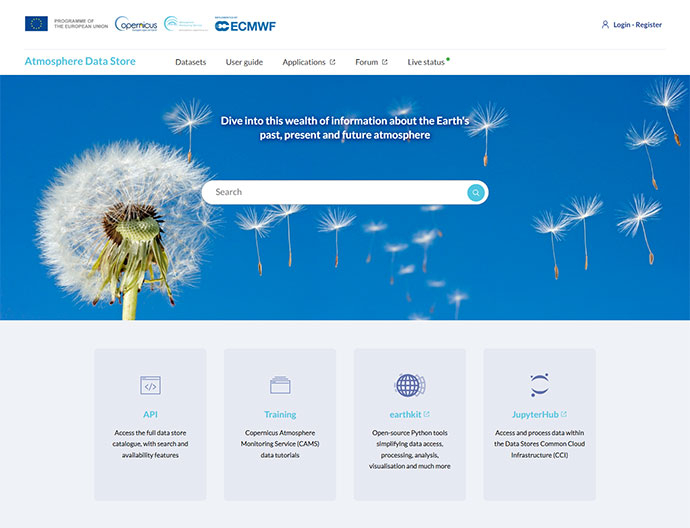
The Copernicus Atmosphere Data Store (ADS) provides access to data and tools related to atmospheric monitoring.
Emma Pidduck, User Solutions Team Lead at ECMWF, said: "Our goal is to make high-quality data as accessible and usable as possible for researchers, policymakers, businesses and innovators while removing dataset friction."
The architecture of the data stores reflects many of the features envisaged for Common European Data Spaces: federated data from distributed providers, harmonised access via standardised APIs, cloud-based processing tools, and open-source software.
From data stores to data spaces: a natural evolution
The recent modernisation of ECMWF's Data Stores has further aligned the Centre's infrastructure with the Data Spaces paradigm. The modernised system runs on ECMWF's Common Cloud Infrastructure (CCI), which also hosts the European Weather Cloud (EWC), a community cloud computing platform jointly operated by ECMWF and EUMETSAT for their Member States. The CCI provides computing and storage resources, enabling federation with other cloud infrastructures and seamless integration with EU initiatives.
ECMWF's data infrastructure also serves as a federated data bridge to the WEkEO platform: a Copernicus Data and Information Access Service (DIAS) developed in partnership with EUMETSAT, Mercator Ocean International and the European Environment Agency. WEkEO allows users to work with Copernicus data directly in the cloud, supporting the “bring the computation to the data” approach that underpins the Data Spaces concept.
The Centre's role in the EU's Destination Earth (DestinE) initiative further demonstrates this alignment. ECMWF is implementing the Digital Twin Engine and the first two Earth-system digital twins, producing unprecedented volumes of high-resolution simulation data. These outputs are made available through the DestinE Data Lake, contributing to a federated ecosystem that connects data from multiple European institutions and offers harmonised access via standardised interfaces.
Governance, quality and trust
Common European Data Spaces are underpinned by governance frameworks that ensure data quality, provenance and trust. These principles have long been central to ECMWF's data provision. Every dataset in the Copernicus Data Store is quality-assured, with documented provenance and clear licensing terms. As an intergovernmental organisation serving 35 Member and Co‑operating States, ECMWF provides a well‑established and trusted model for operational data stewardship.
ECMWF’s open‑source software, including the EarthKit Python libraries and the CDS Toolbox, supports transparency and enables users to build and adapt their own workflows. This approach also encourages collaboration within the wider community, which is a core intention of the Data Spaces model.
Shaping a vision for the European meteorological community
In 2025, at the request of its Member States, ECMWF joined forces with EUMETSAT and EUMETNET to explore what Common European Data Spaces could mean for the European Meteorological Infrastructure (EMI) and the wider community it serves. Through dedicated workshops with Member States, the organisations and their collective membership began investigating how the Data Spaces model might be applied to strengthen data sharing, interoperability and service provision across the European meteorological community. This collaborative effort reflects a shared recognition that the EMI is well placed to lead by example as Europe builds its data-driven future.
Supporting Europe’s data-driven future
As the EU scales up its Common European Data Spaces and develops the Green Deal Data Space for environmental and climate data, ECMWF is well prepared to support these initiatives. The Centre's existing infrastructure already provides many of the capabilities that these initiatives seek to build from scratch in other sectors: federated access to distributed data, cloud-based processing, open APIs, quality assurance, trusted governance, and a large, active user community.
Umberto Modigliani added: "We have spent years building the data infrastructure, services, governance frameworks and user communities that Common European Data Spaces are now designed to create. As the EU looks to operationalise its Data Strategy, ECMWF is ready to contribute its experience and to ensure that weather, climate and environmental data continue to be at the heart of Europe's data-driven future."
At a glance
- ECMWF operates one of the world's largest archive of numerical weather prediction data (MARS), containing hundreds of petabytes.
- The Copernicus Climate Data Store has over 246,000 registered users and delivers about 100 TB of data per day.
- ECMWF adopted an open data policy in 2020, ahead of many of its peers.
- The European Weather Cloud, jointly operated with EUMETSAT, provides community cloud computing for the European Meteorological Infrastructure.
- ECMWF is one of three Entrusted Entities delivering the EU's Destination Earth initiative, alongside ESA and EUMETSAT.
- The modernised Copernicus Data Stores (CDS, ADS, etc.) run on ECMWF's Common Cloud Infrastructure and serve as federated data bridges to WEkEO and the broader Copernicus ecosystem.
- ECMWF participated in the RODEO project led by EUMETNET, whose goal was “The provision of open access to public meteorological data and development of shared federated data infrastructure for the development of information products and services”.
Further reading
This article is part of ECMWF’s In Focus series on data, exploring how evolving infrastructure, open data, and AI-ready systems are reshaping access to weather and climate information:
- Data sovereignty in practice: ECMWF infrastructure for European services
- Minutes matter: how ECMWF delivers time-critical data at global scale
- Data friction and the user experience: a framework for improvement
- The living archive: inside ECMWF's exabyte-scale meteorological data repository
- Powering the AI weather revolution: from ERA5 to AI-ready pipelines
- ECMWF's data infrastructure and services: ready for the era of Common European Data Spaces