
On 1 April 2026, NASA’s Artemis II mission launched successfully with a crew of four on a 10-day return trip around the Moon, 54 years after the last Apollo Moon landing.
During the first two days of the mission, the astronauts photographed our planet with handheld cameras. Although most of us are familiar with images of Earth from geostationary meteorological satellites, some of the Artemis photos were particularly fascinating because of their unusual composition, viewing angles and lighting conditions.
As a natural follow-up to my previous simulations from the IFS of images of Earth from the Apollo mission, as described in Lopez (2020) (L20 hereafter), I decided to repeat the exercise for three of the most striking Artemis II photos, using a much-improved simulator compared to L20.
Here are the three Artemis photos selected for simulation:
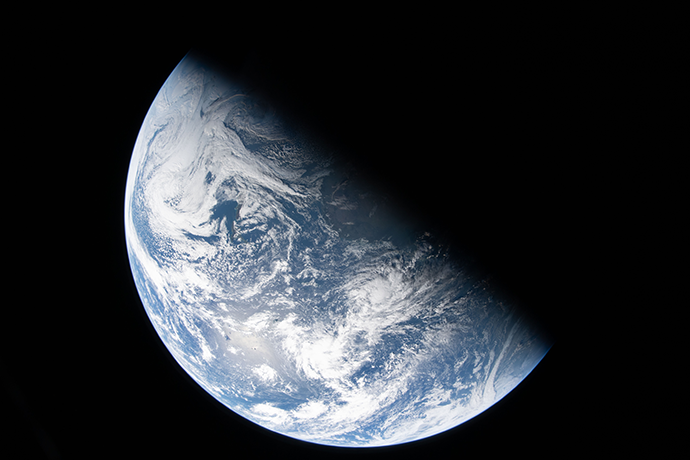
Photo #1: Artemis II Captures the Terminator Line
A “half Earth” view photographed from the Orion spacecraft.
Camera: Nikon D5
Date and time: 2 April 2026, 20:55:15 UTC
Image credit: NASA (CC BY-NC-ND 4.0)
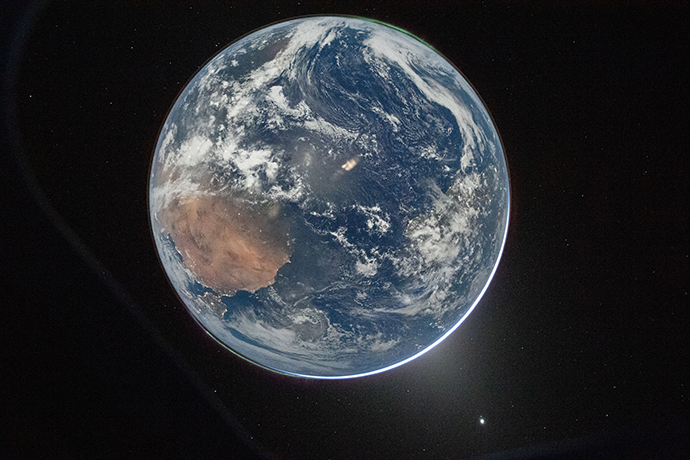
Photo #2: Hello World
Moonlit Earth with Venus in the bottom right corner. The northern and southern lights are visible as thin green lines near both poles.
Camera: Nikon D5
Date and time: 3 Apr 2026, 00:27:39 UTC
Image credit: NASA (CC BY-NC-ND 4.0)
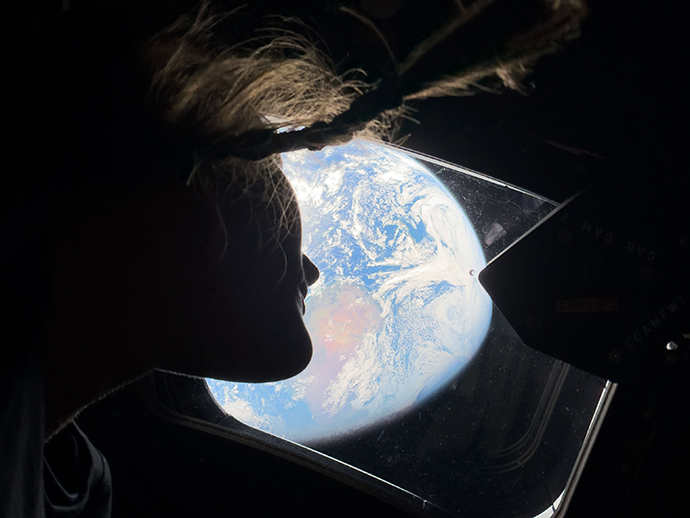
Photo #3: Spaceship Earth
Astronaut Christina Koch enjoying the view.
Camera: iPhone 17 Pro Max
Date and time: 2 Apr 2026, 22:44:38 UTC
Image credit: NASA (CC BY-NC-ND 4.0)
Reconstructing the view from Orion
The photos were obtained from Flickr/NASA/Artemis II, with some information about their date and time, as well as the cameras and settings used.
The biggest challenge was reconstructing the viewing geometry of each image using NASA ephemeris data to compute the trajectory of the Orion spacecraft. The animation in Figure 1 shows how the view of Earth evolved during the first three days of the mission. Combined with additional hints provided by bits of land visible on each photo, the animation helped me estimate Orion’s position relative to Earth at the desired time.
Figure 1: Animation of Earth as viewed from the Orion spacecraft during the first three days of the Artemis II mission. Colour shading shows sunlit regions (Sun’s height over the horizon), while no shading indicates nighttime. Date and time (UTC), spacecraft distance to Earth, and sub-spacecraft coordinates are given in each frame’s title.
The most remarkable event in the animation is the abrupt change in the spacecraft’s trajectory caused by the translunar injection burn at the end of 2 April. This is the moment when the engine had to be briefly switched back on to set the spacecraft on its course to the Moon. All three selected photos were taken around this crucial period. After all, when the possibility of return becomes uncertain, photographing one’s home becomes an almost instinctive act, even for a seasoned astronaut!
Simulating the Artemis images with the IFS
The final step was to simulate the selected Artemis images from IFS weather forecasts. Unlike the simpler approach used in L20, these simulations were created by feeding 3D atmospheric and surface fields from operational Integrated Forecasting System (IFS) 9 km resolution forecasts into the detailed radiative transfer model RTTOV (Saunders et al. 2018). RTTOV plays a key role in ECMWF’s operational assimilation of satellite observations.
For each photo, RTTOV simulated top-of-the-atmosphere reflectances (TOA), which indicate how much incoming light is reflected back to space, for four different wavelengths: blue, green, red and near-infrared. Since RTTOV cannot simulate handheld cameras, such as the Nikon D5 or the iPhone 17 used by the astronauts, I assumed that the viewing instrument was the imager on board EUMETSAT’s Meteosat Third Generation (MTG) geostationary weather satellite. Combining reflectances at the four simulated wavelengths allowed natural colour images to be created. These were supposed to mimic quite accurately what a handheld camera would see.
An additional challenge came from photo #2 which shows the full Earth under moonlight rather than sunlight. To handle these unusual lighting conditions, the simplest approach was to run RTTOV as if the Sun replaced the Moon. A rather unorthodox approach that worked rather well.
IFS and Artemis: how do they compare?
Figures 2 to 4 compare the images simulated from IFS against the three selected Artemis photos. Forecast ranges of approximately one and three days are shown for all three cases, while the 5-day forecast is only displayed for photo #2 due to IFS data availability.
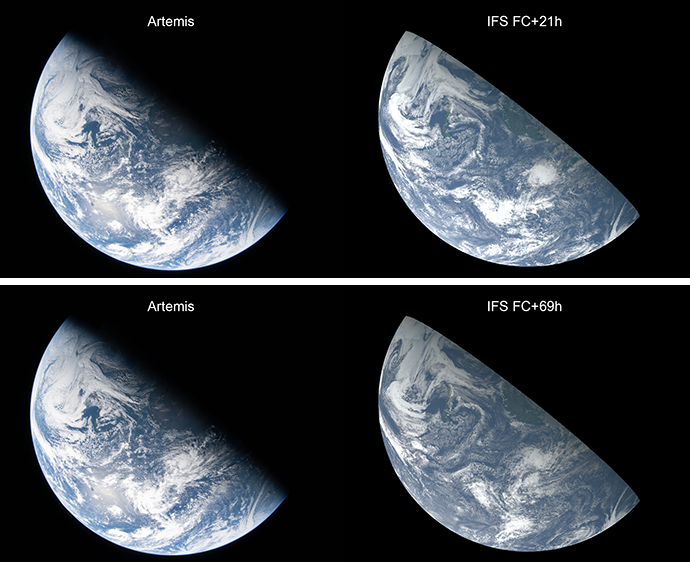
Figure 2: Comparison of Artemis photo #1 (left) with simulations from IFS 21h and 69h-range forecasts (right). Artemis image credit: NASA (CC BY-NC-ND 4.0)
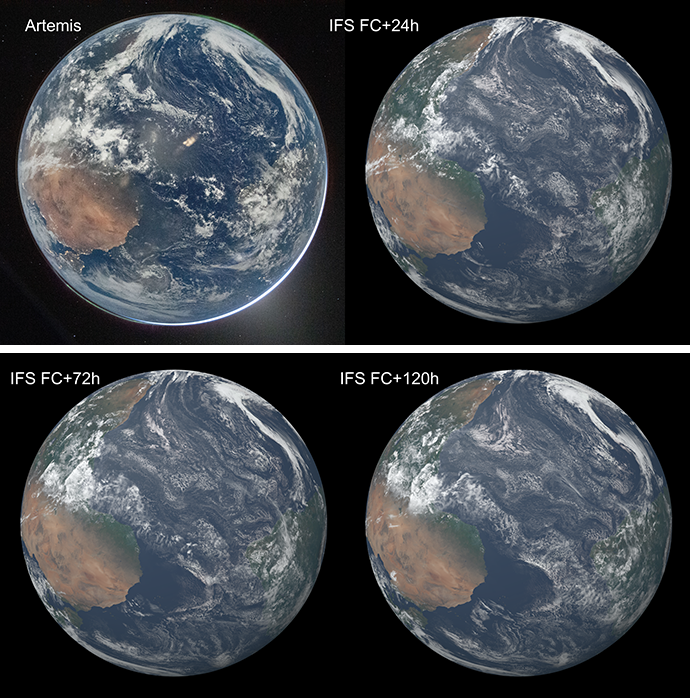
Figure 3: Comparison of Artemis photo #2 (top left) with simulations from IFS forecasts (three other panels). On this almost “upside-down” view of moonlit Earth, Africa appears on the left, with the Sahara Desert clearly visible, while South America is recognisable on the right. A small bright lens flare, caused by reflection from the spacecraft’s window, can be seen just above the centre of the Artemis photo. Artemis image credit: NASA (CC BY-NC-ND 4.0)
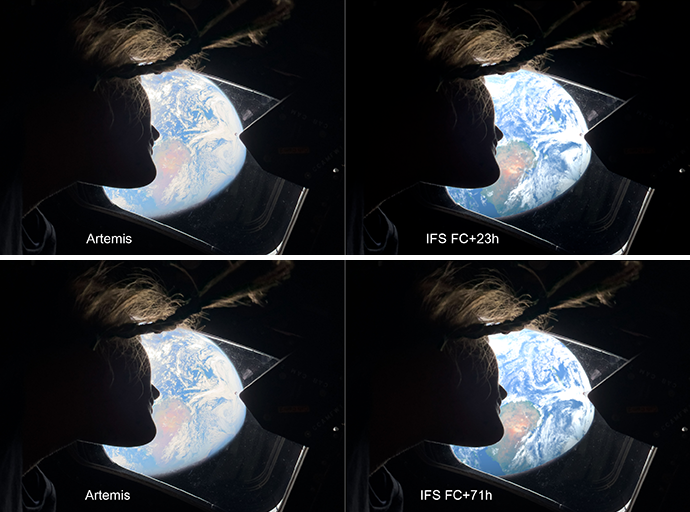
Figure 4: Comparison of Artemis photo #3 (left) with simulations from IFS forecasts (right). Tilted by 84 degrees anticlockwise, this daytime view of Earth shows Australia next to the astronaut’s mouth and New Zealand in the centre-right. Artemis image credit: NASA (CC BY-NC-ND 4.0)
The cloud patterns simulated from IFS forecasts agree rather well with the three Artemis photos (Figures 2 to 4). The one-day forecasts look slightly more realistic than the longer forecasts, especially in the tropics, which is not surprising given the more unpredictable nature of convective clouds. By contrast, clouds in mid-latitudes and in polar regions look good at all prediction ranges up to day 5. The idea that we can now predict, with good accuracy, how the whole Earth would look from space several days ahead is quite fascinating.
Compared with the simulations of the “Blue Marble” picture from 1972 (Figure 3 in L20), these rather accurate Artemis simulations highlight the huge benefits of assimilating large numbers of satellite observations into ECMWF’s current operations to improve initial conditions. Back in 1972, only a single polar-orbiting satellite, NOAA-2, was available, meaning that global weather conditions, especially over tropical oceans, were far less accurately represented in ECMWF’s ERA5 reanalysis. And usually, the better the initial conditions, the better the short- and medium-range forecasts.
Reasons for imperfections
Imperfections in the IFS model itself are likely to explain some of the discrepancies found in the spatial distribution and location of clouds. Other discrepancies may arise from simplifying assumptions which were formulated when computing reflectances with RTTOV. For instance, assuming that Earth was observed by Meteosat’s imager rather than by handheld cameras may explain some inaccuracies in the rendering of simulated images.
In the case of photo #2, replacing the Sun with the Moon in the simulator – thereby neglecting special properties of the moonlight’s spectrum – might also contribute to errors. It should also be noted that northern and southern lights, which appear as thin green lines near both poles on photo #2, cannot currently be simulated from IFS data.
Furthermore, the RTTOV software, despite its complexity and versatility, could still be improved. For example, RTTOV currently does not account for 3D radiative effects. This explains why the terminator (i.e. the day–night transition zone) always appears to be much sharper on simulated images than on real images, as obvious in Figure 2.
Finally, the simulated images presented here might still be affected by small navigation errors, given the unavailability of information about the viewing geometry in the original photos.
In a nutshell
Images of Earth simulated by running the radiative transfer model RTTOV on operational IFS forecast data show a remarkable level of agreement with photos taken during the Artemis II lunar mission, especially in the extratropics, and at lead times up to five days. This kind of validation exercise, while not ground-breaking from a theoretical point of view, has offered a unique opportunity to tackle new technical challenges and explore unusual avenues in our modelling capabilities, through observations of Earth from unconventional vantage points and instruments.
Top banner image credit: cropped from NASA imagery (CC BY-NC-ND 4.0)