

The BUILDSPACE (“Enabling Innovative Space-driven Services for Energy Efficient Buildings and Climate Resilient Cities”) project concluded on 31 January 2026, completing a 36-month Horizon Europe Innovation Action, involving 14 organisations from eight countries. The project set out to leverage Earth observation (EO), Internet of Things (IoT) and drone survey data, together with digital twins and augmented reality (AR) and virtual reality (VR) technologies, to improve urban development and building construction practices, ultimately strengthening the resilience of cities to climate change.
A central challenge in urban resilience is bringing together heterogeneous information – such as satellite products, positioning services, local repositories and sensor observations – into workflows that decision-makers can use. BUILDSPACE addressed this challenge through an underlying core platform that integrates European Global Navigation Satellite System (EGNSS) services, Copernicus core services, and external sources, including repositories and IoT data.
On top of this platform, BUILDSPACE delivered five thematic services spanning building-scale digital twin generation and enrichment, and city-scale climate risk and energy-demand analysis (Figure 1).
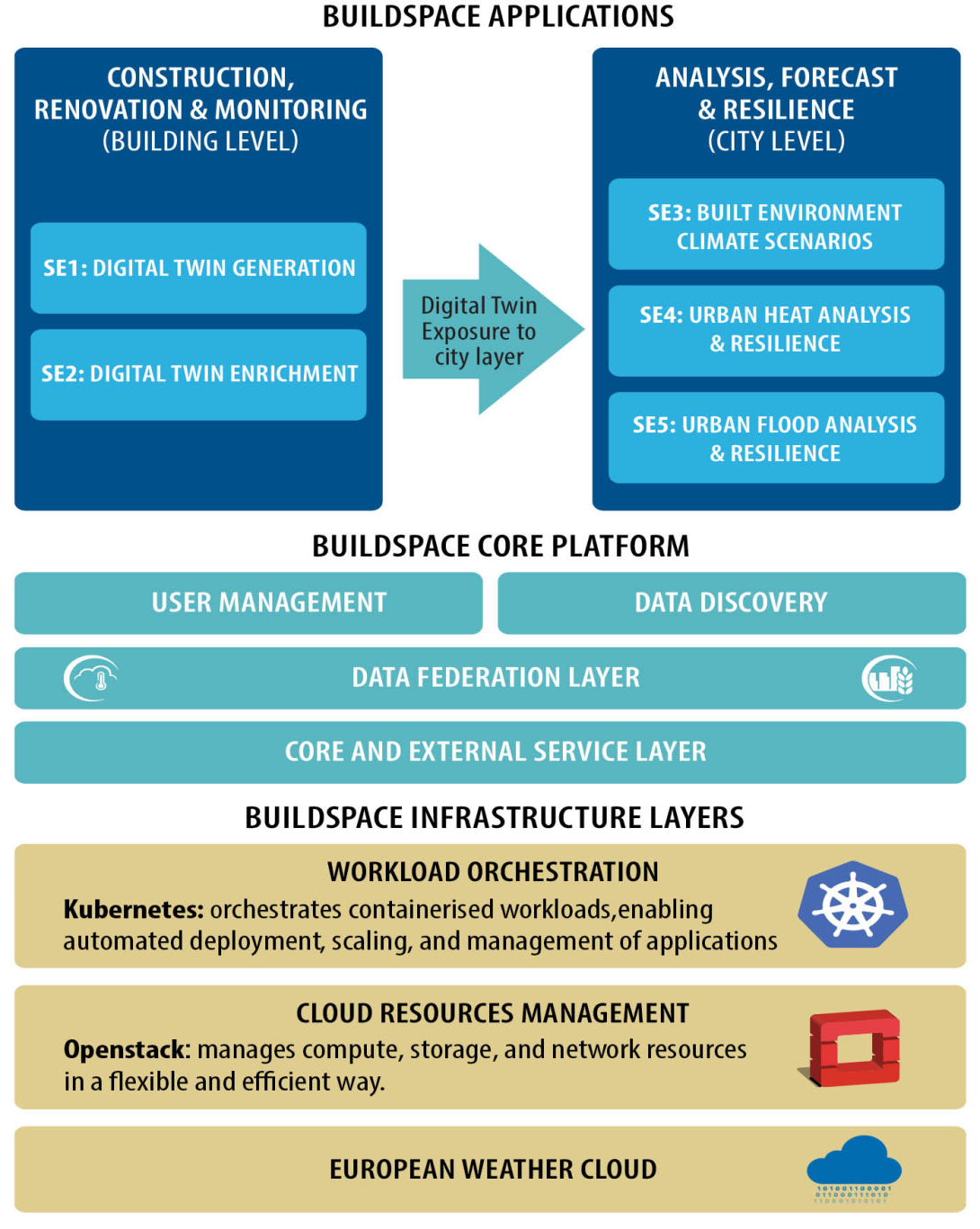
The services include:
- Digital Twin Generation, creating building-level digital twins linked with EGNSS and supporting interactive visualisation via AR/VR.
- Digital Twin Enrichment, adding Simultaneous Location and Mapping (SLAM) techniques, Unmanned Aerial Vehicle (UAV) imagery and thermal analysis to assess building energy performance.
- Building Environment Climate Scenarios, supporting stakeholders in understanding how building stock energy demand may evolve under climate change.
- Urban Heat Analysis and Resilience, combining high-resolution urban heat information with sociodemographic layers to assess heat risk and social vulnerability.
- Urban Flood Resilience, integrating Copernicus and local data with climate measurements to assess flood risk and support renovation guidelines and blue-green infrastructure planning.
The services allowed for the identification of environmental hotspots, assessment of risks, and generation of evidence to support interventions such as targeted building renovation or urban resilience planning.
Practical impact
ECMWF’s contribution to BUILDSPACE was delivered largely through the European Weather Cloud (EWC), a community cloud computing platform jointly operated with EUMETSAT, producing several broad-range tangible and transferable results:
- Infrastructure-as-Code (IaC) blueprints for rapid, highly available Kubernetes on the EWC. Building on earlier experience from the Horizon Europe-funded EO4EU project (https://www.ecmwf.int/en/newsletter/186/news/conclusion-eo4eu-project), ECMWF implemented a fully automated IaC approach that enables the deployment of highly available Kubernetes clusters on the EWC in a matter of minutes.
- Continuous integration and continuous delivery (CI/CD) patterns for secure, scalable geospatial web applications. ECMWF contributed to the scalable design and automated deployment of BUILDSPACE’s Urban Heat Analysis and Resilience service on the EWC, establishing CI/CD workflows that are being reused and refined in ongoing projects. ECMWF also designed and managed a security-hardened GeoServer deployment and automated publication workflows using a GitOps approach.
- Copernicus and Destination Earth (DestinE) engagement to support interoperability and uptake. BUILDSPACE strengthened the use of ECMWF-contributed Copernicus datasets across services and helped align project outcomes with DestinE’s evolution through engagement at community events and initiatives. These activities are continuing in the context of other ongoing projects (especially CLIMRES; https://cordis.europa.eu/project/id/101147777).
Demonstrations and urban resilience outcomes
BUILDSPACE services were demonstrated in four pilot locations across Europe with different climate profiles (Figure 2): Poland (construction support for facilities at the University of Warsaw and the Poznań University of Technology), Latvia (Riga – energy demand forecasting and climate scenario analysis), Greece (Piraeus – building and urban heat risk assessment), and Slovenia (Ljubljana – urban flood resilience).
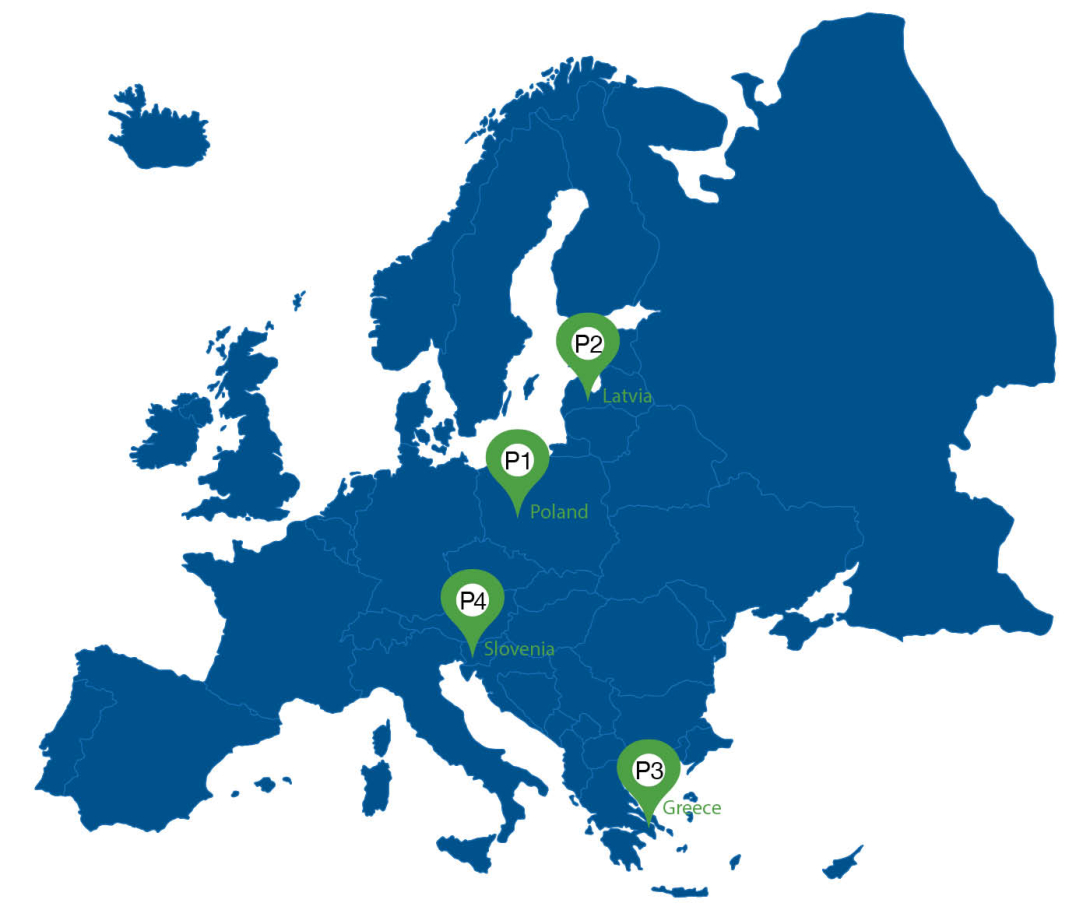
Together, these pilots showcased how digital twins and EO-driven analytics can translate into practical outputs such as hotspot maps for heat risk, evidence for renovation planning, and flood-risk assessments supporting resilience measures and blue-green infrastructure planning.
BUILDSPACE also contributed to COSPACE, a clustering initiative under the Horizon Results Booster programme. Building on the technical work, the initiative produced a joint policy brief recommending that decision-makers enhance data-sharing frameworks and interoperability, invest in artificial intelligence (AI)-driven climate services, promote nature-based solutions for urban resilience, strengthen climate-resilient agriculture, and expand climate monitoring and early warning capabilities.
From project to operational deployment
Looking forward, one practical objective is to bundle and maintain the BUILDSPACE cloud-native patterns (IaC, GitOps, CI/CD and observability) into a standardised “project deployment kit” for EWC-based services, accelerating delivery while improving reliability and repeatability.
Funding acknowledgement
BUILDSPACE (grant agreement 101082575) was funded by the European Union. Views and opinions expressed are those of the authors and do not necessarily reflect those of the European Union or the granting authority. Neither the European Union nor the granting authority can be held responsible for them.