

ECMWF maintains a comprehensive range of verification statistics to evaluate the accuracy of its forecasts. Each year, a summary of verification results is presented to ECMWF's Technical Advisory Committee (TAC). Their views about the performance of the operational forecasting system in 2025 are given in the box.
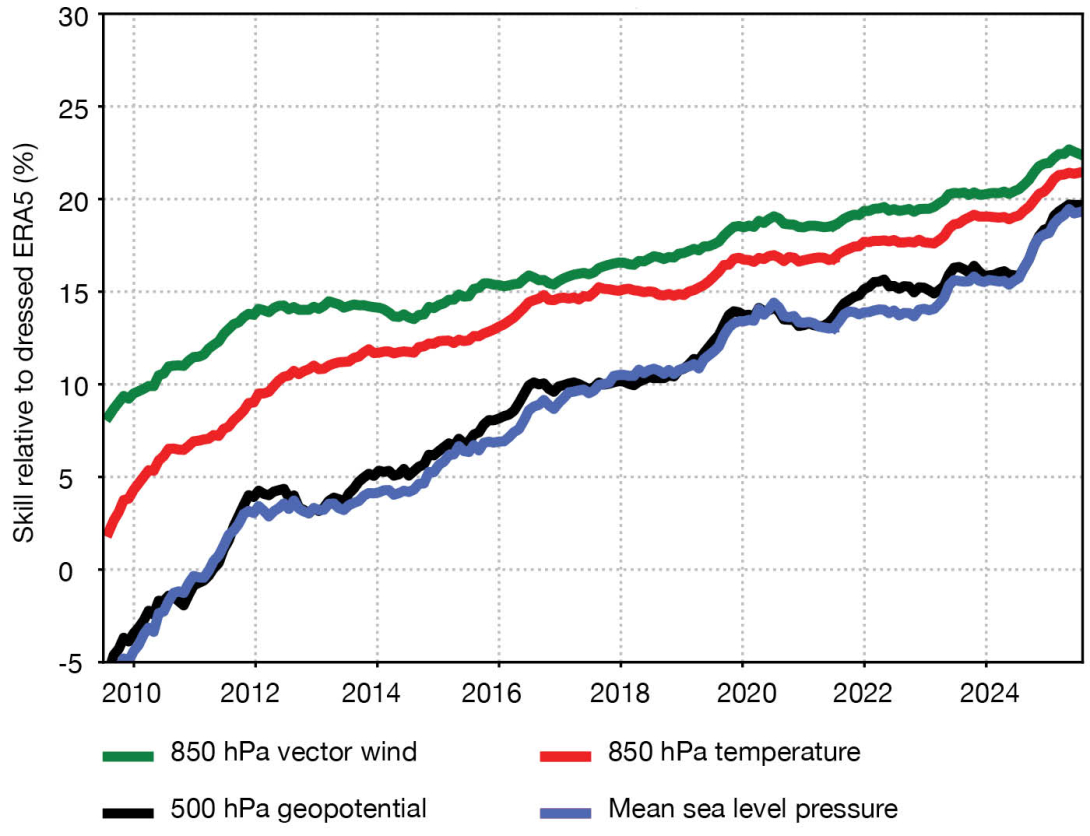
The implementation of Cycle 49r1 of the Integrated Forecasting System (IFS) on 12 November 2024 has improved medium-range scores in the extratropics by several percent. It is the largest improvement in upper-air ensemble forecast (ENS) scores from a single upgrade since 2011 and has increased ECMWF’s lead over other centres in terms of upper-air scores in the medium range. Cycle 49r1 introduced, among other changes, 2 m temperature assimilation in 4D-Var and the use of the Stochastically Perturbed Parametrizations (SPP) scheme. For surface parameters such as 2 m temperature and 10 m wind speed, the upgrade has reduced the number of large errors in the northern extratropics by about 10% in the ensemble forecast (Figure 1). While precipitation forecast skill has improved slightly (0.5–1%), scores for 2 m dewpoint and total cloud cover have been largely neutral. IFS Cycle 50r1, scheduled for spring 2026, is expected to deliver substantial improvements in these variables.
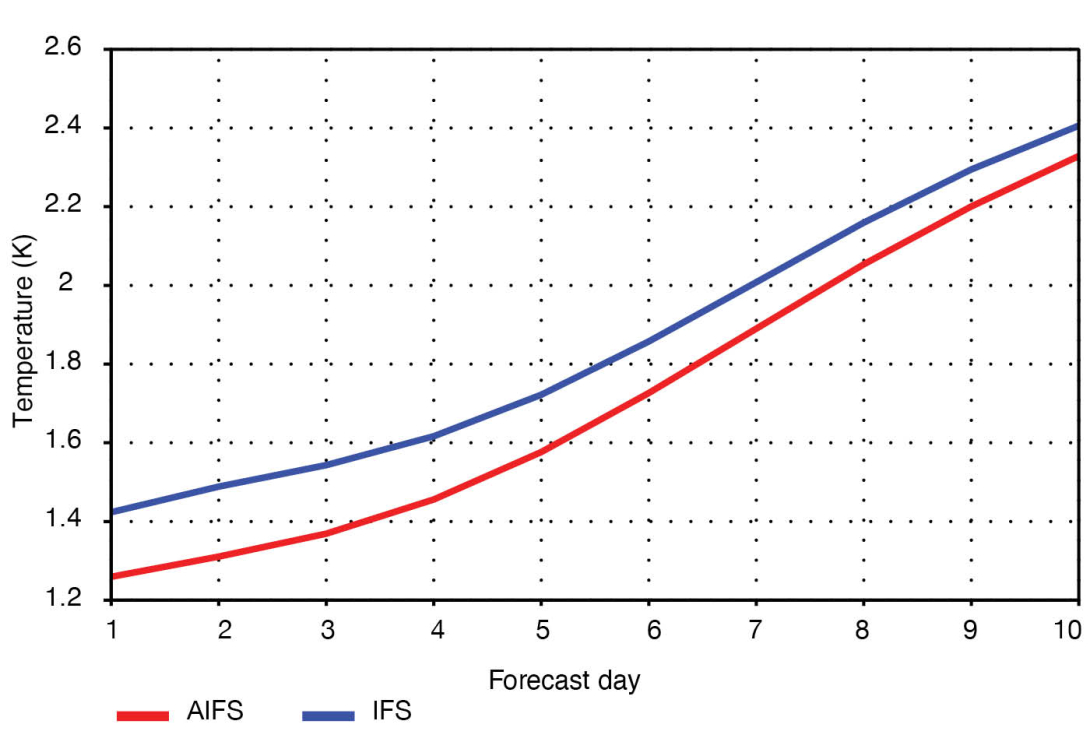
On 25 February 2025, the machine-learning (ML) model AIFS Single v1 was implemented, followed by the operational launch of AIFS-ENS on 1 July 2025. Both AIFS Single and AIFS ENS show superior skill for most upper-air and surface parameters compared to the IFS control and ensemble forecasts. Error reductions in the medium range are typically of the order of 5–15%. This includes a reduction in the number of large errors, for example in 2 m temperature, especially in wintertime stable situations. Precipitation is improved as well in the ML vs physics-based forecast by about 10% in the medium range, equivalent to 0.5–1 forecast day. Tropical cyclone (TC) position errors are reduced substantially in the AIFS compared to the IFS, whereas TC intensity errors are generally larger due to a weak-intensity bias.
IFS sub-seasonal forecasts in the extratropics show a continuing trend of increasing skill in week 2, and a marginally significant trend in weeks 3 and 4. On the seasonal timescale, due to the absence of strong forcing from Tropical Pacific sea-surface temperatures in 2025, forecast skill was modest, especially in boreal winter (December-January-February) 2024/25; however, large-scale boreal summer (JJA) temperature anomalies were captured. The strongly negative phase of the Indian Ocean Dipole (IOD) was well predicted.
IFS-COMPO is competitive with other air quality forecasts in predicting NO2, surface ozone, and PM2.5. Scores for column ozone and aerosol optical depth (AOD) indicate a slight improvement in forecast skill due to Cycle 49r1.
The complete set of annual verification results is available in ECMWF Technical Memorandum No. 931 on 'Evaluation of ECMWF forecasts', downloadable from https://www.ecmwf.int/en/publications/technical-memoranda.
Additional resources
Verification as part of ECMWF's charts page: https://charts.ecmwf.int
WMO inter-comparison of global model forecast skill: https://wmolcdnv.ecmwf.int
WMO ocean wave model intercomparison results: https://confluence.ecmwf.int/display/WLW/WMO+Lead+Centre+for+Wave+Forecast+Verification+LC-WF
List of 'Known IFS Forecasting Issues': https://confluence.ecmwf.int/display/FCST/Known+IFS+forecasting+issues
IFS cycle changes since 1985: http://www.ecmwf.int/en/forecasts/documentation-and-support/changes-ecmwf-model
Assessment of ECMWF’s Technical Advisory Committee, 20–21 October 2025
a) congratulated ECMWF on its 50th anniversary and is looking forward to many more years of successful and fruitful collaboration between ECMWF and Member and Co-operating States;
b) welcomed the positive benefits of 49r1. The revised assimilation of 2 m temperature, the switch from SPPT to SPP and the increase in resolution of EDA have, relative to the ERA5 benchmark, brought a large improvement in skill. Cycle 49r1 shows the largest improvement in skill from a single model cycle since the introduction of 46r1 several years ago;
c) congratulated ECMWF on maintaining and increasing their lead over other centres in upper air scores for the extratropics;
d) noted that ECMWF does not lead over all centres for all surface parameters, more so in the shorter range especially for precipitation. The difference between ECMWF and those centres who are leading in this respect has narrowed for 2 m temperature due to the introduction of 49r1;
e) welcomed the benefits 49r1 has brought for high-impact weather. For example, EFI skill has improved, especially for precipitation. Heavy summertime precipitation skill scores over Europe also seem to be starting to improve having been relatively stagnant for some time whilst some Member States noted an improvement in 10 m wind details, especially during winter. Cloudiness is also improving;
f) noted that skill scores for DestinE continuous Extremes digital twin (IFS at 4.4 km horizontal resolution) remain higher than for IFS. Since the introduction of 49r1, DestinE upper air scores have shown more improvement, implying 49r1 has an even greater benefit at higher resolutions;
g) welcomed tropical cyclone verification showing the smallest D+3 position error so far and a reduced central pressure bias whilst noting the ENS location forecast has moved from being under- to over-dispersive
h) welcomed the benefits of 49r1 in IFS-COMPO (CAMS) for prediction of atmospheric composition;
i) congratulated ECMWF on the operational introduction of AIFS Single in late February 2025 and AIFS ENS in early July 2025. These are world-leading achievements and initial skill improvements from AIFS ENS are particularly encouraging. Information ECMWF has provided on verification and model characteristics to help users build trust has been welcomed;
j) noted that, compared to the physics-based forecasts, machine learning forecasts lead on skill for many parameters and are less jumpy;
k) recognised that the performance of AIFS is similar to several other machine learning forecasts, including a small decrease in skill during the last 12 months;
l) noted that, compared to IFS, AIFS leads for 2 m temperature and 10 m wind speed, especially over Europe. In particular, AIFS is better with 2 m temperature in stable wintertime synoptic situations and benefits AIFS brings to 10 m wind speed are larger over flatter, less complex terrain.
m) noted that AIFS shows a smaller position and track error for tropical cyclones than IFS, but has a greater intensity bias;
n) congratulated ECMWF on maintaining its long-term lead over other centres for significant wave height and its lead for peak period scores;
o) welcomed the sub-seasonal model showing some improvements in week 2. Noted that when considering warm summer and cold winter anomalies there is yet to be any statistically significant robust increase in skill for weeks 3 and 4;
p) noted that, although the transition from El Niño to La Niña and thence to neutral conditions was well-captured by the seasonal model, the amplitude of cycle was more muted in reality;
q) recognised that the lack of strong forcing from Pacific SSTs would impact seasonal forecast skill, skill being lower-than-average in such situations. Nevertheless, seasonal forecasts for winter 2024–25 and summer 2025 showed some skill over the northern hemisphere, but missed the cold winter anomaly over North America and were generally less skillful over the southern hemisphere, especially over Australia;
r) appreciated ECMWF’s continued development of new diagnostics and products, and its very good support provided to Member and Co-operating States over the last year, with engagement via many mechanisms including online support, the annual UEF, online seminars, site visits and meteorological representatives at Member States.