

Outer-loop ocean–atmosphere coupled data assimilation will be fully integrated into ECMWF’s operational systems with the Integrated Forecasting System (IFS) Cycle 50r1. The upgrade introduces interactive 3D ocean and sea-ice components coupled to the existing atmosphere, wave and land components within the numerical weather prediction (NWP) data assimilation system. This milestone reflects extensive development across ECMWF to operationalise an approach first demonstrated in the coupled reanalysis (CERA) systems. For the first time, we will create a unified Earth system analysis to initialise our forecasting system.
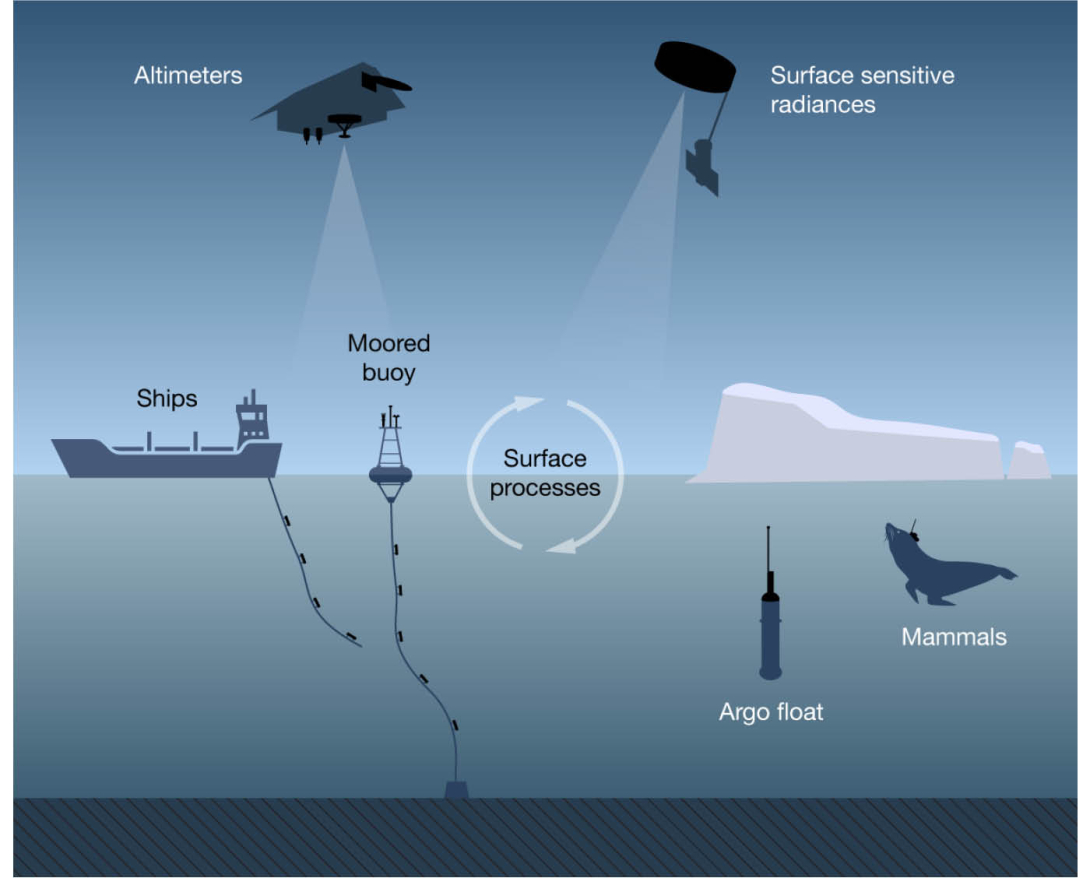
As well as aligning the analysis model with that of the forecasts, we will soon actively assimilate oceanic observations across all analysis and forecast systems. These include in situ subsurface profiles of temperature and salinity from Argo floats, moored buoys, ships, air-dropped instruments, and elephant seals with sensors (Figure 1). The system also actively assimilates sea-level anomaly data from altimeters.
Making better use of interface observations
One of the major benefits of the coupled data assimilation is that, for the first time, we can fully utilise so-called interface observations that are sensitive to both the ocean surface and atmosphere. Going well beyond the CERA reanalyses – ECMWF’s earlier coupled reanalysis system (Schepers et al. 2018; https://doi.org/10.21957/sp619ds74g), we are now extracting additional information from satellite radiance observations to impact not only atmospheric analyses but also the 3D ocean and sea-ice fields. The system uses observations from both microwave and infrared instruments on low Earth orbit and geostationary satellites.
Previously, ECMWF ran a fixed reanalysis and analysis ocean system, last updated in 2016 with the ocean reanalysis ORAS5. With Cycle 50r1, the coupled analysis and the daily forced ocean and sea-ice analysis are part of the operational cycle, enabling regular updates of the ocean component with each IFS release. Although the system remains anchored to the new ocean reanalysis ORAS6, it will be possible to add new observation types, modify perturbation methods, and generally respond to user requirements. Anchoring to ORAS6 also ensures consistency with re-forecasts, as well as drastically reducing testing requirements and therefore speeding up the research-to-operations process for cycle development.
Delivering better forecasts
These changes bring benefits for forecasts. They improve consistency in the boundary layer and allow better use of surface processes within 4D-Var. For example, when using scatterometers in the data assimilation system we are now able to use surface stress relative to the ocean currents to compare with satellite measurements. Similarly, ocean currents are present in the wave data assimilation, allowing waves to diffract as they do in the real world. The system reduces reliance on external data products and provides the ability to extract more timely information. In the case of sea-surface temperatures, information could be up to 69 hours more timely.
The coupled system also strengthens cross-component consistency. Ocean subsurface observations of temperature and salinity can detect and verify changes in the atmosphere, while satellites and traditional atmospheric observations can reveal and verify changes in the ocean. In this way, each component now helps constrain the quality of the other. In addition, the system now fully utilises information from interface observations that was previously discarded.
The lower boundary condition for the analysis is no longer the sea or ice surface; it is now the bathymetry and geothermal heating at the ocean floor. This shift increases the number of prognostic variables available to be used within the assimilation, such as sea-surface salinity, sea-ice albedo, and more. As a result, this opens new avenues of research to extract more data from existing observations and to allow more data to be used.
With the long journey from research to operations nearing completion, this new platform will allow exciting new scientific developments. For example, work will exploit data from future satellite missions such as the Copernicus Imaging Microwave Radiometer (CIMR) and CRISTAL, with impacts across the Earth system. Research has started exploring the direct assimilation of satellite microwave radiances to initialise the ocean salinity, supplementing the existing sparse conventional observations. Future coupling also extends to land–atmosphere (see article by Herbert et al. in this Newsletter).
In the new age of data-driven forecasting, we are continuing to expand and develop the physics-based system. However, the benefits of this will be felt in the data-driven systems, too, by providing better initial conditions and more consistent coupled analysis datasets for training.