

The coupling methodology in current state-of-the-art numerical weather prediction systems is primarily based on weakly coupled data assimilation. This involves running separate assimilation approaches for each Earth system component, with coupling occurring only through cycling of the coupled forecast model. As a result, observations from one component cannot influence others until the next data assimilation window. We developed an outer loop coupling approach for increased consistency and more balanced initial conditions between land and atmosphere.
In line with the ECMWF Earth system strategy, coupled data assimilation is central to providing consistent initial conditions across the atmosphere, land, and ocean – allowing observations to simultaneously influence the analysis of multiple components (de Rosnay et al., 2022). Figure 1 illustrates the ECMWF reanalysis coupled data assimilation configurations used in ERA5 (Herbsach et al., 2020) and plans for future reanalysis generations.
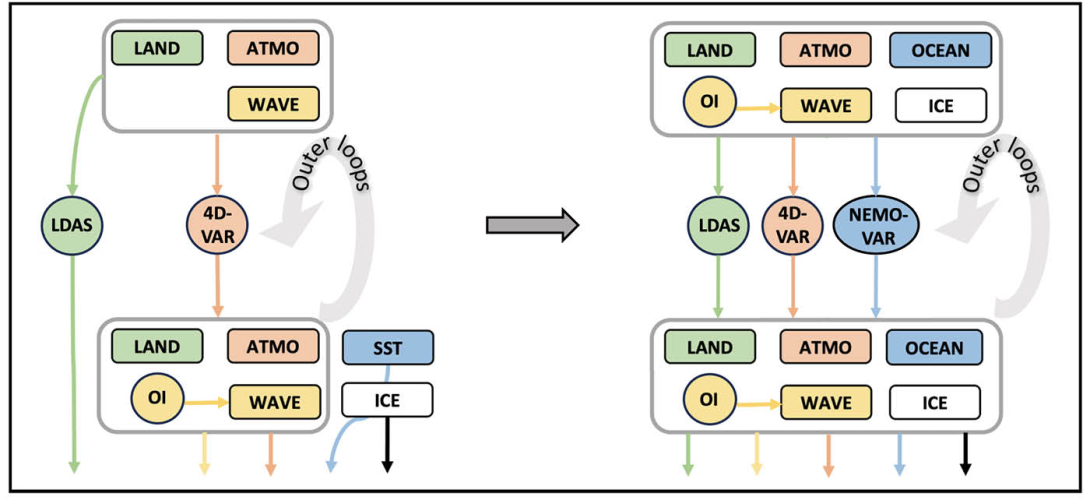
The Copernicus Climate Change Service Evolution (CERISE) project aims to advance coupled surface–atmosphere assimilation in preparation for the next generations of seasonal prediction and reanalysis systems beyond ERA6. CERISE builds upon quasi-strongly coupled assimilation, as described by Penny et al., 2017. In this method, the system is not treated as a single fully integrated state vector, as it is in a strongly coupled data assimilation. However, cross-component state exchange between the different assimilation systems occurs within the same data assimilation window. This is implemented through outer loop coupling within the incremental formulation of 4D-Var used for atmospheric analysis (see Box A). ECMWF’s Integrated Forecasting System (IFS) Cycle 50r1 will already feature outer loop coupled assimilation between the ocean/sea-ice and the atmosphere (see article by Browne et al., 2026 in this Newsletter). For land, ECMWF has been developing a unified Land Data Assimilation System (LDAS) built upon the Simplified Extended Kalman Filter (SEKF). This system already includes a multi-layer soil moisture analysis in operations and has been extended to other variables, making it suitable for enhanced coupling (Herbert et al., 2024).
A
4D-Var outer loops and the LDAS in detail
Incremental 4D-Var relies on outer loop cycling. In each iteration of what is referred to as an outer loop, a nonlinear model trajectory is produced. We linearise the nonlinear model trajectory around the most recent state estimate, resulting in a quadratic cost. This is then minimised by an iterative solver in what are called inner loops. The minimisation yields an increment being the update to the forecast state using observations based on their respective error statistics. The increment is valid at the start of the assimilation window, and we use it to update the nonlinear state as the improved guess for the next outer loop iteration. In the final outer loop, we propagate the increment obtained from the minimisation associated with the penultimate trajectory by the tangent-linear model from the start of the assimilation window to the required times to form the analysis. The analysis is then used to initialise the short forecast to provide the initial condition for the subsequent assimilation window.
The LDAS includes screen-level analysis, snow analysis (including single-layer snow temperature), as well as soil moisture and soil temperature analyses at multiple soil depth layers (0–7 cm, 7–28 cm, and 28–100 cm). The screen-level analysis is an intermediate step required to produce gridded analysis fields from SYNOP relative humidity (RH2m) and temperature (T2m) station observations at screen level (2 metres). These observations are typically reported at standard synoptic hours (e.g. 00, 06, 12, 18 UTC) and rely on a 2-dimensional Optimal Interpolation (2D-OI). The analysed RH2m and T2m fields are assimilated as pseudo-observations, i.e. not measured directly by instruments but treated as observations. We use an SEKF to analyse soil moisture, soil temperature and snow temperature. The sensitivities between the observations and these prognostic variables are derived from their spread in the 50 members of the Ensemble of Data Assimilations currently produced. For the soil moisture analysis, in addition to using the screen-level observations, we assimilate satellite soil moisture retrievals from the Soil Moisture and Ocean Salinity (SMOS) and the Advanced SCATterometer (ASCAT) missions.
As part of CERISE, we developed capabilities in the IFS to enable outer loop land–atmosphere coupling using a similar infrastructure approach as for the ocean. In this setup, we run the LDAS in multiple outer loops within each assimilation window, initialising each Earth system component at every outer loop with updated land and atmospheric fields. We investigated different configurations to identify the optimal degree of land–atmosphere coupling in terms of number of coupled loops.
The coupling configuration with the LDAS in the first three outer loops allows for the most balanced initial conditions across the land and the atmosphere, showing an overall positive impact on near-surface atmospheric forecasts and improved fit to independent atmospheric observations. However, enhanced coupling can also lead to degraded skin temperature at regional scale when evaluated against land surface temperature data, mainly due to deficiencies in the representation of the diurnal cycle.
Outer loop coupling developments
We conducted major infrastructure developments to support outer loop land–atmosphere coupled data assimilation. In the current weakly coupled system, the SEKF runs its own nonlinear trajectory to provide the necessary forecast fields used for quality control, screening, first-guess departure calculations and as the background for the SEKF analysis. The trajectory represents most of the SEKF computational cost, and effectively re-runs the first nonlinear trajectory in the atmospheric 4D-Var. As a cost-effective alternative, we developed an externalised SEKF configuration which does not run a trajectory. In this configuration, the required trajectory fields are written out to disk in the first 4D-Var trajectory and are simply read back in the SEKF without the need to run additional trajectories. In combination with several additional optimisations, this reduces the SEKF computational cost by a factor of 80 at horizontal resolution Tco1279 (~9 km), while maintaining equivalent meteorological performance.
In the IFS, we are integrating the LDAS into the 4D-Var workflow as a separate family. We follow a structure similar to that of ocean–atmosphere coupled assimilation, where we run the surface tasks in parallel to the atmospheric minimisation. The LDAS can be flexibly activated up to the penultimate outer loop, incorporating both the 2D-OI and the SEKF in each loop, while the snow analysis runs only in the first activated instance.
We can independently initialise each outer loop trajectory and LDAS from one of the recent land-surface states obtained in previous loops. The SEKF produces a land-surface analysis for all the prognostic variables in the top three soil layers, and the respective analysis increments are added at the start of the assimilation window to produce updated land-surface fields for the atmospheric and land analyses in the subsequent outer loop(s).
Coupling methodology
To enhance coupling between the LDAS and the atmospheric 4D-Var, we activate the LDAS within the first, and in several subsequent outer loops. In this framework, a 2D-OI and SEKF analysis can be produced within any outer loop, using the most updated state from the corresponding nonlinear trajectory. Performing the coupling at the outer loop level enables a more consistent exchange of information between components than achieved by weakly coupled configurations, particularly for variables that exhibit variability on short time scales. After running a land analysis, we update the land-surface state and feed it back to the atmosphere to initialise subsequent outer loops. Initial testing showed that more frequent updates between outer loops lead to improved forecast skill compared with simply reducing observation errors in the weakly coupled system.
In the outer loop coupled data assimilation system, the observation error covariance matrix (R) is scaled across successive outer loops, with progressively larger values prescribed in later iterations. The deliberate inflation of observation errors reduces the influence of the same observations when the land analysis is repeatedly updated.
This approach is necessary because the SEKF provides an exact minimisation of the land-surface cost function in a single application and has no knowledge that a given observation has already been assimilated in previous outer loops. Without scaling R, repeated applications of the SEKF would repeatedly “pull” the land state towards the same observations, potentially leading to excessive increments and drifts, particularly in subsurface variables under stronger coupling configurations. Increasing R across outer loops therefore limits the impact of reused observations while still allowing the land analysis to benefit from updated atmospheric conditions arising from nonlinear trajectory effects and the progressively refined 4D-Var atmospheric analysis.
Numerical experiments
Before assessing which coupling strategy performs best, we first examined the benefit of outer loop coupling relative to a re-tuning of the weakly coupled system. We made a direct comparison between short-term IFS experiments of two setups:
- Running the LDAS once in the weakly coupled setup with reduced observation errors
- Running the LDAS in several outer loops with updated conditions
In the first setup, the LDAS was activated only in the first outer loop, but with halved observation errors for the SEKF – an approach roughly equivalent to performing the analysis twice. In the second setup, the LDAS was activated in the first two outer loops using the same observations. This assessment revealed that halving the observation error in the weakly coupled system has a largely neutral impact on near-surface parameters, whereas the outer loop coupling configuration leads to a reduction in forecast errors.
To determine the optimal degree of coupling, we evaluated the impact of activating the LDAS in the first and additional later outer loops without specific tuning involved. The results demonstrated an overall positive impact on atmospheric forecast skill, particularly for T2m and lower-tropospheric temperature, when a higher degree of coupling was employed. Running the LDAS as part of the first three out of four outer loops produces the largest improvements in atmospheric forecast scores.
Improvements were especially pronounced in regions with sparse coverage of SYNOP T2m and RH2m stations. In these observation-sparse areas, atmospheric feedback plays a crucial role by providing more balanced conditions for the land analysis, which are subsequently passed back into the atmosphere. Hereby, atmospheric satellite observations can indirectly constrain the land variables in the absence of surface observations. This highlights the benefit of enhanced coupling. At the same time, some degradations were observed in skin temperature for configurations with increased coupling. These degradations were linked to a reduced amplitude of the diurnal cycle, indicating overly damped surface thermal variability. Sensitivity experiments showed that reducing the skin thermal conductivity over bare soil areas increases the amplitude of the diurnal cycle of skin temperature and can mitigate these degradations in some areas.
The experimental results guided the developments of outer loop coupled land–atmosphere data assimilation. As part of the CERISE project, we investigated the refined outer loop coupling system to produce coupled reanalysis prototypes as proof-of-concept in preparation for future generations of reanalysis systems beyond ERA6. The ERA-CERISE prototypes span boreal summer 2022 and winter 2022/23. Analysis fields are output hourly, consistent with standard reanalysis production – see summary in Table 1. In the selected setup, the LDAS runs within the first three outer loops, with progressively inflated observation errors applied to all observations assimilated into the SEKF.
| Description | LDAS in outer loop(s) | Period | |
|---|---|---|---|
| 1 | Weakly coupled (Control) | 1 (no land feedback) | 1 Jun to 31 Aug 2022 |
| 2 | ERA-CERISE prototype summer | 1, 2, 3 | 1 Jun to 31 Aug 2022 |
| 3 | Weakly coupled (Control) | 1 (no land feedback) | 1 Dec 2022 to 28 Feb 2023 |
| 4 | ERA-CERISE prototype winter | 1, 2, 3 | 1 Dec 2022 to 28 Feb 2023 |
Atmospheric forecast skill
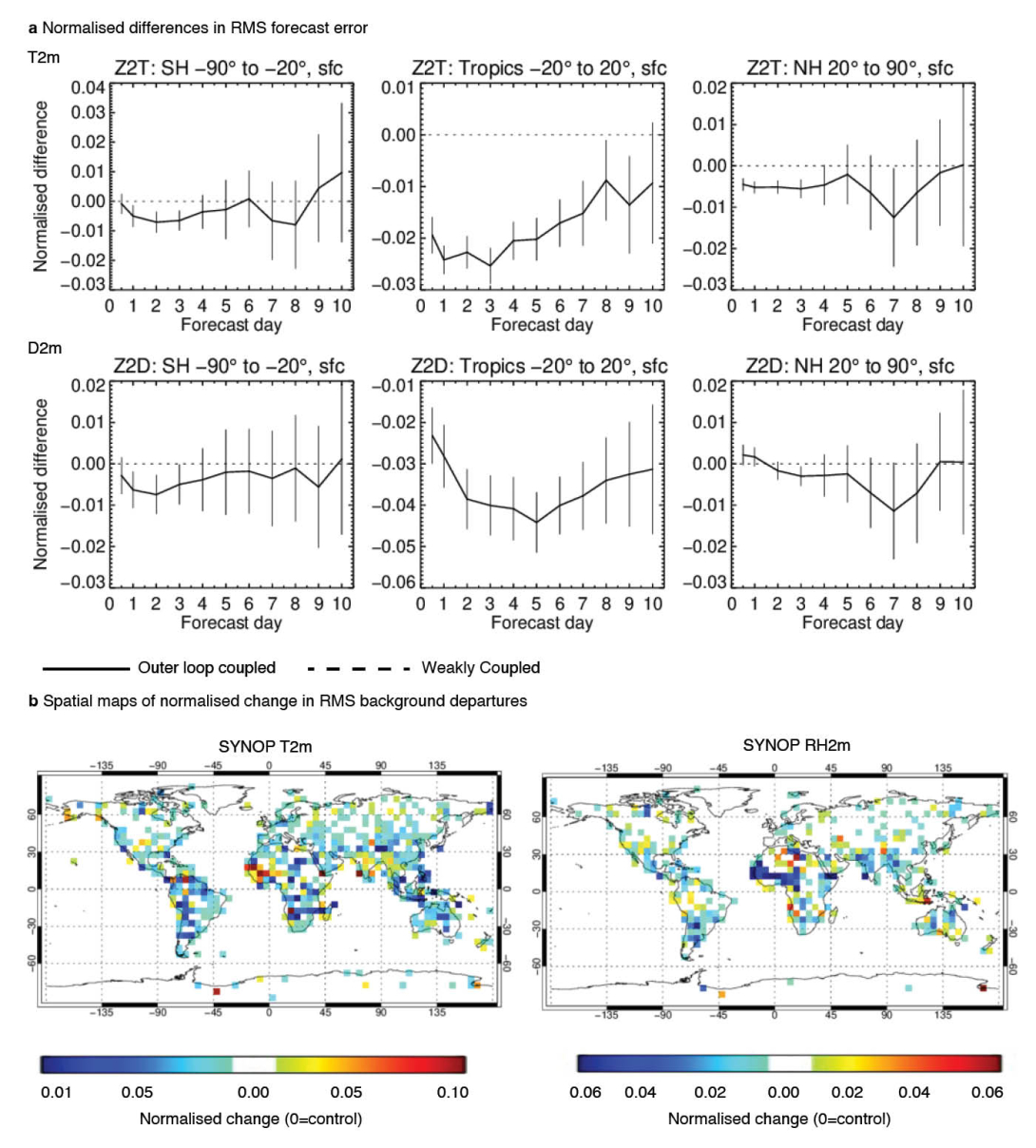
We assessed the results of the experiments listed in Table 1 – comparing the performance of the ERA-CERISE summer and winter prototypes against the weakly coupled approach used in the current operational forecasting system. Compared to the weakly coupled reference, enhanced coupling generally reduces the forecast error for both T2m and 2-metre dewpoint temperature (D2m; Figure 2a), particularly in the tropics, as indicated by predominantly negative differences across nearly all forecast days. This improvement is statistically significant.
We find a spatially coherent positive impact on T2m, again with larger improvements in the tropics (Figure 2b). For RH2m, improvements are also widespread, with the strongest impact over the Gulf of Guinea region in southern West Africa. This example demonstrates that enhanced coupling promotes more active land–atmosphere interaction. Consequently, more moisture from the land enters the atmosphere, providing additional water vapor for cloud formation and precipitation. Both the land model and the LDAS are column-based, with propagation limited to the vertical. Feeding back land-surface conditions into the atmospheric 4D-Var, however, allows the information to be spread horizontally as well.
Impact on land variables
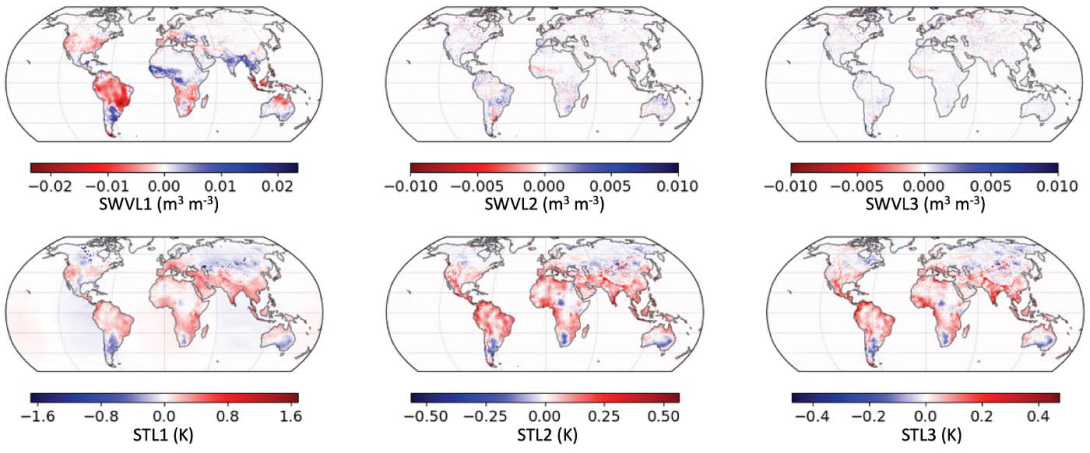
Figure 3 shows the soil analysis increments for winter 2022/2023 outer loop coupled data assimilation ERA-CERISE prototype. The top panel shows that soil moisture increments are larger near the surface with smaller values in deeper layers, as expected. In regions of positive RH2m impact, such as West Africa in boreal winter (see right panel of Figure 2b), enhanced land–atmosphere coupling leads to larger positive increments in the top-soil layer. Increased soil moisture enhances evaporation, adding water vapor to the atmosphere – an effect relative to the weakly coupled system that can be observed across all forecast days – and thereby raises the dew point temperature. At nearly constant air temperatures, this higher dew point results in elevated relative humidity. Soil temperature shows larger increments at all soil layers throughout both periods (not shown). However, there are no observations assimilated with the capability to directly constrain subsurface variables.
Effect on the land–atmosphere interface
Enhanced coupling aims to improve the physical consistency of the model initial conditions at the surface–atmosphere interface. Ideally, updates to the land-surface state should translate into changes in surface fluxes and eventually elicit a downstream response in the atmospheric fields.
In the Gulf of Guinea domain, we assessed hourly-integrated forecasts of surface latent and sensible heat fluxes (Figure 4), averaged over the region, where we identified improvements relative to SYNOP RH2m. Sensible heat flux is typically negative at night, when the surface cools more rapidly than the overlying air. It is governed by the temperature difference between the surface and the air, increasing when the surface is warmer than the air and decreasing when the air is warmer than the surface. Latent heat flux depends on soil moisture availability and increases with wetter soils (or vegetation) due to stronger evapotranspiration. The land cover in this region is dominated by forest near the coast and savanna.
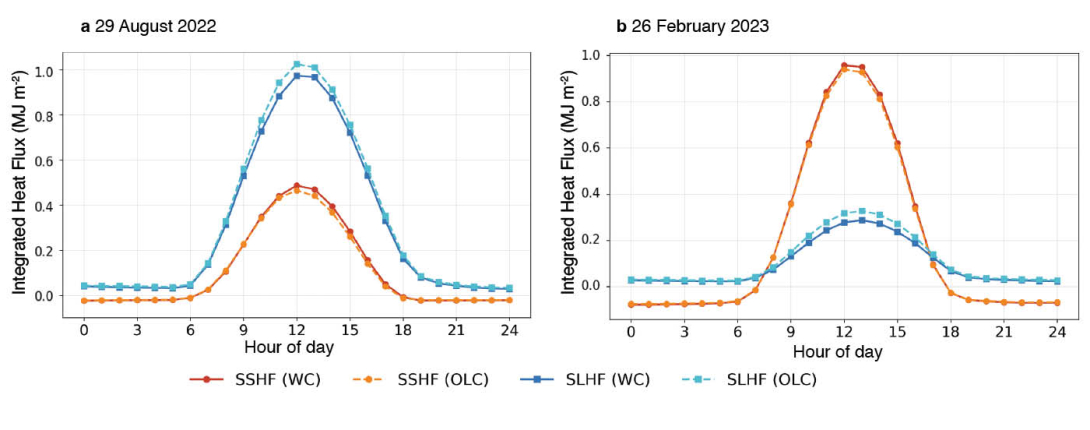
During the wet summer season, moisture-saturated soils lead to latent heat fluxes that clearly exceed sensible heat fluxes, whereas in the drier conditions in February, sensible heat flux is dominant.
Increased soil moisture from enhanced coupling means that the model allows for more evaporation and transpiration whenever water is available, which directly increases latent heat. With more energy being used for evaporation, less energy remains to heat the air, so sensible heat is reduced. Physically, this implies that enhanced coupling corrects for underestimated land–atmosphere moisture exchange in the model in both seasons, thereby correctly shifting the surface energy partitioning from sensible heat towards latent heat. This improves the representation of near-surface conditions, as seen in the RH2m forecast.
We validated the surface latent and sensible heat fluxes against in situ flux tower measurements. No overall significant impact was observed, particularly because surface flux measurements are inherently noisy and the observation network available is restricted to the European domain, where the SYNOP station network is already dense.
Skin temperature evaluation
Surface fluxes between the land and atmosphere are used in the IFS to compute the surface energy balance. The corresponding temperature at the land–atmosphere interface is represented by the skin temperature (SKT). We verify the SKT against land surface temperature (LST) retrievals from the Spinning Enhanced Visible and Infrared Imager (SEVIRI). In contrast to SKT, LST is measured by satellites and reflects the temperature of the radiating layer of the emitting surface, such as soil or vegetation canopy, with an effective depth that can vary depending on surface properties.
Figure 5 compares SKT with SEVIRI-based LST for boreal summer and winter, assessing both analysis error and diurnal cycle in the outer loop coupled and weakly coupled systems. The spatial distribution of normalised differences in RMS analysis error (Figure 5a) shows a mixed pattern in summer and more pronounced regional differences in winter, including over the region where relative humidity improvements are identified (see Figure 2b).
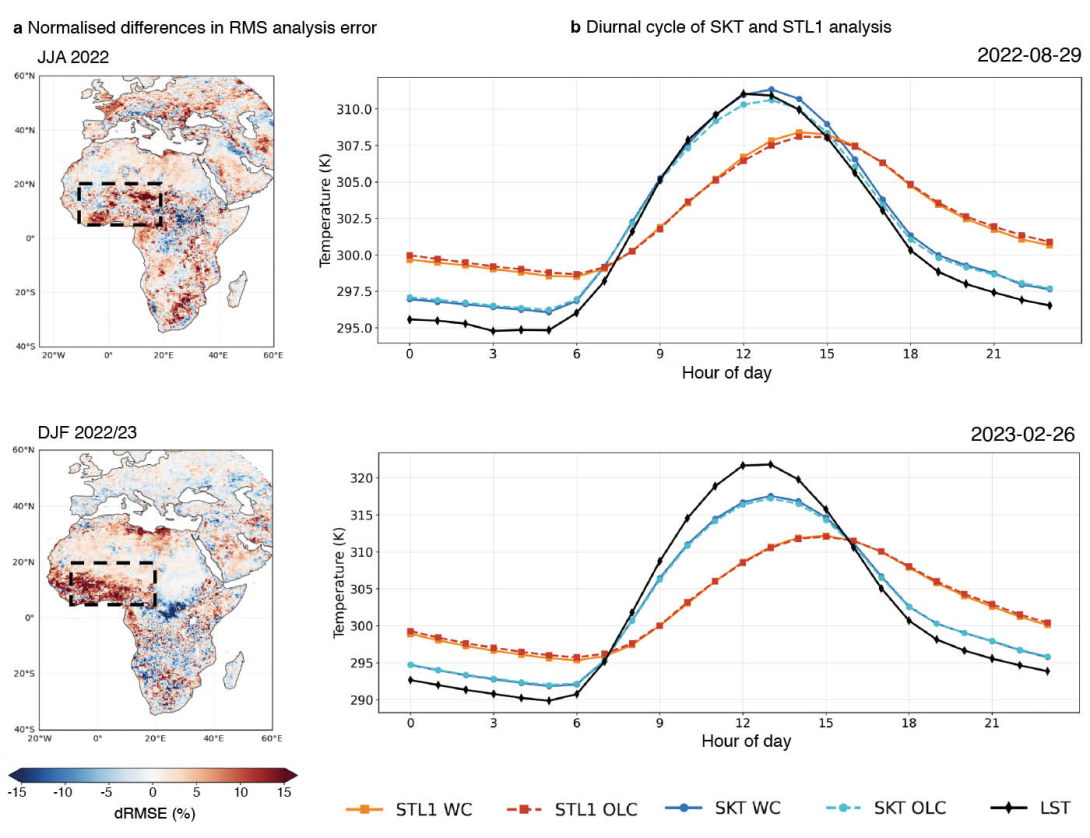
The diurnal cycle reveals a systematic underestimation (Figure 5b). Night temperatures are slightly overestimated (by about 2 K), while daytime peak temperatures are underestimated, particularly in winter (by up to about 5 K). Surface temperature reacts quickly to incoming radiation, leading to a larger diurnal cycle compared with temperatures in the lower atmosphere or in soil layers. Overall, these results indicate that the reduced diurnal amplitude is a model-related feature, and that outer loop coupling has only a minor effect in absolute terms.
Conclusion and outlook
As part of the CERISE project, we developed outer loop coupled land–atmosphere data assimilation as a major step toward enhanced consistency and physically balanced Earth system analyses. By repeatedly updating land initial conditions within the 4D-Var framework, we enable information to be exchanged between the atmosphere and land surface within the same data assimilation window, improving our representation of near-surface variables such as 2-metre temperature, dew point, and relative humidity.
Overall, we find that outer loop land–atmosphere coupling enhances forecast skill and consistency across components, providing a robust foundation for the operational forecasting and next-generation reanalysis systems toward ERA7 and beyond. An optimal degree of coupling that most benefits the atmospheric forecast has been identified. We are now focusing on operationalising the degree of coupling while applying safeguards – such as observation-error scaling and depth tapering of increments in the subsurface – to improve the physical realism of the land-surface state. Our enhanced coupling infrastructure also allows us to better exploit interface observations that are sensitive to both the land and atmospheric components, enabling them to simultaneously inform their respective analyses.
Funding acknowledgement
The CERISE project (grant agreement No 101082139) is funded by the European Union. Views and opinions expressed are however those of the authors only and do not necessarily reflect those of the European Union or the Commission. Neither the European Union nor the granting authority can be held responsible for them.
Further reading
de Rosnay, P., P. Browne, E. de Boisséson, D. Fairbairn, Y. Hirahara, K. Ochi et al., 2022: Coupled data assimilation at ECMWF: Current status, challenges and future developments. Quarterly Journal of the Royal Meteorological Society, 148(747), 2672–2702. https://doi.org/10.1002/qj.4330
Herbert, C., P. de Rosnay, P. Weston & D. Fairbairn, 2024: Towards unified land data assimilation at ECMWF: Soil and snow temperature analysis in the SEKF. Quarterly Journal of the Royal Meteorological Society, 150(764), 4133–4155. https://doi.org/10.1002/qj.4808
Hersbach, H., B. Bell, P. Berrisford, S. Hirahara, A. Horányi, J. Muñoz-Sabater et al., 2020: The ERA5 global reanalysis. Quarterly Journal of the Royal Meteorological Society, 146(730), 1999–2049. https://doi.org/10.1002/qj.3803
Penny, S. G., S. Akella, M. Buehner, M. Chevallier, F.Counillon, C. Draper et al., 2017: Coupled data assimilation for integrated earth system analysis and prediction: goals, challenges, and recommendations (No. GSFC-E-DAA-TN43810).