

The AI Weather Quest (“the Quest”) is an ECMWF-led international competition focused on sub-seasonal forecasting using machine learning (ML). It provides a transparent and operational-style benchmarking and knowledge sharing framework for evaluating ML approaches to forecasts at lead times of 3–4 weeks.
The initiative is endorsed by the World Meteorological Organization (WMO) under the WMO Integrated Processing and Prediction System (WIPPS), reinforcing its role as a coordinated global effort to explore the responsible integration of ML into forecasting systems.
The scientific design and evaluation framework have previously been described in a paper (Loegel et al., 2025; https://doi.org/10.1088/3049-4753/adf649).
Now midway through its first competitive year, the Quest has completed two 13-week forecasting periods, September to November 2025 (SON) and December 2025 to February 2026 (DJF), and is currently in its third period, March to May 2026 (MAM). Experience so far demonstrates strong international uptake, scientific relevance, and sustained participation.
Participation has remained consistently high (Table 1), with more than 25 teams submitting forecasts each week. Across the two completed periods, 42 teams, 194 participants and 74 distinct models have contributed.
| Participating teams | Participating team members | Participating models | Participating models eligible for full period-aggregated scoring | |
|---|---|---|---|---|
| SON period | 35 | 166 | 60 | 13 |
| DJF period | 37 | 177 | 66 | 18 |
Broad engagement across the weather and ML ecosystem
Participating teams represent a broad range of institutional backgrounds across the weather and ML ecosystem, spanning research organisations, universities, meteorological institutions, and industry (Figure 1).

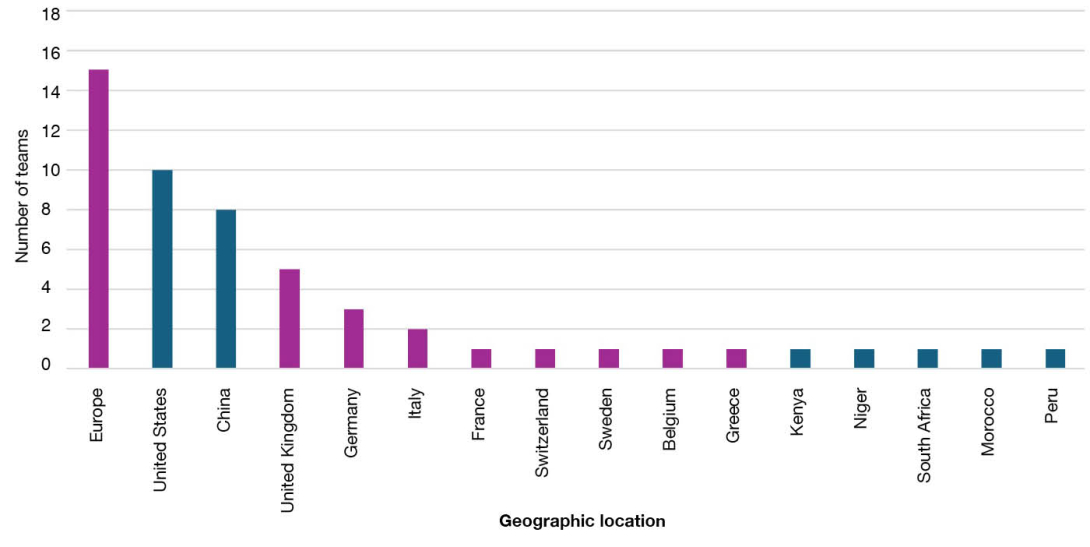
Geographically, teams span Europe, China and the United States, with additional participation from Kenya, Niger, Morocco, Peru, South Korea, Canada and Brazil (Figure 2). This distribution demonstrates the increasingly global interest in applying ML to sub-seasonal prediction.
Beyond participation, several teams achieved full period-aggregated scoring by submitting forecasts consistently for all variables across a full forecasting period. Organisations whose teams met this eligibility criterion during the SON or DJF periods include meteorological institutions, universities and companies across multiple regions (Table 2).
| Organisation type | Full period-aggregated scoring eligible organisations (country) |
| Meteorological institution |
|
| Research organisation (academic/independent) |
|
| Academic (student) |
|
| Company (large tech/SME/Startup) |
|
Table 2 Organisations whose non-anonymous teams met the eligibility criterion for full period-aggregated scoring during the SON or DJF periods. Teams listed here submitted forecasts consistently for all required variables across an entire 13-week forecasting period, making them eligible for full evaluation and leaderboard ranking.
Transparent benchmarking and structured exchange
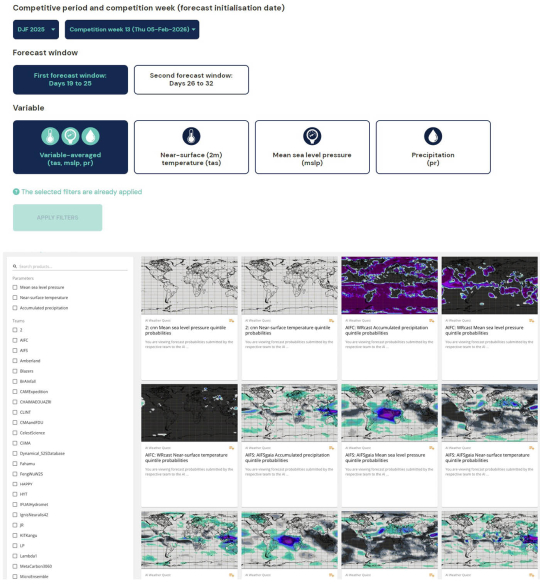
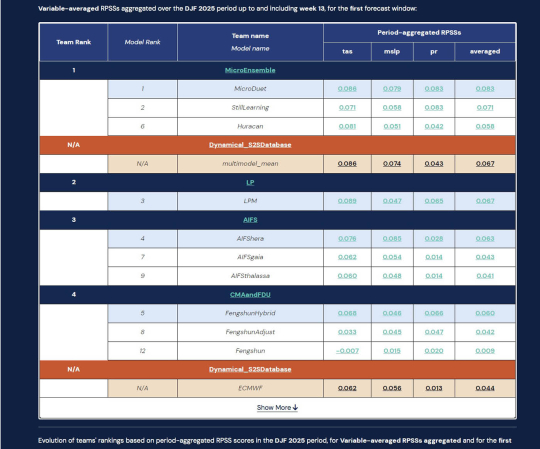
The Quest operates with full transparency. Visualisations of submitted forecasts are published each week (Figure 3), while leaderboards provide continuously updated performance metrics (Figure 4). After each completed 13-week forecasting period, all submitted forecasts and team methodology summaries are made publicly available, enabling approaches to be openly compared over time.
The initiative also fosters structured dialogue between participants, for example through its end-of-period awards webinars. During the SON and DJF period awards webinars, five teams presented their methodologies and results to an international audience:
- MicroEnsemble (Microsoft, Harvard University, University of Toronto, IMPA, MIT and Rhiza Research)
- CMAandFDU (China Meteorological Administration and Fudan University)
- LP (Jiangsu Climate Center)
- AIFS (ECMWF)
- Fahamu (IGAD Climate Prediction and Applications Centre)
Leaderboards, submitted forecast visualisations and data, methodology summaries and webinar recordings are accessible on the AI Weather Quest website (https://aiweatherquest.ecmwf.int/).
First scientific insights
The first two competitive periods provide initial evidence on the performance of ML approaches at sub-seasonal timescales. Results suggest that improvements over dynamical models are most evident for precipitation, while added value for temperature and pressure remains limited to post-processing techniques. Many of the strongest-performing systems combine ML with dynamical forecast information, and surpassing climatology at lead time of 3–4 weeks remains challenging.
A detailed scientific analysis is available in the accompanying science blog on the ECMWF website (Talib et al., 2026; https://doi.org/10.21957/0fddea4898).
Looking ahead
The third competitive period is under way, with the fourth scheduled to begin on 14 May 2026. New teams are still welcome to join. Participation is designed to be straightforward. Forecasts are submitted using the AI-WQ package, a dedicated Python package that ensures full compatibility with the evaluation system and visualisation portal. Detailed installation instructions and user guidance are available in the official documentation (https://ecmwf-ai-weather-quest.readthedocs.io/en/latest/).
In parallel, the AI Weather Quest organisers are planning a joint special issue bringing together peer-reviewed manuscripts from participating teams. The issue will be published in the Royal Meteorological Society journal International Journal of Climatology and Meteorological Applications, titled Advances in Machine Learning for Weather and Climate: Modelling, Forecasting, and Applications (https://rmets.onlinelibrary.wiley.com/hub/journal/14698080/call-for-papers/si-2026-000201). The call for papers is currently open.
Acknowledgements
All authors and organisation of the AI Weather Quest are supported with funding from the European Union, provided to ECMWF under the Contribution Agreement between the European Union, represented by the European Commission, and ECMWF on the implementation of the Destination Earth (DestinE) initiative.
We gratefully acknowledge the hard work and enthusiasm of all AI Weather Quest participants. We also extend our thanks to the Advisory Board, whose interdisciplinary expertise in AI and meteorology has helped shape the structure and direction of this challenge.