

Climate change is no longer a distant threat. It is already reshaping ecosystems, economies and living standards across the globe. Understanding these changes and responding effectively requires high-quality, consistent, long-term climate data. The European Union’s Copernicus Climate Change Service (C3S), implemented by ECMWF, contributes decisively to this effort. By enabling the production of quality controlled, validated climate data, C3S provides information that empowers scientists, policymakers and businesses to monitor trends and develop effective adaptation and mitigation strategies.
Why Essential Climate Variables matter
Essential Climate Variables (ECVs) are a critical component of C3S activities. These are variables considered fundamental for understanding the climate system and its changes over time. Examples of ECVs include sea-surface temperature, greenhouse gas concentrations, ocean colour and soil moisture. By tracking these variables over time, we can detect trends, identify anomalies, and evaluate the impacts of climate change on natural systems and human society. ECV quantities form the foundation of observation-based Climate Data Records (CDRs): long-term datasets derived from in situ networks and satellite observations that follow rigorous processing and validation to ensure consistency over decades. These records make it possible to assess climate change and variability, enabling evidence-based research, policies, and operational services.
The ECV programme
C3S operates an ECV programme organised around six thematic domains: Atmospheric Physics, Atmospheric Composition, Oceans and Sea Ice, Land Cryosphere, Land Hydrology, and Land Biosphere. By applying robust data processing to satellite observations, it provides a global perspective on climate that ground-based networks alone cannot deliver. Through the Climate Data Store, the C3S ECV programme provides access to 30 of the 55 ECVs defined by the Global Climate Observing System (GCOS), along with their associated quantities (see Figure 1). In addition, the programme delivers value-added services that enhance the usability of its datasets. These include an independent Evaluation and Quality Control (EQC) activity, which ensures that datasets are reliable and suitable for scientific and policy applications. It is this blend of rigorous data and strong service support that makes the ECV programme unique.

From satellite measurements to climate information: the snow case study
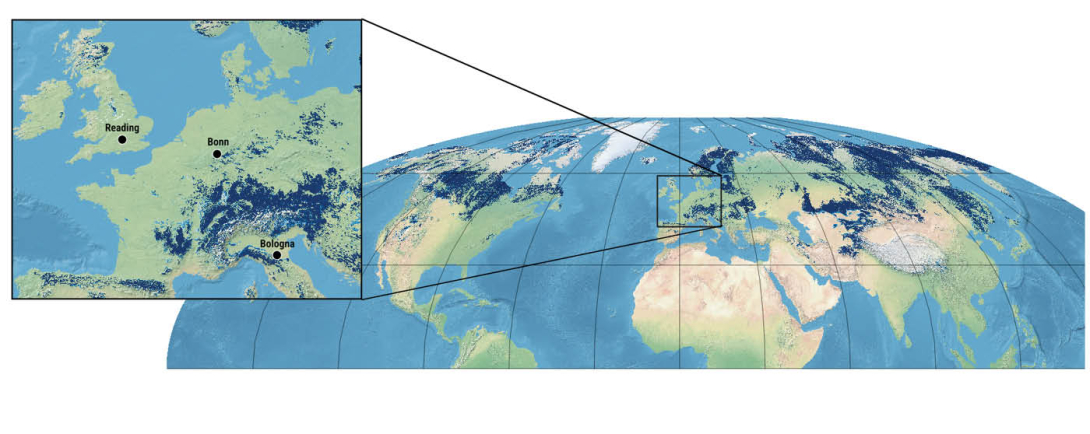
An example of an ECV product is the Snow Cover Extent CDR. Snow cover plays an important role in the climate system by influencing the Earth’s energy balance and freshwater availability. By reflecting a large fraction of incoming solar radiation, snow helps regulate surface temperatures, while seasonal snowpack acts as a natural water reservoir in many regions. The C3S dataset provides daily maps of snow-covered areas across the northern hemisphere derived from multiple satellites since the early 1980s (see example in Figure 2). These data can be used to monitor changes in the timing and duration of seasonal snow cover. For example, long-term analyses show that in many regions, spring snow melt occurs earlier than in previous decades. Such information helps assess the impacts of climate change on water availability and mountain ecosystems.
The importance of collaboration
Collaboration is central to the success of the C3S ECV programme. By working closely with agencies such as the European Space Agency (ESA) and the European Organisation for the Exploitation of Meteorological Satellites (EUMETSAT), C3S ensures that its datasets remain state of the art and seamlessly integrated within the broader Earth observation infrastructure. These partnerships allow the programme to incorporate data from new-generation satellite sensors, including most recent missions from EUMETSAT and the Copernicus Sentinel satellites, into the production chain of CDRs. Future Copernicus missions will further expand climate monitoring capabilities. With their focus on high-latitude observations, satellites like the Copernicus Imaging Microwave Radiometer (CIMR) and the Copernicus Polar Ice and Snow Topography Altimeter (CRISTAL) will enhance our monitoring of the Arctic and Southern Oceans, along with the Greenland and Antarctic ice sheets, significantly improving our capability to observe environmental changes in these remote regions. Close coordination with partner agencies remains essential to integrate these new data streams into operational CDR production and to further develop services that meet the diverse needs of C3S’s broad audience.
Expanding the ECV programme
The ambition is to eventually cover all 55 GCOS ECVs to give a complete view of the climate system. Efforts will also focus on strengthening consistency across datasets through cross-ECV initiatives and improved methodologies. Reanalysis products will complement direct observations, particularly for variables that are difficult to measure from space. Where both observations and reanalysis are available, ensemble approaches will help increase confidence and reduce uncertainty. By linking ECV datasets to climate and policy-relevant indicators, the programme will provide timely and actionable information for adaptation and mitigation efforts. Enhanced data access, robust evaluation services and continued collaboration will ensure that this remains an authoritative source of climate knowledge, supporting Europe and the world in navigating the challenges of a changing climate for years to come.