

"Federated Digital Twins for Wind-Offshore" (DTWO; https://dtwo-project.eu/) is a Horizon Europe-funded project that aims to unlock new possibilities in offshore wind-power production. It does this by developing a digital twin that integrates existing models and simulation assets for greater energy reliability and security. The project started in June 2024 and recently passed its 18-month mid-term review. Involving 12 organisations from 9 countries, DTWO brings together expertise from across the wind-energy value chain, from the world’s largest offshore wind turbine manufacturer to research centres, academia, IT, and energy and weather-forecasting institutions.
To achieve its objectives, DTWO is organised around five scientific modules: Earth, Wakes, Siting, Turbine and Grids. These modules combine digital assets from each project partner. They will be integrated and orchestrated within a federated digital twin software architecture, known as the DTWO platform, which is designed to help wind asset owners better manage and optimise their portfolios. Platform users will access the modules via four use cases defined by industrial partners. These are currently being integrated and tested through five test scenarios representing real-world wind farm applications.
ECMWF led the Earth module to completion last November and is now leading the initial scientific integration of the Siting and Turbines modules into the DTWO platform. In addition, ECMWF is facilitating the use of data from the EU’s Destination Earth (DestinE) initiative across the various use cases, ensuring that partners can efficiently access and use these resources. ECMWF is also enhancing the usability of global weather prediction data for wind-energy applications by developing dedicated plugins for targeted workflows. These leverage the Plume framework (https://github.com/ecmwf/plume) to equip the Integrated Forecasting System (IFS) with additional functionalities tailored to sector-specific needs.
DTWO modules
Earth: Advanced modelling of atmospheric, ocean and wave conditions crucial for offshore wind planning and operating.
Wakes: Modelling inter- and intra-farm wake interactions to optimise turbine placement and maximise wind-farm energy production.
Siting: Assessment of wind resources, environmental conditions and turbine design to identify the most efficient and cost-effective offshore wind-farm locations.
Turbine: Monitoring turbine health and predicting reliability, maintenance needs and component lifetimes to reduce downtime and operational costs.
Grids: Analysis of grid connectivity, energy markets and storage integration to support investment planning and reliable offshore wind power delivery.
Practical impact
From ECMWF’s perspective, DTWO fosters the development of the Plume framework with a particular focus on wind energy use cases. Plume is a plugin mechanism for Earth system models and forms part of the Digital Twin Engine developed within DestinE. It is also part of the ECMWF Software Engine, where it is currently at an emerging maturity level. An initial proof-of-concept, co-funded by DestinE, showed promise for applications such as point extraction for the single-column model and machine-learning-based tropical cyclone detection. Plume has since been integrated with DestinE Cycles 48r3 and 49r3. Through DTWO, the framework has been consolidated and the plugin portfolio expanded to include two new plugins (Figure 1):
- wind farm parametrization, for power estimation and wind field impact assessment; and
- extreme event capture, for high-impact weather signal identification.
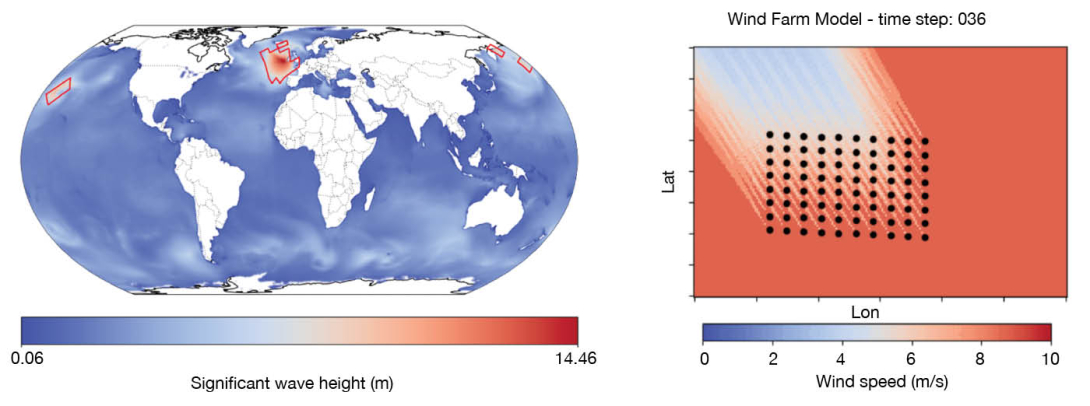
Continuous improvements to Plume are being implemented as user needs are identified. As DTWO’s objectives required the creation of the two new plugins described above, a numerical weather prediction emulator was introduced into Plume during the initial months of the project to facilitate the development and testing of plugins. The emulator supports two running modes, with one serving synthetic data and another for historical data from GRIB files to emulate a model run with Plume enabled. This capability makes plugin development accessible to a broader community, enabling users to better shape the future of the framework.
The DTWO project’s focus on offshore wind motivated the introduction of support for coupled model runs in Plume, whereas previously it was limited to the atmospheric model. The addition of a Plume entry point in the wave model, ecWAM, now allows plugins to process wave model fields. For example, plugins can detect extreme wave conditions that would prevent turbine maintenance operations.
These efforts contribute to integrating Plume into research and operational workflows within ECMWF, making it a robust and well-embedded component of ECMWF’s digital ecosystem. The framework is evolving to support internal developments, as well as the needs of Member States, Co-operating States and other external partners.
Next steps
The second half of DTWO will focus on the technical integration and evaluation of its use cases into the platform, and on finalising the implementation of the scientific workflows in each use case.
Beyond its coordination role on the technical integration, ECMWF will bring more contributions to the Wakes module. In particular, the architecture of Plume will be challenged to evaluate its suitability for two-way coupling of plugins, allowing them to act as source or sink terms within governing equations. The wind farm parametrization plugin will be used to test and guide the design of this new feature. A two-way coupling between plugins (dynamically loaded applications) and the model would create opportunities for more dynamic interactions within Plume and open new user journeys. For example, Plume could simplify parametrization development by enabling rapid and collaborative scheme iteration and calibration in a separate library, postponing the more complex model integration steps until the scheme is validated.
Funding acknowledgement
The DTWO project (grant agreement No 101146689) is funded by the European Union. Views and opinions expressed are however those of the authors only and do not necessarily reflect those of the European Union or the Commission. Neither the European Union nor the granting authority can be held responsible for them.