


Authors: Umberto Modigliani, Matthieu Chevallier, Thomas Haiden, Sebastien Villaume
Every day, ECMWF produces and disseminates hundreds of terabytes of forecast, climate and environmental data. This data underpins decisions made by national meteorological and hydrological services, emergency responders, governments, businesses and researchers worldwide – from issuing flood warnings to planning renewable energy supply.
But the value of this information depends on one fundamental question: can it be trusted?
At ECMWF, trust is built through continual monitoring, evaluation, feedback, and improvement. It depends not only on operational quality-control systems and scientific expertise, but also on the close partnership with our Member and Co-operating States. Their national meteorological services use ECMWF forecasts every day, provide independent assessments of forecast performance, and play a central role in the co-development of forecasting systems and products.
This collaborative approach is embedded throughout every stage of ECMWF’s forecasting process, from observations entering the system, through modelling and verification, to the delivery of products and support for users.
Quality at scale in a system that never stops
Unlike many industries, weather and climate science operate in real time and at a global scale. Forecasts are produced continuously, leaving little room for delays in the systems that process data and ensure quality.
“In a system that runs 24/7, trust depends on our ability to detect and respond to issues in real time,” said Umberto Modigliani, Acting Director of Forecasts at ECMWF.
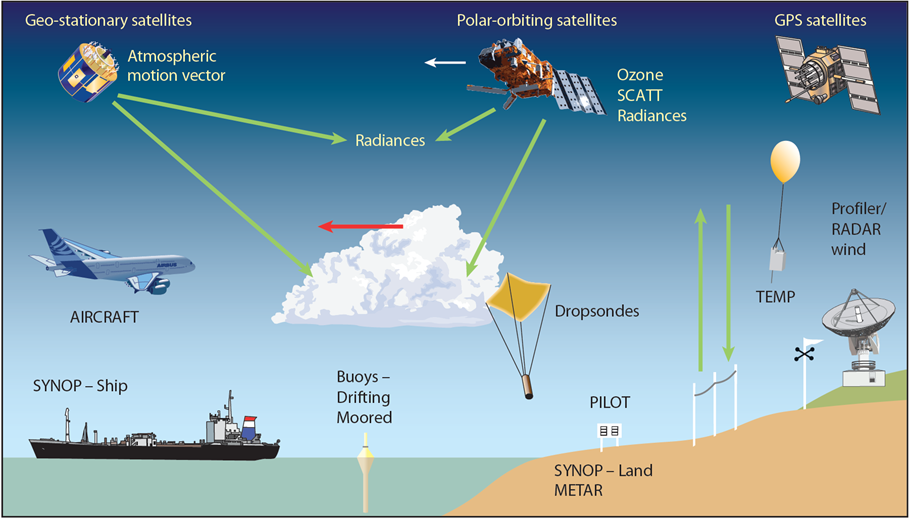
ECMWF receives 800 million observations every day, with 60 million quality-controlled observations feeding into the IFS.
ECMWF receives around 800 million observations daily from satellites, weather stations, ships, aircraft and buoys. Of these, roughly 60 million quality-controlled observations feed directly into the Integrated Forecasting System (IFS), forming the basis for forecasts that users may rely on within hours.
In this environment, even small problems can have consequences if they remain undetected.
This is why data quality at ECMWF is not a discrete step – it is a continuous operational function. Monitoring, verification and governance are embedded directly into workflows, ensuring that potential issues are identified, understood and addressed as close as possible to their point of origin.
“Data quality is not a checkpoint at the end of production – it is a continuous operational responsibility that underpins every ECMWF service,” added Umberto.
Continuous quality control
Maintaining quality begins before a forecast is produced. Every forecast and climate analysis is only as reliable as the observations and information that underpin it. At the heart of ECMWF’s data provision services is a philosophy of proactive quality monitoring rather than reactive correction.
Observational data streams are continuously assessed to ensure that expected observations are available, delivered within operational deadlines, and consistent in quality over time.
“Forecast accuracy starts with observation quality – and both must be monitored continuously,” said Matthieu Chevallier, Head of Forecast Evaluation at ECMWF.
Automated systems generate alerts when anomalies are detected, enabling rapid investigation and response. This ensures that data quality issues – whether caused by instrument drift, communications failures or changes in observing networks – are identified before they affect downstream products.
These monitoring capabilities extend beyond ECMWF itself. The Centre contributes to and operates key elements of the World Meteorological Organization’s (WMO) Integrated Global Observing System (WIGOS) Data Quality Monitoring System (WDQMS), helping countries assess and improve their observing networks.
This reflects the interconnected nature of global forecasting. ECMWF’s forecasting systems depend on observations from around the world, meaning that gaps or inconsistencies in one region can affect forecast accuracy far beyond their source.
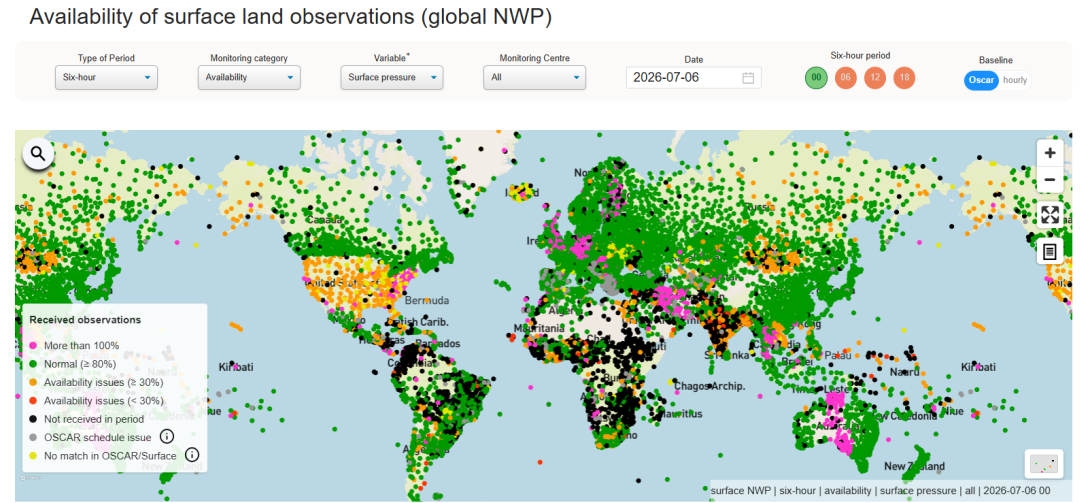
The WMO's WDQMS web tool, hosted by ECMWF, monitors the quality and availability of global observations.
Verification: improving forecasts together
Alongside observation monitoring, forecast verification plays a central role in ensuring the quality of ECMWF’s products.
Verification is not simply about determining whether a forecast was "right" or "wrong" – weather systems are complex, and uncertainty is an inherent part of forecasting. Instead, we examine how accurately forecasts capture different aspects of the Earth system (atmosphere, oceans, cryosphere, land surface), from temperature and rainfall to large-scale circulation patterns and extreme events.
"Our verification workflows are designed to catch anomalies as early as possible, enabling rapid response and correction,” said Thomas Haiden, Forecasts Verification and Observation Monitoring Team Leader.
To do this, ECMWF continually monitors the performance of its operational forecasts and publishes a wide range of verification information. Forecast skill is summarised through a set of headline scores, jointly developed with Member and Co-operating States.
These headline scores provide a concise, standardised summary of model performance across key variables, forecast time ranges, and high-impact weather events, allowing changes in forecasting skill to be tracked over time.
They cover upper-air metrics, sub-seasonal forecasts, near-surface indicators, and high-impact weather parameters like the Extreme Forecast Index (EFI).
These scores, together with additional verification products, are regularly updated and made publicly available in near-real time through OpenCharts, giving users transparent access to information on how forecasting systems are performing.
Verification does not rely solely on statistical evaluation. Operational experience from meteorologists in Member and Co-operating States provides an equally important perspective on how forecasts perform.
Each year, ECMWF invites its Member and Co-operating States to share feedback on their use of ECMWF forecasts, including assessments of forecast performance and verification activities. These national reports, together with summaries published by ECMWF, offer valuable insight into how forecasts are performing in operational use across different countries and weather events.
Verification is therefore more than a tool for monitoring quality. By combining statistical evaluation with the operational experience of Member and Co-operating States, it supports a co-development approach that continually improves ECMWF's forecasting systems and products.
Data quality in service delivery: beyond the forecast
While much attention naturally focuses on forecast accuracy, data quality in ECMWF services extends much further – into how data are packaged, documented and delivered.
Users today do not simply consume forecasts; they integrate them into complex workflows, platforms and decision systems, where usability is important for realising the value of accurate forecasts.
From this perspective, data quality includes not only the reliability of the underlying science, but also the characteristics that determine whether data can be effectively used in practice – including clear documentation, consistency across datasets and releases, reliable delivery services and interoperability across platforms.
Without these elements, even scientifically sound data can become difficult to use, increasing the risk of misinterpretation and operational inefficiencies.
This understanding of quality is also embedded across the EU Copernicus services implemented by ECMWF. In both the Copernicus Climate Change Service (C3S) and the Copernicus Atmosphere Monitoring Service (CAMS), dedicated evaluation, quality-control and assurance activities independently assess datasets, products, tools and services against observational evidence and user needs.
Beyond evaluation, quality management practices are applied throughout the data lifecycle and include a comprehensive approach to data governance and standards, designed to support consistent, reliable and usable services.
Reducing barriers to use – often described as “data friction” – is a part of that approach. Even high-quality data can lose value if they are difficult to access, understand or integrate.
“Reducing data friction is a key part of quality – ensuring that users can move from data to decision without unnecessary barriers,” said Sebastien Villaume, Senior Analyst at ECMWF.
ECMWF works actively to reduce data friction, for example, by adopting internationally recognised data standards such as the WMO’s standard data formats GRIB and BUFR, supported through ecCodes, to ensure consistent encoding and decoding of meteorological data. The FAIR principles are also a core part of ECMWF’s approach to managing and delivering data, helping ensure that data are Findable, Accessible, Interoperable and Reusable.
Together with clear metadata and documentation, these practices enable users to understand where information comes from, how it has been processed and how datasets evolve over time. This is complemented by maintaining clear policies on data management, versioning and access.
Transparency builds trust
Trust in data depends not only on producing strong results but also on the ability for users to see how forecast performance is assessed, understood and communicated.
This means embedding transparency throughout the evaluation process, ensuring that evidence, methods and known limitations are openly documented and accessible. This takes several forms:
Making performance visible: ECMWF regularly publishes forecast verification summaries.
Communicating known issues and limitations: ECMWF maintains publicly available documentation on known issues within the IFS, helping users understand limitations and interpret forecasts appropriately.
Two-way communication with users: the ECMWF Forum provides a public space for questions, discussion of products and services, and clarification of updates.
Learning from real-word events: Since 2014, the Severe Event Catalogue has brought together forecast products, meteorological analysis and verification for significant weather events, alongside operational feedback from Member and Co-operating States.
Transparency at ECMWF also extends to its scientific tools and infrastructure. Initiatives such as OpenIFS, earthkit and Anemoi contribute to a broader shift towards open science, enabling greater scrutiny, reuse and collaboration. While this is an ongoing process, it reinforces the same principle that trust is strengthened when methods and systems are open to examination.
This openness is increasingly important as forecasting systems become more complex, including through the integration of AI and machine learning.
“As forecasting systems evolve, strong data quality practices and forecast performance are what make innovation safe and usable at scale. This is key in building and sustaining trust in weather and climate forecasts,” said Matthieu Chevallier.
As forecasting becomes increasingly sophisticated, users need clear information about how products are generated, evaluated and updated, so they can understand both the strengths and limitations of the information they rely on.
Maintaining trust at global scale
Together, these interconnected activities – from continuous monitoring and verification through to open communication and collaborative development with Member and Co-operating States – are what make ECMWF forecasts and products trustworthy.
The future of forecasting will be defined not only by advances in science, but by the ability to deliver reliable, usable and trustworthy data at scale.
Further reading
This article is part of ECMWF’s In Focus series on data, exploring how evolving infrastructure, open data, and AI-ready systems are reshaping access to weather and climate information:
- More than data: services enabling Europe’s growing user community
- Driving innovation in data provision – the Data Stores Service
- Data without friction – ECMWF’s multi-faceted approach to improving data usability
- Data sovereignty in practice: ECMWF infrastructure for European services
- Minutes matter: how ECMWF delivers time-critical data at global scale
- Data friction and the user experience: a framework for improvement
- The living archive: inside ECMWF's exabyte-scale meteorological data repository
- Powering the AI weather revolution: from ERA5 to AI-ready pipelines
- ECMWF's data infrastructure and services: ready for the era of Common European Data Spaces