


Image generated by NotebookLM
Authors: Victoria Bennett, Umberto Modigliani, Angel Lopez Alos, Emma Pidduck
On any given day, hundreds of thousands of people draw on ECMWF information – sometimes directly, often through associated services and organisations. The reach is easy to describe in terms of data volumes and downloads.
But the real story is what happens next: how users discover, access, process, and apply complex Earth system information without needing their own specialist infrastructure.
“It is not just data but also all the associated services and the data service ecosystem that provide the added value,” said Umberto Modigliani, Acting Director of Forecasts at ECMWF.
Across Europe and beyond, ECMWF supports a growing ecosystem spanning research, public services and innovation. Users access platforms such as the Copernicus Climate and Atmosphere Data Stores – part of the European Union’s (EU) Copernicus Programme implemented by ECMWF – alongside ECMWF’s open real-time and archive data portals, and data from the digital twins in the EU's Destination Earth (DestinE) initiative. Services continue to evolve to meet a user base that is expanding in both size and diversity.
ECMWF’s development continues to be driven by users’ needs, a commitment to data quality, accessibility and reliability, and highly professional support services. Collaboration with and feedback from our users is key.
From mandate to modern ecosystem
When ECMWF was established in 1975, its mandate focused on delivering high‑quality medium‑range forecasts for Member States, making meteorological data available operationally, and offering training and computing resources for research in numerical weather prediction.
That user-first mindset remains, but the community has broadened well beyond its original core. Today, while Member and Co-operating States remain central, ECMWF services also support researchers, policymakers, small and medium-sized enterprises (SMEs) and commercial operators, and user feedback continues to shape what is built next.
Who uses ECMWF services – and what they need
Member and Co-operating States rely on ECMWF real-time operational forecasts to complement national capabilities and provide boundary conditions for limited-area models. Researchers and academics use ECMWF data for climate modelling and other scientific work, while public authorities and policymakers increasingly depend on decision-support tools for climate adaptation and emergency response.
Commercial users – including energy, transport, agriculture and insurance – are adopting ECMWF services to improve operational efficiency and manage risk.
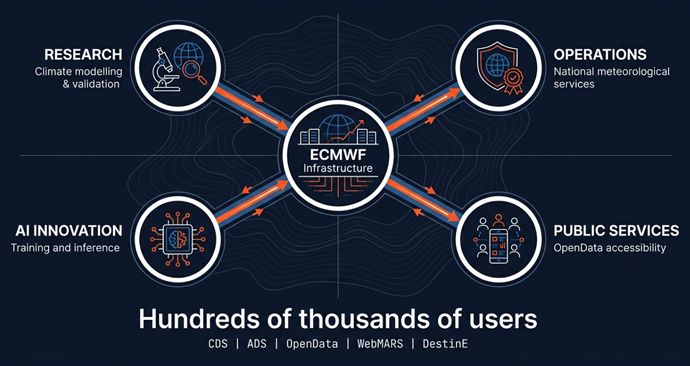
ECMWF‘s data ecosystem is growing – at scale – to support an ever-widening diversity of users with requirements from raw data to highly interactive applications. Credit: image generated by NotebookLM and edited by ECMWF.
The diversity matters because it changes the design problem. Some users want raw data and APIs; others need intuitive interfaces, ready‑made charts and applications that turn data into decisions. ECMWF’s data ecosystem has had to grow to support both – at scale.
Open data at scale – and the services that make it usable
A major milestone came with the move to open data: ECMWF made its archive data open in 2020, and in October 2025, made its entire catalogue of real-time forecast products open under Creative Commons (CC-BY-4.0).
As access expanded, usage grew sharply: requests and download volumes from the ECMWF open data portal increased substantially between 2024 and 2025. ECMWF also mirrors open data on Azure, AWS, and Google, where traffic exceeds that on ECMWF’s own systems.
At the centre of this is the service layer: the platforms and infrastructure that enable a global user community to discover and retrieve complex environmental information without requiring specialist local infrastructure. The ECMWF Data Stores Service underpins the Copernicus Climate, Atmosphere and Early Warning Data Stores, providing cloud-based access to data and applications and supporting millions of downloads and API requests.
“ECMWF data services are at the heart of a thriving European ecosystem, powering research, operations, and innovation across sectors,” added Victoria Bennett, Head of User Services at ECMWF.
From minutes to decades: a portfolio across timescales
ECMWF provides data across past, present and future timescales, with common parameters that enable coherent planning, operations and analysis. Medium-range ensemble forecasts from the Integrated Forecasting System (IFS) remain foundational, while the wider portfolio includes monthly and seasonal forecasts and extends across broader Earth system domains.
Long-term context comes from the MARS archive – a record of operational forecasts, analyses and research data spanning decades – which is increasingly important for weather and climate science and for the growing interest in AI-driven approaches. ECMWF began issuing its own machine-learning forecasts in early 2025 through the Artificial Intelligence Forecasting System (AIFS), and the code was made open source.
And because timing is everything, ECMWF operates one of the largest real‑time, time‑critical dissemination services globally, sending data to hundreds of destinations four times a day, every day.
Tools, applications and support: helping users turn data into decisions
Open data provision is complemented by free supporting resources, including pre-made charts and Jupyter notebooks, alongside raw data for programmatic processing. For Member and Co-operating States and customers with service agreements, additional applications support configuration, delivery, and advanced processing and visualisation.
For many users, the most visible layer is the applications layer. Examples highlighted include Climate Pulse (near-real-time maps and charts of surface temperatures), Aerosol Alerts (daily alerts relevant to public health and events such as dust storms and pollution episodes), and the Copernicus Interactive Climate Atlas for exploring observed trends and projected change.
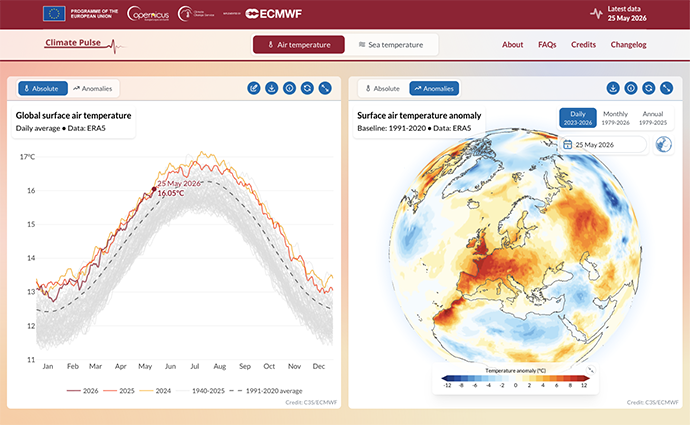
The Copernicus Climate Change Service Climate Pulse application allows users to easily visualise changes in surface temperature across the globe.
Just as important is the human service layer: the ECMWF staff providing dedicated support to data users and dealing with many thousands of queries each year – a reminder that scaling access also means scaling expertise.
Scaling sustainably: fairness, performance, continuous improvement
As open data and easier access have increased the size and breadth of the user base, this success also brings pressure – on infrastructure and support. ECMWF’s approach emphasises sustainable service design, fair access, high performance as demand grows, and continuous improvement based on user feedback and technological advances.
“Sustainable service design is a cornerstone of ECMWF’s approach,” said Emma Pidduck, User Solutions Team Leader.
Turning data into decisions
ECMWF’s data services are more than repositories: they are the platforms, interfaces, applications and support that enable users across Europe – and beyond – to turn Earth system information into decisions.
As demand grows, the focus remains on pairing open, high-quality data with services that ensure access is fair, usable and reliable at scale.
Further reading
This article is part of ECMWF’s In Focus series on data, exploring how evolving infrastructure, open data, and AI-ready systems are reshaping access to weather and climate information:
- Driving innovation in data provision – the Data Stores Service
- Data without friction – ECMWF’s multi-faceted approach to improving data usability
- Data sovereignty in practice: ECMWF infrastructure for European services
- Minutes matter: how ECMWF delivers time-critical data at global scale
- Data friction and the user experience: a framework for improvement
- The living archive: inside ECMWF's exabyte-scale meteorological data repository
- Powering the AI weather revolution: from ERA5 to AI-ready pipelines
- ECMWF's data infrastructure and services: ready for the era of Common European Data Spaces