

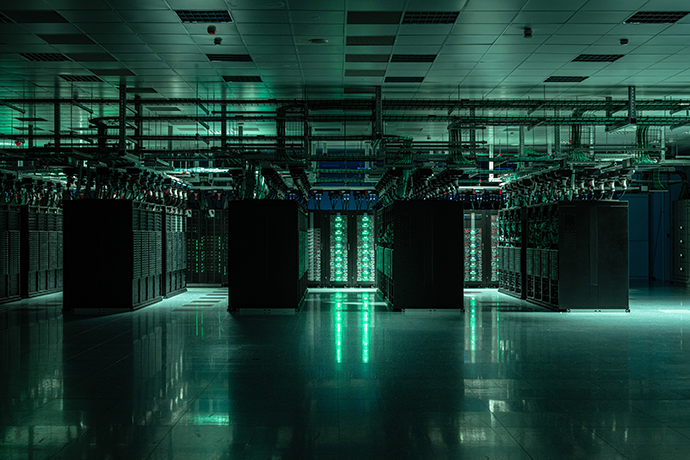
ECMWF's high-performance computing facility in Bologna, Italy. Photographer: Stefano Marzoli
Authors: Umberto Modigliani, Martin Palkovič, Christine Kitchen, Michael Hawkins, Irina Sandu
ECMWF's world-class weather, environmental and climate services rely on computing power.
As artificial intelligence (AI) advances, data volumes rapidly expand and technologies evolve, why does ECMWF invest in both a world-leading high-performance computing facility (HPCF) and a cloud infrastructure? And why are both located at the ECMWF data centre in Bologna?
The answer is simple: ECMWF's supercomputing and cloud services are two parts of a single ecosystem. They support different types of work and together provide the performance, flexibility, resilience and strategic independence needed to deliver forecasting, environmental monitoring and climate services to Member and Co-operating States and beyond.
One mission, two complementary services
Every day, vast amounts of observations from satellites, aircraft, weather stations and other sources are combined with sophisticated numerical models to produce forecast products.
National meteorological services use these products, alongside their own expertise and systems, to support forecasts and warning systems for people in their own countries. These underlying forecasts must therefore be delivered on time, every time, around the clock.
The HPCF provides the large-scale computing capacity for ECMWF’s forecasting systems, including advanced physics-based models, data assimilation systems, and ensemble prediction systems, as well as an increasing number of AI-driven forecasting applications.
The facility is used both to run ECMWF's operational forecasting systems and to prepare the Centre’s future forecasting systems.
ECMWF cloud services, including the European Weather Cloud, play a distinct yet complementary role by providing researchers, developers, national meteorological services, and collaborative projects with flexible environments for accessing data, experimenting, developing applications, and sharing solutions.
"The HPC is the industrial-scale production system designed to support ECMWF’s operational weather forecasts and to deliver environmental and climate services within the EU’s Copernicus Atmosphere Monitoring Service (CAMS) and the Copernicus Climate Change Service (C3S), both implemented by ECMWF.
ECMWF’s cloud services are a complementary innovation and collaboration platform that enables users to turn data into new services, applications and knowledge," said Martin Palkovič, Director of Computing at ECMWF.
The supercomputers behind ECMWF’s forecasts
What makes ECMWF’s HPCF different from many other supercomputing facilities is the operational contract that underpins it.
ECMWF’s forecasting systems do not run only when capacity is available; they must run to a strict schedule, several times a day, with sufficient headroom to absorb technical issues, urgent reruns and future increases in model complexity.
The HPCF is therefore designed not only for peak speed but also for sustained, reliable production: predictable access to computing, storage and data movement at the scale needed to deliver forecasts on time.
When operational forecasting workloads are not running, capacity is used to develop and test new models, evaluate innovations, and prepare future forecasting systems. This approach ensures efficient use of the facility while maintaining the availability required for time-critical operational forecasting.
The need for guaranteed, predictable computing availability is one of the key reasons ECMWF continues to operate dedicated on-premises supercomputing facilities.
“For a time-critical service such as weather forecasting, computing cannot be treated as a best-effort resource. Dedicated on-premises supercomputing gives ECMWF the guaranteed, predictable access needed to deliver forecasts when they are required, while keeping a core strategic capability under trusted European governance," said Michael Hawkins, Head of HPC and Cloud Systems at ECMWF.
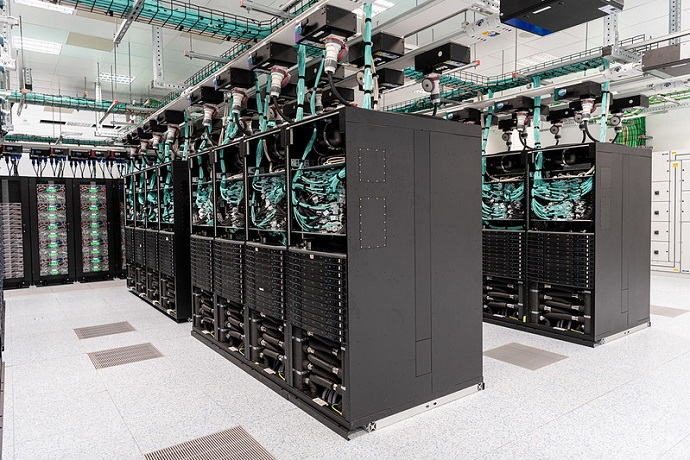
ECMWF's supercomputer facility is designed for operational resiliency.
Supporting Member States directly
The value of the HPCF extends beyond ECMWF’s own forecasting operations.
A quarter of its available resources is allocated directly to ECMWF Member and Co-operating States, enabling them to run national forecasting applications, regional models and research activities on infrastructure they could not easily build individually. Hundreds of external users already benefit from access to these facilities.
For smaller meteorological services, this shared capability is a powerful example of the European model in action: pooling resources to create capabilities that are greater than the sum of their parts.
"Modern forecasting and AI require sustained investment on an unprecedented scale. ECMWF's HPC enables Europe to compete collectively," said Martin Palkovič.
Why cloud matters just as much
The European Weather Cloud, a joint initiative of ECMWF and EUMETSAT, was created to help users work directly with the data holdings of the two organisations.
Instead of downloading large datasets across networks, users can bring their applications to where the data already reside.
For users, this offers significant advantages:
- faster access to data;
- reduced data transfer requirements;
- increased flexibility to install their own software;
- greater responsibility for and control over applications and workflows;
- collaboration across national boundaries.
Since becoming operational, the European Weather Cloud has supported a growing community of projects spanning research, machine learning, operational meteorology, training and international collaboration.
It now hosts hundreds of user environments and initiatives involving ECMWF and EUMETSAT Member and Co-operating States, EUMETNET activities and wider European programmes.
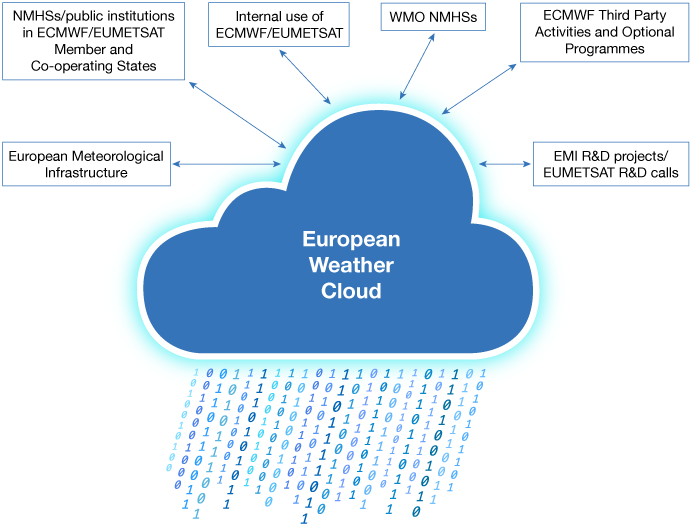
The European Weather Cloud is available to different groups of users.
Making AI more accessible
The rise of AI perhaps offers the clearest example of why both HPC and cloud environments are needed.
Users need environments in which they can experiment with machine learning methods, deploy AI services, share trained models, and collaborate on common tools.
Training large-scale AI weather models requires access to very large datasets, high-throughput storage, massive parallel computing capacity, and sufficient GPU resources. The HPCF provides the scale, high-speed interconnects, and reliability required for this data-intensive training.
The cloud, by contrast, is especially valuable once models, tools and workflows that require GPU-enabled environments can be tested, shared, adapted and used collaboratively by a wider community.
The Anemoi ecosystem, developed by ECMWF and several national meteorological services across Europe to build and operationalise AI weather and climate applications, offers a practical example of the complementary roles of HPC and cloud services.
For Anemoi, the HPCF provides the heavy lifting: computing power, fast access to ECMWF’s large data holdings used to train the AI models, including the ERA5 reanalysis data, suitable GPU capacity, and a reliable environment for training demanding AI models.
The cloud provides the shared workshop: a GPU-enabled space where the wider community can test tools, compare results, improve methods, reuse workflows, and make successful approaches easier for others to adopt.
This combination has already delivered practical results. ECMWF could operate both large-scale HPC resources and flexible cloud environments, with Member States supporting the development of the shared capabilities underpinning them.
This enabled the Centre to move very quickly from AI research to operational implementation. In 2025, AIFS Single was implemented operationally on 25 February, followed by the ensemble version AIFS ENS on 1 July.
The HPCF provided the stable, tuned, high-performance environment needed for training, testing and operational reliability; the cloud and Anemoi ecosystem helped accelerate collaboration, reproducibility and wider engagement with the tools. Together, they shortened the path from scientific breakthrough to an operational service used by the forecasting community.
Choosing the right computing environment for each workload
ECMWF is often asked whether its forecasting systems could simply be moved to the public cloud. After all, commercial cloud computing has become a familiar part of everyday life, and many organisations successfully use commercial cloud services.
The reality, however, is more nuanced.
ECMWF has benchmarked forecasting workloads in public cloud environments and found that, while the cloud can be an effective solution for some applications, continuously running operational forecasting systems require guaranteed capacity, predictable performance and high sustained utilisation, which changes the overall cost and operational considerations.
Internal studies have found that dedicated on-premises HPC can be substantially more cost-effective for high-sustained utilisation workloads such as those run by ECMWF.
Forecasting systems typically operate at utilisation levels far higher than the threshold where public cloud becomes economically advantageous.
However, this does not diminish the value of cloud.
Different workloads benefit from different computing models. ECMWF's strategy is therefore based on deploying each technology where it delivers the greatest value.
Public cloud providers can also offer both HPC-style computing and more flexible cloud services, so the distinction is not simply between HPC and cloud. Key considerations include how resources are provisioned, the level of capacity and performance that can be guaranteed, and the economics of running a particular workload.
ECMWF has used EuroHPC, which brings together the national academic HPC resources in Europe, to accelerate the training of demanding AI models, including higher-resolution versions of the AIFS and ensemble configurations.
EuroHPC is strategically important because it pools European investment in world-class supercomputing, GPU and data infrastructure, reducing dependence on non-European capacity and providing public organisations, research institutes and industry with capabilities that no single country could easily sustain alone.
For the weather and climate community, this infrastructure can support higher-resolution forecasting, ensemble forecasting, digital twins of the Earth, such as those implemented in the EU’s Destination Earth initiative, and AI model training.
By combining its own HPC and cloud services with EuroHPC capabilities, ECMWF can train models faster, strengthen Europe’s public-domain expertise in physics and in AI-based numerical weather prediction and Earth system modelling, and ensure that a critical part of the weather and climate prediction value chain remains anchored in European infrastructure.
Keeping computing close to the data
Computing capacity is only part of the equation; the location of that computing relative to the data is also important.
ECMWF manages some of the world's largest meteorological and climate datasets. Moving such volumes across networks can be costly, time-consuming and environmentally inefficient.
By co-locating cloud services, data archives and supercomputing systems within a shared infrastructure, users gain direct, high-bandwidth access to the information they need.
This creates what many call a "compute-to-data" model: instead of moving petabytes of data to users, users move their computation closer to the data.
The result is faster processing, reduced operational complexity, and a better user experience.

The Meteorological Archival and Retrieval System (MARS) is ECMWF's exabyte-scale archive, holding one of the world's largest collections of weather and climate data.
A strategic asset for Europe
Beyond technology and economics lies a broader strategic question: who controls the infrastructure underpinning critical forecasting services?
This question has become increasingly relevant as geopolitical tensions, cybersecurity concerns, and competition for advanced AI computing resources continue to intensify.
Recent discussions within ECMWF have highlighted that forecasting capability increasingly depends not only on scientific expertise but also on access to advanced computing, AI training capacity and trusted data ecosystems.
Maintaining these capabilities within a trusted European framework helps ensure long-term resilience and operational independence.
At the same time, ECMWF remains strongly connected to the global scientific and technological ecosystem. It actively collaborates with international partners and continues to assess new computing approaches. However, maintaining critical forecasting capacity under European governance provides assurance that essential services remain aligned with the needs of Member and Co-operating States.
"Sovereignty is not about doing everything alone. It is about ensuring that the capabilities on which society depends remain available, trusted and under appropriate governance when they matter most," said Umberto Modigliani, Deputy Director of Forecasts at ECMWF.
From separate platforms to a computing ecosystem
The most interesting development may not be the existence of both HPC and cloud services, but the increasing relationship between them.
ECMWF's long-term computing strategy is moving toward a seamless environment where users can access the most appropriate computing resources without worrying about where they are hosted.
ECMWF has established a Common Cloud Infrastructure to harmonise different cloud services and, over time, move toward closer integration of cloud and HPC capabilities.
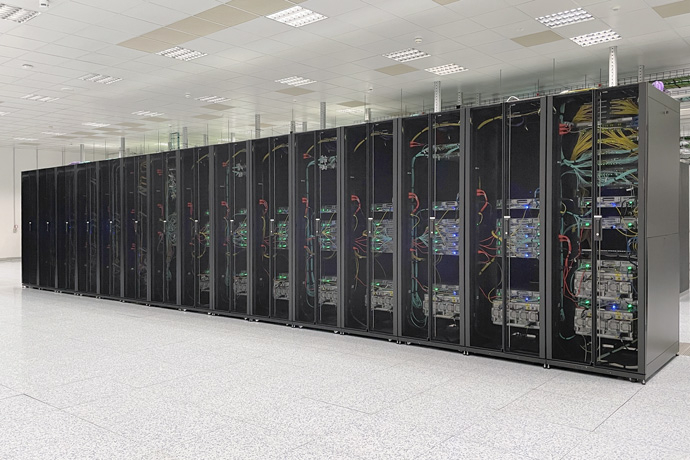
Common Cloud Infrastructure hardware.
This convergence is especially important for GPU resources. AI development depends on using the right kind of accelerator in the right environment: large, tightly coupled GPU capacity for training on HPC, and more flexible GPU access in the cloud for experimentation, fine-tuning, inference, demonstrations, and community use.
For users, this means:
- easier access to computing resources;
- reliable, secure environments;
- improved movement of workflows between environments;
- better access to data;
- more opportunities for collaboration;
- support for future AI-driven applications.
Strategic European autonomy for AI-powered forecasting
The future of weather forecasting will require more computing power, more data and more collaboration than ever before.
Supercomputers will continue to provide the performance, reliability and large-scale GPU capacity needed to produce operational forecasts and to train the most demanding AI models on the vast volumes of data required for modern machine learning.
Cloud platforms will provide the flexibility, openness, GPU-enabled experimentation environments and collaborative workspace needed to help communities such as the one behind Anemoi to develop, test, share and apply those models in practice.
Together, they demonstrate a broader principle that has underpinned ECMWF for 50 years: shared European investment and collaborations can create capabilities that no individual organisation could achieve alone.
In the AI era, this principle may be more important than ever.
"The real question is not whether ECMWF needs supercomputers or the cloud. It needs both. HPC gives ECMWF the scale, data access and advanced computing capabilities, including GPUs, needed to train the AI models of the future; the cloud provides the community with flexible, secure, scalable environments, including GPU and other specialist computing capabilities, in which to collaborate, experiment and turn those models into shared services.
The challenge is to combine them in a way that delivers scientific excellence, operational resilience, innovation and strategic autonomy. That is exactly the path ECMWF is pursuing," concluded Umberto Modigliani.
Further reading
For more information on how ECMWF’s data, evolving infrastructure, open data, and AI-ready systems are reshaping access to weather and climate information:
- More than data: services enabling Europe’s growing user community
- Driving innovation in data provision – the Data Stores Service
- Data without friction – ECMWF’s multi-faceted approach to improving data usability
- Data sovereignty in practice: ECMWF infrastructure for European services
- Minutes matter: how ECMWF delivers time-critical data at global scale
- Data friction and the user experience: a framework for improvement
- The living archive: inside ECMWF's exabyte-scale meteorological data repository
- Powering the AI weather revolution: from ERA5 to AI-ready pipelines
- ECMWF's data infrastructure and services: ready for the era of Common European Data Spaces