

ECMWF has released earthkit version 1.0, marking a major milestone for its open-source Python software ecosystem, designed to simplify and accelerate weather and climate science workflows.
Developed as part of ECMWF’s long-term software strategy, earthkit provides a flexible set of tools for accessing, processing, analysing and visualising meteorological and climate data.
The release of version 1.0 signals that earthkit’s core interfaces are stable, providing a solid foundation for ECMWF’s next generation of open, scalable and user-oriented scientific software, and confirming its readiness for wider operational and research use.
Umberto Modigliani, Acting Director of Forecasts and Services, said: “Earthkit 1.0 is more than a software milestone: it is an investment in the way ECMWF and its Member States will work with weather and climate data in the years ahead.
"By making our tools more open, interoperable and easier to use, we are helping users turn increasingly complex datasets into reliable information and better services for society.”
Tiago Quintino, Head of Development at ECMWF, said: “Earthkit 1.0 is an important milestone in ECMWF’s transition towards a more open, interoperable and scalable software ecosystem.
"By combining operationally proven components with open development and close collaboration with Member States, earthkit strengthens the foundations for future weather and climate workflows – from research and innovation to operational services.”
Supporting a new generation of scientific workflows
As weather and climate science increasingly relies on larger datasets, more complex workflows and rapidly evolving computing technologies, the software that supports this work must evolve alongside it.
In January 2023, ECMWF published its Software Strategy and Roadmap for 2023–2027, outlining plans to strengthen and evolve its software development over the next five years.
Key priorities include improving software reusability and componentisation, increasing the use of external software, adopting open development practices, ensuring data scalability for higher resolutions, and modernising to new standards for higher interoperability.
Earthkit realises this vision by offering multiple interoperable software components built on well-established open-source Python libraries. It also integrates and leverages the robust and operations-ready software stack that is used in ECMWF production systems.
Developed openly from the outset on publicly visible code repositories, earthkit has benefitted from contributions across ECMWF and collaboration with Member States.
A flexible ecosystem for weather and climate data
Rather than a single software package, earthkit is an ecosystem of Python packages that can be used individually or together to create powerful data processing workflows.
The earthkit 1.0 release includes a suite of core packages that support data retrieval, provide tools for working with geospatial shapes and grids, provide meteorological calculations, support hydrological analysis, and produce high-quality weather and climate visualisations.
Together, these packages allow users to move seamlessly from data access to analysis and visualisation within a consistent framework.
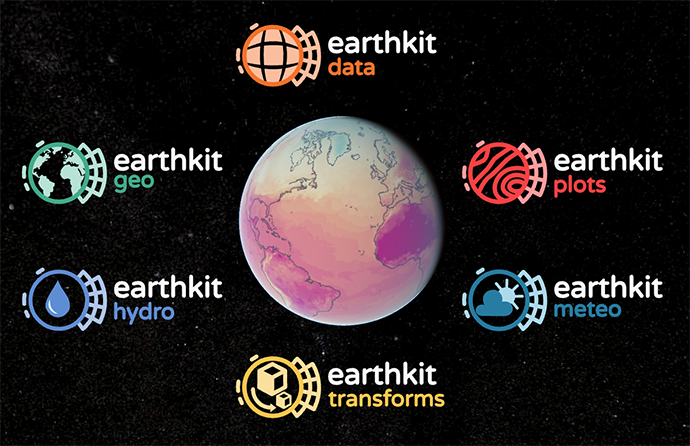
The earthkit ecosystem.
The significance of version 1.0
The release of version 1.0 marks an important step for users, as earthkit’s core interfaces are now considered stable, allowing workflows to be built with confidence that future updates in the 1.x release series will remain compatible and avoid unexpected disruptions.
This milestone reflects several years of development work and provides a solid foundation for broader adoption across both research and operational environments.
Iain Russell, earthkit Release Coordinator and Team Leader at ECMWF, said: “Earthkit 1.0 builds on years of development of libraries that have been maturing internally and are used today to deliver mission-critical services in production at ECMWF.
"For users, this means the software is not experimental: it combines proven operational reliability with stable interfaces, clearer documentation and a more consistent Python-based experience, giving them greater confidence to build workflows that can move from research and prototyping into operational use.”
The future of earthkit
Earthkit is already integrated into several ECMWF systems. It is currently used for much of the data processing in the ecCharts web service, and within parts of ECMWF’s Anemoi machine learning framework, where pre-1.0 versions have been in use for some time, with work now underway to test and upgrade the operational code to use version 1.0.
Over time, earthkit will replace two of ECMWF’s long-standing software packages, Metview and Magics. One priority is to ensure that earthkit has all the functionality required to do this, coupled with a migration guide for users.
Victoria Bennett, Head of User Services at ECMWF, said: “earthkit 1.0 gives users a modern way to work with ECMWF data without losing the reliability and specialist capabilities they depend on. The goal is to make the transition from existing tools as smooth as possible, with clear documentation, migration support and open collaboration with the community.”
Development will continue in collaboration with Member States and external partners, drawing on shared expertise across the many fields that support meteorology and climate science.
Earthkit is open-source and freely available for anyone to use, with the wider community encouraged to raise issues, suggest improvements or contribute directly.
More information
Earthkit 1.0 is available now. Explore the ecosystem and documentation on the earthkit website.
Further reading
Find out more about how ECMWF is evolving its infrastructure, open data, and AI-ready systems to reshape access to weather and climate information in our data In Focus series:
- More than data: services enabling Europe’s growing user community
- Driving innovation in data provision – the Data Stores Service
- Data without friction – ECMWF’s multi-faceted approach to improving data usability
- Data sovereignty in practice: ECMWF infrastructure for European services
- Minutes matter: how ECMWF delivers time-critical data at global scale
- Data friction and the user experience: a framework for improvement
- The living archive: inside ECMWF's exabyte-scale meteorological data repository
- Powering the AI weather revolution: from ERA5 to AI-ready pipelines
- ECMWF's data infrastructure and services: ready for the era of Common European Data Spaces