

“AI-augmented ecosystem for Earth Observation data accessibility with Extended reality User Interfaces for Service and data exploitation” (EO4EU) was a Horizon Europe-funded project, which aimed to make Earth observation (EO) data more accessible and usable for environmental, governmental, and business applications by leveraging artificial intelligence (AI) tools and extended reality interfaces. Running from June 2022 to November 2025, the project involved 19 organisations from 10 countries, with ECMWF responsible for the technical coordination.
Earth observation (EO) data holds enormous potential, but its use is often hindered by fragmentation across multiple sources and platforms. Researchers, policymakers, and businesses therefore face significant barriers in accessing, integrating, and exploiting these datasets efficiently. The EO4EU Platform (https://www.eo4eu.eu/platform) was conceived to overcome these obstacles by creating a unified, AI-augmented cloud-native system that simplifies data discovery, processing, and visualisation. With advanced technologies such as knowledge graphs, machine learning (ML), and immersive interfaces, EO4EU is making EO data more accessible and actionable for a wide range of stakeholders. The work aligns closely with European priorities for sustainable environmental governance, while supporting initiatives like Copernicus and Destination Earth (DestinE) and fostering innovation across sectors.
Key capabilities of the EO4EU Platform include:
- Knowledge graph-based search engine: facilitates access to heterogeneous EO data sources from Copernicus, DestinE, EUMETSAT and Sentinel-2.
- Data processing engine: allows the execution of workflows designed through a graphical interface.
- AI/ML marketplace: provides AI and ML models, algorithms, techniques and documentation.
- A wide range of user interfaces: graphical, command-line, APIs, and augmented/extended reality, to interact both with the platform functionalities and with data.
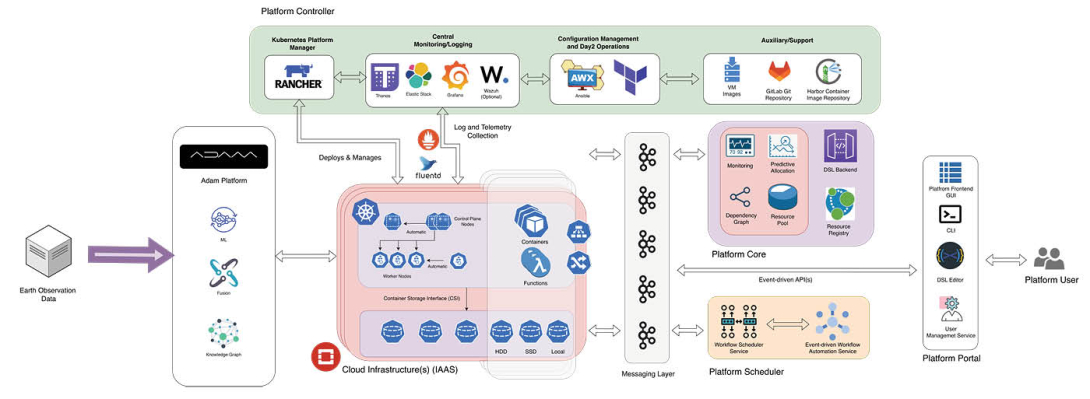
The EO4EU Platform employs a wide range of cloud computing and infrastructure-as-code technologies, supporting a geographical multi-cloud deployment on top of the CINECA and WEkEO Data and Information Access Services (DIAS) cloud infrastructures. Its architecture and features underpin its flexibility and ability to serve different user groups (see the figure).
Practical impact
From ECMWF’s perspective, the EO4EU project has yielded several technical achievements. Its multi-cloud architecture and infrastructure-as-code approach have acted as a precursor to the design of data bridges within Destination Earth. The project has also contributed to improvements in secret management, cybersecurity, infrastructure monitoring, DNS record and certificate management and application containerisation. EO4EU has made EO data easier to access and use for both technical and non-technical users. The platform streamlines data selection and retrieval from sources such as Copernicus services, DIAS, and DestinE, reducing complexity and accelerating the development of EO applications. EO4EU also supports the integration of in situ measurements with EO datasets, enabling advanced correlation and fusion techniques. Its visualisation capabilities allow users to explore original, spatio-temporally constrained, and transformed data, creating opportunities for deeper insights into environmental processes.
Use cases
To demonstrate its practical impact and versatility, EO4EU implemented seven use cases across environmental, social, and economic domains:
- Ocean Monitoring for marine health and resource management.
- Food Security to support agricultural planning.
- Forest Ecosystems for biodiversity and conservation.
- Soil Erosion monitoring for land management.
- Environmental Pests detection to protect crops and ecosystems.
- Personalised Healthcare Services using EO data for health-related insights.
- Civil Protection to improve disaster preparedness and response.
Next steps
EO4EU is being onboarded into the DestinE Core Service Platform (DESP), to ensure continued visibility and long-term use beyond the project’s official end. The consortium is also exploring opportunities to position EO4EU within emerging frameworks such as AI Factories, leveraging its advanced AI and ML capabilities to support new use cases. These efforts aim to maximise the impact of EO4EU, fostering innovation and enabling broader adoption of Earth observation data for science, policy, and industry.
Funding acknowledgement
The EO4EU project (grant agreement No 101060784) was funded by the European Union. Views and opinions expressed are however those of the authors only and do not necessarily reflect those of the European Union or the Commission. Neither the European Union nor the granting authority can be held responsible for them.