

At the end of October 2025, Hurricane Melissa brought destructive winds and rainfall to Jamaica as it made landfall as a Category 5 hurricane. Melissa formed on 21 October over the Caribbean Sea from an African Easterly Wave (AEW) that had crossed the Atlantic. The AEW affected the eastern Caribbean on 19 October with moderate rainfall. As it later slowed down over the warm Caribbean Sea, the system developed more organised convection. After becoming a tropical cyclone on 21 October, it continued to slowly move to the north-west for almost a week. The cyclone then rapidly intensified on 26–27 October while moving westwards. On 28 October, the cyclone, now a Category 5 hurricane, turned to the north and made landfall in south-western Jamaica later that day, and in Cuba the day after. The system also brought torrential rainfall to Haiti, leading to landslides and flooding.
Forecasting challenges
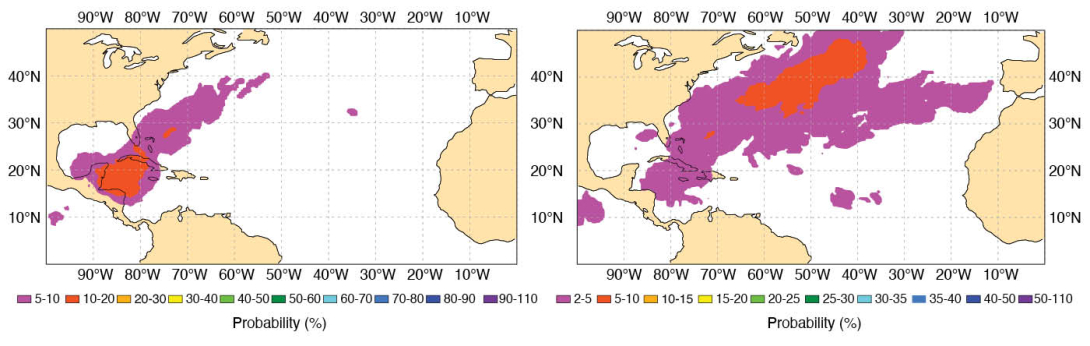
As early as 13 October, ECMWF forecasts started to indicate the risk of a cyclone in the Caribbean Sea in the week beginning 27 October (see first figure). This signal was visible in the probability map of weekly tropical cyclone activity produced by the sub-seasonal forecasting system. Over the western Caribbean Sea, the probability for a tropical cyclone (defined as winds exceeding 17 m/s in the forecast) was 10-20%, albeit somewhat to the west of the actual storm. Based on the ECMWF re-forecasts, the climatological probability for a storm during a week at the end of October is 2–5%, indicating enhanced tropical cyclone activity in the forecast. The predictability of the tropical cyclone genesis was linked to the prediction of the AEW, which at the time of forecast initialisation was located just west of Africa.
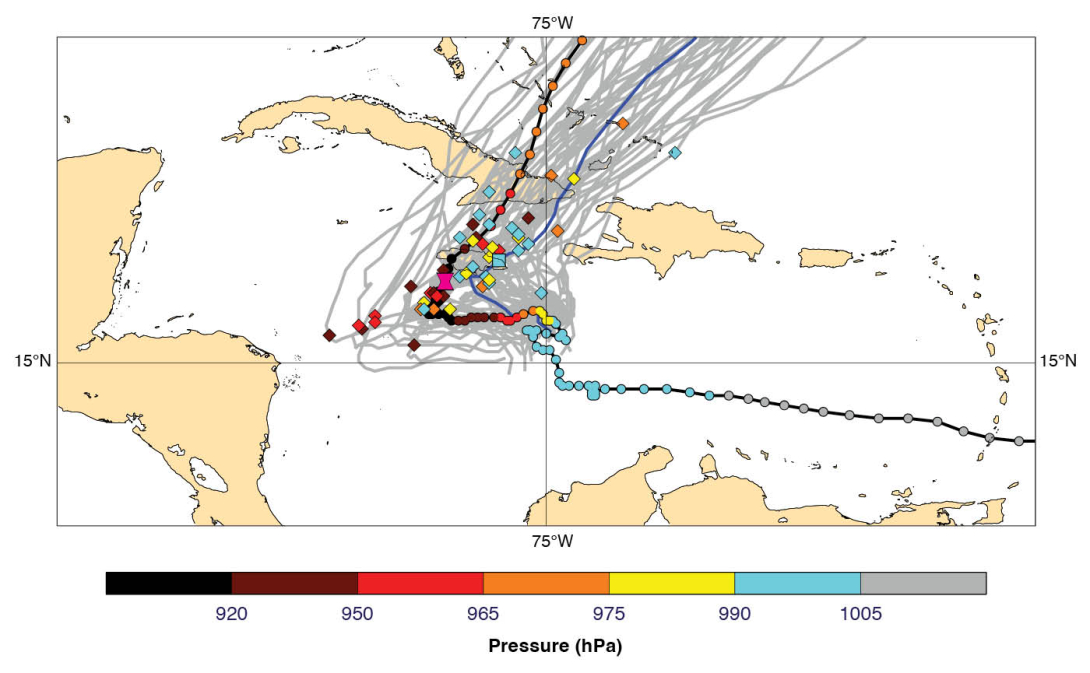
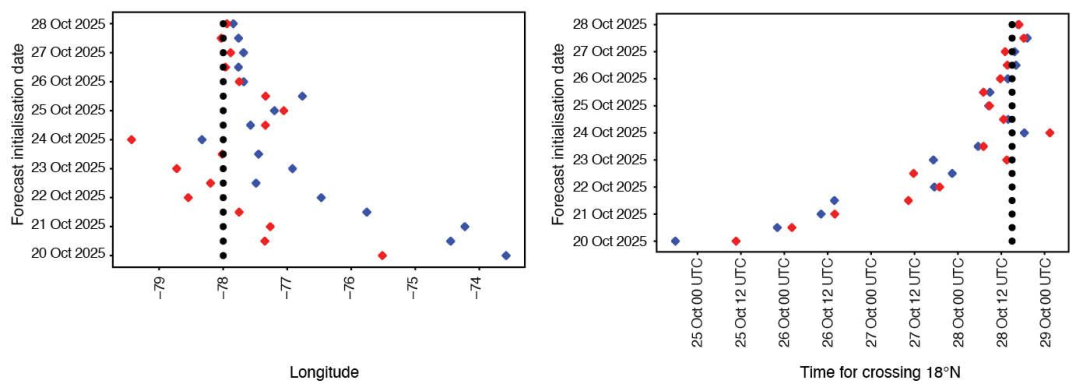
After the cyclone formed, its westward movement followed by a rapid turn to the north caused large uncertainties regarding the timing and location of the landfall in Jamaica. These uncertainties persisted (see second figure) from the medium-range into the short-range forecast. This is shown by the evolution of the longitude and timing of the cyclone crossing the latitude of 18°N (latitude of southern Jamaica; see third figure). For forecasts issued between 20 and 22 October, the Artificial Intelligence Forecasting System (AIFS) ensemble turned the cyclone northwards too early. This resulted in predictions crossing 18°N that were too far east and too early. This was also predicted by the Integrated Forecasting System (IFS) ensemble. While the ensemble mean error decreased with shorter lead time, the forecast from around 25 October still showed an early northward turn in both systems, putting the eastern part of Jamaica under threat. However, both ensembles had large ensemble spread for this case, indicating large uncertainties.
Intensity prediction issues
Large uncertainties were also present in the prediction of the intensity of the cyclone. Some members in the IFS ensemble predicted the rapid intensification in the forecast between 23 and 25 October. However, they did not reach a pressure below 900 hPa as was the estimated intensity from observations. The AIFS ensemble did not capture the intensification at all. After the rapid intensification of the storm, the ECMWF analyses, and subsequent forecasts, struggled to capture the intensity, with an error of around 60 hPa. This occurred despite the cyclone being well observed by dropsondes and aircraft measurements. One dropsonde measured the strongest verified hurricane wind speed on record, according to the National Center for Atmospheric Research (NCAR). This raises the question of whether the cyclone was too small-scale to be properly handled by the data assimilation and whether the available observations could be used more effectively.
In summary, Hurricane Melissa posed different challenges at different time scales. ECMWF is working together with the University of Miami and NCAR to better understand the predictability of tropical cyclone genesis that originate from AEWs in the medium and sub-seasonal ranges. In the medium range, the presence of the uncertainties in landfall position and timing was a challenge. In the short range, predictions were affected by large analysis errors for the intensity. Further work is under way within the EU Destination Earth initiative to improve the use of observations and the resolution of data assimilation.