

Machine learning (ML) is becoming increasingly integrated into ECMWF’s activities, offering a growing suite of operational services that deliver data, software, and computing capability to the user community. Developments in this area are fast-paced and highly collaborative; teams across ECMWF and European national meteorological and hydrological services (NMHSs) are contributing to these shared tools and services.
In 2025, ECMWF continued to expand and refine the tools enabling this shift. Operational data-driven forecasts, open-source modelling frameworks, graphics processing unit (GPU)-enabled computing environments and new training materials have significantly lowered the barrier to engagement. A broad range of ML services is now available to support users at every stage, from first-time exploration to the development of advanced research and operational workflows.
AIFS: data-driven forecasting now in operations
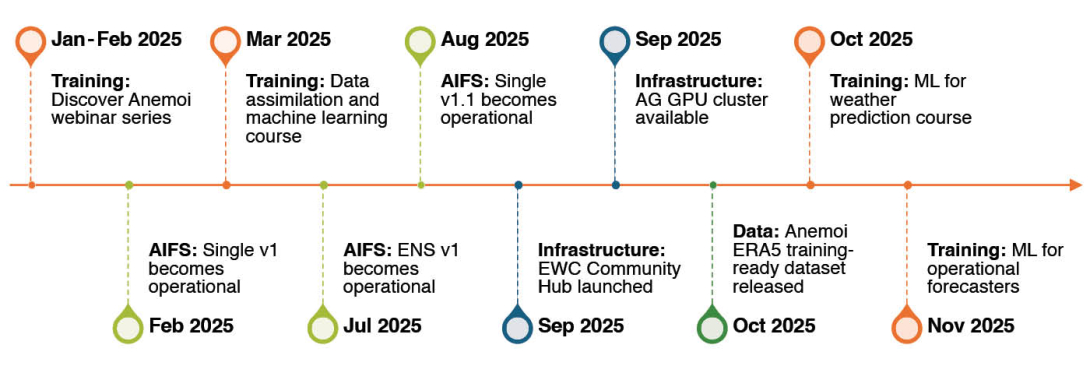
A major milestone for the meteorological community was reached on 25 February 2025, when ECMWF began producing operational forecasts using the deterministic version of the Artificial Intelligence Forecasting System (AIFS Single). This marked the first time a global, data-driven prediction model became part of an operational forecast service at an international meteorological centre. AIFS Single produces a full 15-day forecast in minutes on ECMWF’s high-performance computing facility (HPCF), showcasing the efficiency of AI-based weather prediction.
On its first full day of operations, AIFS Single disseminated 130 gigabytes of customised forecast data to 46 remote sites around the world. In addition to these bespoke products, the complete set of AIFS Single forecast products was made freely available on open data platforms, democratising access to forecast data.
The operational launch of the AIFS ensemble (AIFS ENS) model followed on 1 July 2025, adding uncertainty estimation and enabling users to explore probabilistic data-driven prediction. Together AIFS Single and AIFS ENS generate approximately 6 terabytes of forecast data each day, providing a robust data-driven complement to the operational Integrated Forecasting System (IFS).
Access AIFS data and products
All global real-time forecast products produced by the AIFS are freely available to the public.
- AIFS open data are published immediately after production on a variety of open data platforms.
- AIFS forecast charts showing a subset of the most popular products are published on the OpenCharts platform each day. These charts allow users to interact with AIFS weather forecast products without downloading data.
Bespoke real-time and historical AIFS forecast products are also available for registered users.
For users wishing to run the AIFS and generate data themselves, model weights for AIFS Single and AIFS ENS are also openly available on HuggingFace (https://huggingface.co/ecmwf).
Software and data services
Anemoi: the framework powering data-driven innovation
Co-developed by ECMWF and NMHSs across Europe, Anemoi is an open-source, Python-based framework that provides a complete toolkit for developing data-driven weather forecasting models. Since its launch in 2024, the Anemoi framework has grown in functionality and now forms the backbone of ECMWF's operational data-driven forecasting system, the AIFS. The Anemoi ecosystem is also evolving and actively being developed. A key achievement in 2025 was the release of an open Anemoi dataset – a training-ready version of ECMWF’s ERA5 reanalysis. ERA5 has been widely used to train data-driven weather forecasting models, including the AIFS. The release of the ERA5 Anemoi dataset enables users to train their own data-driven models using the Anemoi framework.
Anemoi’s impact across the community was recognised in 2025 with two major international awards: the EMS Technology Achievement Award 2025 and the HPCwire Readers’ and Editors’ Choice Award 2025.
Get started using Anemoi
The Anemoi ecosystem includes comprehensive documentation, example notebooks and introductory webinars covering:
- dataset creation and management;
- model configuration and training;
- evaluation and forecast generation.
To generate your own AIFS forecast using the anemoi-inference package, follow the notebook examples for AIFS Single and AIFS ENS (https://huggingface.co/ecmwf).
To download the Anemoi ERA5 dataset and get started training your own model, refer to the anemoi-training package documentation (https://anemoi.readthedocs.io/projects/training/en/latest/user-guide/download-era5-o96.html).
ai-models
In addition to developing its own models, ECMWF runs several third-party data-driven weather forecasting systems alongside the AIFS using the ai-models Python package. The models include DeepMind’s GraphCast, Huawei’s Pangu-Weather, Microsoft’s Aurora and NVIDIA’s FourCastNet. These models are run daily for verification and comparison with the AIFS.
Interact with third-party models
Although ai-models is experimental, with limited support and no plans for further expansion, the package and its output are available to users:
- Graphical forecast products and performance scores are publicly available on the OpenCharts platform (https://charts.ecmwf.int/catalogue/packages/ai_models/), enabling comparison with the AIFS and IFS.
- Users can also generate their own forecasts from these models using the experimental ai-models Python package (https://github.com/ecmwf-lab/ai-models), which handles the retrieval of input data required to initialise the models.
Computing resources
GPU access
Many ML workflows require GPU acceleration and specialised software environments. In 2025, ECMWF expanded both its high-performance computing and cloud-based offerings to support this growing demand. Access is available to users affiliated with NMHSs in ECMWF’s Member and Co-operating States.
ECMWF high-performance computing facility
In 2025, a new GPU cluster was introduced to the HPCF. The cluster, called AG, more than doubles ECMWF’s existing GPU capacity. The AG cluster consists of 30 accelerated nodes, each containing four Grace Hopper GH200 Superchips, for a total of 120 GPUs. To facilitate access, ECMWF’s JupyterHub service (https://jupyterhub.ecmwf.int/hub/home) allows users to run interactive GPU sessions in a browser.
European Weather Cloud
GPUs are also available to users of the European Weather Cloud, which currently offers 32 Nvidia Ampere A100 GPUs.
In addition to hardware, the EWC also provides ready-to-use ML software environments. In September 2025, the European Weather Cloud Community Hub (https://www.europeanweather.cloud/community-hub) was launched. The Hub offers a centralised platform where users can discover, evaluate, select, and deploy items and services tailored to the European meteorological community (see the screenshot). In the context of ML, this includes ready-made templates that provide pre-configured software stacks for the AIFS and Anemoi.
These resources lower the barrier to entry for users who want to experiment with ML.

Use computing resources
Users who wish to access GPUs on the HPC or EWC should:
- Refer to the access guidelines (https://www.ecmwf.int/en/computing/access-computing-facilities), to check eligibility.
- If you are a Member or Co-operating State user, contact your Computing Representative to arrange access.
- You may also apply for access as part of a European Meteorological Infrastructure (EMI) R&D project.
Training and community engagement
Training and knowledge exchange remain essential to supporting the growth of ML. Throughout 2025, ECMWF delivered a number of training courses, webinars and training resources, with materials available on the ECMWF website:
- In January, the six-part Discover Anemoi webinar series demonstrated how to use key components of the Anemoi ecosystem, covering dataset creation, graph construction, model training, inference and contributing as a developer.
- In March, the five-day Data assimilation and machine learning training course introduced meteorologists to a range of ML techniques applicable to data assimilation workflows through lectures and hands-on exercises.
- In October, the five-day Machine learning for weather prediction training course brought together meteorologists and ML scientists, providing an overview of ML in Earth system sciences and introducing software and hardware frameworks available at ECMWF.
- In November, the three-part Machine learning for operational forecasters webinar series attracted operational forecasters from more than 100 countries, offering guidance on accessing, using and interpreting AIFS forecast products.
Looking ahead to 2026
The landscape of ML at ECMWF has evolved significantly over the past five years. The milestone of the first operational data-driven forecast with the AIFS marks only the beginning of exploring ML’s potential.
In 2026, the AIFS Single and AIFS ENS models will be upgraded in parallel with the implementation of IFS Cycle 50r1. The upgrades will feature improved forecast scores and new output variables, including snow.
The year ahead will also see the release of the first AIFS sub-seasonal model. More than 60 sub-seasonal models are currently being developed by international teams as part of the AI Weather Quest competition. ECMWF is prototyping three models ahead of the 2026 release. The competition is ongoing and welcomes both individual participants and teams of up to ten members.
Finally, further training and outreach activities are planned for 2026. ECMWF will host the fifth iteration of the joint ECMWF-ESA ML workshop in Bologna, Italy, in April 2026. Under Destination Earth, a course on machine learning will take place in Bonn in February 2026, followed by a series of online courses on ML in Earth Systems Modelling beginning in March, which will run over 2026. The data assimilation and machine learning course will also run again in March 2026 in Reading. Users may register for these training courses and workshops on the ECMWF website and by following the Destination Earth page (https://destine.ecmwf.int/ml-training/).
Further resources
To keep up with the rapid pace of ML developments at ECMWF, users can refer to the website and user guide for ML services (https://confluence.ecmwf.int/display/UDOC/Machine+Learning+Services+and+Support). Users are also invited to join our communication channels to receive updates about future AIFS cycle upgrades and other ML activity:
- Subscribe to our mailing lists by emailing forecast_changes-request@lists.ecmwf.int (subject: subscribe) for AIFS cycle updates, and ml_training-request@lists.ecmwf.int (subject: subscribe ml-training) to receive information about upcoming training events.
- Join our user forum (https://forum.ecmwf.int/) and watch the announcements in the ‘IFS, AIFS and OpenIFS’ category.
- Follow our LinkedIn channel for users (https://www.linkedin.com/showcase/ecmwf-users/).