

As a part of a collaboration with the German Meteorological Service (DWD), in addition to the efforts to monitor and assimilate cloud-sensitive visible data (Necker et al., 2025), ECMWF is also advancing the use of aerosol visible reflectance data. This work will enhance the initialisation of aerosol forecasts within the Integrated Forecasting System’s (IFS) four-dimensional variational data assimilation (4D-Var) in the atmospheric composition configuration (IFS-COMPO), used operationally in the Copernicus Atmosphere Monitoring Service (CAMS). The aerosol visible reflectance assimilation system (AVRAS) prototype was developed under the CAMS EvOlution project (CAMEO) and followed the approach of Benedetti et al., 2020. This system currently leverages Level-2 cloud-screened aerosol visible reflectance observations from the Moderate-resolution Imaging Spectro-radiometer (MODIS) instrument aboard the Aqua and Terra satellites, which are already operationally received at ECMWF. Future work could extend to VIIRS or similar products developed for other imagers. The first assimilation experiment has been successfully conducted over several cycles, with promising preliminary results. This feature article summarises major findings from this exciting endeavour.
Essential steps that paved the way
Monitoring atmospheric composition is a key objective of Copernicus, the European Union’s flagship Earth observation initiative. CAMS provides free and continuous data and information on atmospheric composition, supporting air quality monitoring, progress towards sustainable development goals, and the transition to sustainable energy. The CAMEO project was funded to enhance the quality and efficiency of the CAMS service and to strengthen its ability to respond to policy needs. Within CAMEO, efforts have concentrated on implementing a fast observation operator that ensures the assimilation of replace with aerosol visible reflectances can be performed within the time constraints of operational IFS cycles.
Infrared and microwave satellite radiances have long been assimilated into ECMWF’s IFS to help estimate the best possible initial conditions for global numerical weather prediction (NWP). Visible observations, on the other hand, have largely been underexploited for data assimilation. This is due to the heavy computational cost associated with resolving complex interactions between radiation, clouds, aerosol particles and the reflecting surface at visible wavelengths. As a result, direct assimilation of reflectances to estimate aerosols was not feasible until recently. Instead, the aerosol analysis has been constrained by assimilating aerosol optical depth (AOD) products.
The first attempt to assimilate aerosol visible reflectances at ECMWF was made at ECMWF within the Aerosol Radiance Assimilation Study (ARAS) project, a European Space Agency-funded project that ran from 2018 to 2020. As part of ARAS, an observation operator for visible reflectances based on look-up tables was developed by the Oxford-RAL Aerosol and Cloud team and incorporated into the IFS, although it did not reach operational maturity. ARAS results showed that the assimilation of aerosol visible reflectances increased the aerosol load in the analysis to a level comparable to the MODIS aerosol optical depth data (Benedetti et al., 2020), while also improving other aerosol parameters.
A fast radiative transfer model for visible wavelengths
Realistic simulation of visible reflectances in the presence of aerosols requires a fast radiative transfer operator capable of accurately and efficiently simulating top-of-atmosphere visible reflectances. Traditional radiative transfer solvers for aerosols, such as the Discrete Ordinate Method (DOM), are highly accurate but computationally expensive and impractical for large-scale data assimilation systems that require repeated simulations with the forward, tangent linear, and adjoint observation operators.
A major advance in this area is the Method for Fast Satellite Image Synthesis (MFASIS), developed by DWD and the Ludwig Maximilian University of Munich within the framework of the Hans Ertel Centre for Weather Research. The MFASIS is implemented in the Radiative Transfer for TOVS (RTTOV, currently at version 14.0; Saunders et al., 2018) within the EUMETSAT NWP SAF. It provides a fast and accurate approximation of the one-dimensional radiative transfer model DOM solution for simulating visible reflectances in the presence of multiple scattering due to clouds and aerosols. The MFASIS is under continuous development to further increase accuracy and to extend its capabilities. Examples of this are the introduction of a neural-network-based solver for cloudy visible reflectances (MFASIS-Cloud; Scheck, 2021), and the application of MFASIS for the direct assimilation of aerosol visible reflectances, where aerosol scattering dominates (MFASIS-Aerosol, Box A).
A
MFASIS-Aerosol in the IFS-COMPO
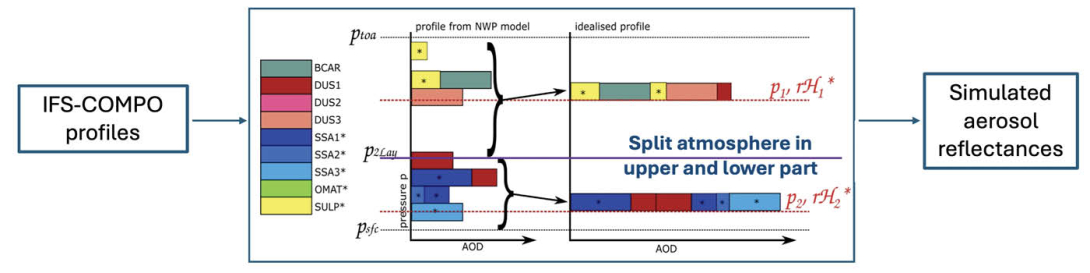
The MFASIS-Aerosol version integrated into the upcoming RTTOV-14.1 release takes as input vertical profiles of atmospheric pressure, temperature, humidity and aerosols, along with information about the surface, and it outputs top-of-atmosphere visible reflectances (see Figure 1). Adjoint and tangent-linear codes are also provided. Aerosol content from the original profile is represented in a simplified profile by concentrating the CAMS aerosol species defined in RTTOV (i.e. sea salt, desert dust, organic matter, black carbon, sulphate) into two distinct layers. This approach captures boundary-layer aerosols and a middle-to-upper tropospheric plume while preserving the total vertical integral of the aerosol loading.
A more recent CAMS global atmospheric composition profile dataset was produced in 2025 (Turner, 2025). It incorporates all previous variables as well as some new ones, specifically three aerosols: ammonium, nitrate and secondary organic matter. Future re-training of MFASIS-Aerosol will make use of the full set of CAMS species to improve the aerosol reflectance modelling.
Benefits of integrating RTTOV MFASIS-Aerosol in the IFS-COMPO include:
- Enhanced aerosol representation. Visible reflectances are sensitive to aerosol size, and composition, adding information beyond the standard AOD products.
- Better aerosol initial conditions. These improve both CAMS air-quality analyses and NWP forecast skill through more accurate shortwave radiation and surface energy balance.
- More consistent assumptions. The approach is compatible with the IFS-COMPO’s 4D-Var, unlike those used in external satellite retrievals.
- Multi-sensor capability. This enables the joint assimilation of visible reflectances from multiple sensors, exploiting their combined information content and reducing limitations tied to individual retrieval algorithms, viewing geometries, or missing channels.
Handling cloud sensitivity in visible-channel aerosol assimilation
Assimilating aerosol visible reflectances requires careful treatment of cloud sensitivity, as clouds strongly influence observed reflectances and can introduce significant biases if not properly accounted for. Three potential approaches for handling cloud sensitivity in visible reflectance assimilation have been identified:
- Apply in-house cloud screening to Level-1 reflectances. This approach relies on a dedicated cloud-detection step to remove visible reflectance observations affected by clouds before assimilation can be performed. However, as Level-1 visible reflectances usually do not include flags to distinguish and separate clouds from aerosols, relying only on model cloud fields can lead to misinterpreting observed cloud signals as aerosol ones and to a degradation in the analysis.
- Simultaneous assimilation of clouds and aerosols. A more advanced option would be to assimilate cloud and aerosol properties together using a single, combined observation operator. While this method would allow the assimilation system to account for both aerosol and cloud contributions to the observed reflectance, in practice, this is not currently possible. In the future, when a unified MFASIS Cloud and Aerosol operator will be available, this joint-assimilation approach could be revisited.
- Use Level-2 cloud-screened observations. The most practical approach involves the use of pre-processed Level-2 cloud-screened aerosol reflectances from instruments like MODIS (Aqua/Terra) or VIIRS (NOAA) on polar-orbiting satellites. These products apply established cloud-screening algorithms, greatly reducing cloud aliasing risks and supporting operational implementation. This approach was selected for the CAMEO project. MODIS Collection 6.1 Level-2 observations were used since they are operationally available in IFS-COMPO, but future work could extend to VIIRS or similar products developed for other imagers.

Observation processing
A bespoke workflow was established to pre-process aerosol visible reflectance data, facilitating their integration within the IFS and enabling their monitoring and assimilation. MODIS reflectances at 665 nm are extracted from the Level-2 cloud-screened aerosol reflectance sequence dedicated to the AOD processing and converted into a local template, dedicated to the visible reflectance processing. The volume of visible reflectance data available for monitoring is substantial, with datasets arriving at their native high spatial and temporal resolution. A critical issue in using visible data in NWP models is the resolution mismatch between high-resolution satellite observations and coarser model grids used for the analysis. MODIS visible reflectances were experimentally superobbed at a resolution of 80 km to reduce data volume, as well as to ensure consistency with the model at the analysis scale and to minimise the impacts of possible horizontal correlations on the observation error. Screening mechanisms are applied to exclude data that may degrade analysis quality, especially for areas affected by ice, snow, or observations at extreme sun or satellite angles. The final number of observations retained depends strongly on the chosen superobbing strategy, the stringency of screening criteria, and the temporal sampling frequency. In the current setup, following pre-processing and superobbing, a single channel from each MODIS instrument typically yields around 15,000 active observations per day. The data selection and the impact of the quality control are illustrated in Figure 2.
Evaluation of monitoring and assimilation results
Assimilation of AOD in the IFS-COMPO 4D-Var has been operational since 2008. The aerosol variable that is adjusted in the analysis is the total aerosol mixing ratio, representing the aerosol load in the atmospheric column. Other variables that are adjusted in the analysis are temperature, humidity, winds, and surface pressure. The aerosol observations are only indirectly related to those meteorological variables. Therefore, when using AOD or aerosol reflectance, the biggest impact is on the aerosol load. Moreover, the current configuration of the IFS-COMPO 4D-Var aerosol analysis does not allow the extraction of information on winds via the so-called “tracing effect”, which is connected to the transport of a given species by the model winds. This effect is active for humidity and ozone, but not for aerosols. However, because the 4D-Var leverages on the dynamical transport model to produce a short-range forecast of aerosol mixing ratio over the 12-hour assimilation window, the effect of assimilating aerosol observations over one location (i.e. over sea) can also be felt away from that location (i.e. over land). This is a unique feature of assimilation systems which are four-dimensional (4D) as they include a time evolution of the fields which are being assimilated.
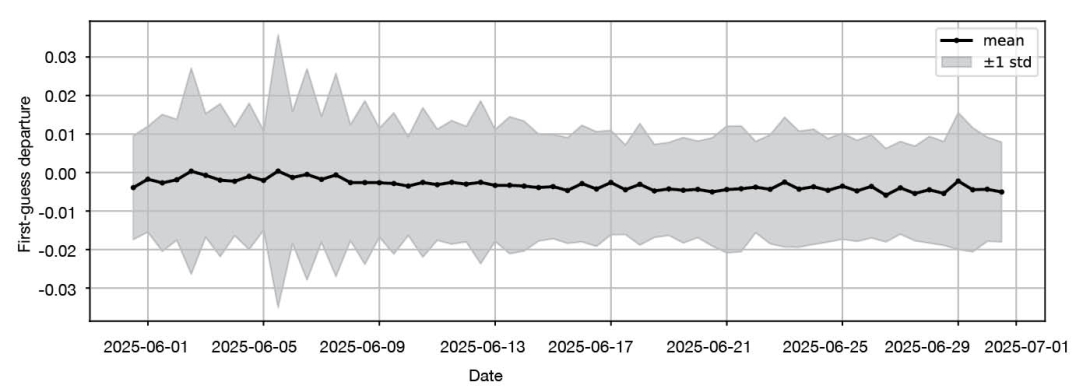
The timeseries of first-guess departures (Figure 3) and the first-guess departure mean map (Figure 4a) show a small negative bias over ocean in aerosol-clear scenes. In contrast, the presence of aerosols introduces a positive bias, indicating that the aerosol loading influences the reflectance values. Additional regional biases are observed around 50°S, likely associated with strong surface winds. These conditions can alter surface reflectance and aerosol distribution, contributing to localised discrepancies between observations and model equivalents.
The impact of the visible reflectance assimilation is shown in Figure 4. The analysis departure mean map (Figure 4b) exhibits smaller values than the first-guess departures, especially in areas where higher aerosol concentrations are present. Departure reduction (Figure 4c) is negative across the globe, meaning the analysis is closer to the observation than the first guess. A significant reduction can be seen in the Gulf of Guinea, north Atlantic and the west-coast of Africa.

case study
Dust event on 4 June 2025
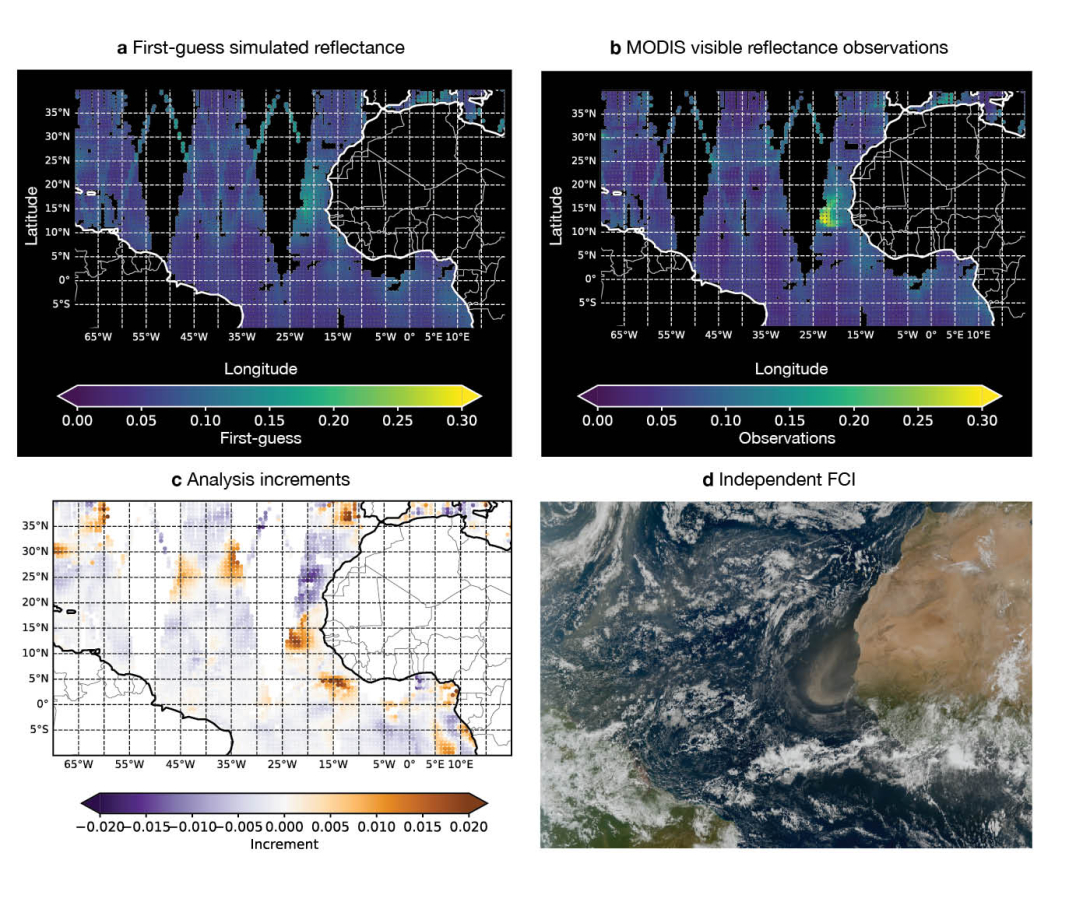
A Saharan Desert dust event on 4 June 2025 provides an illustration of the impact of assimilating visible reflectances (Figure 5). The presence of a large aerosol load, confirming the spatial extent of the dust outbreak, is clearly seen in the image captured by the Flexible Combined Imager (FCI) instrument onboard Meteosat-12. Visible reflectance observations from MODIS confirm the presence of a strong dust plume over the region. The model-simulated reflectances capture the aerosol signal in the same area but underestimate its intensity. Assimilation increases aerosol concentrations in the analysis, enhancing the event representation. The assimilation of the reflectances brings clear benefits in this case, highlighting the ability of the assimilation system to improve aerosol representation and reducing biases when visible reflectances are assimilated.
Verification against ground-based observations
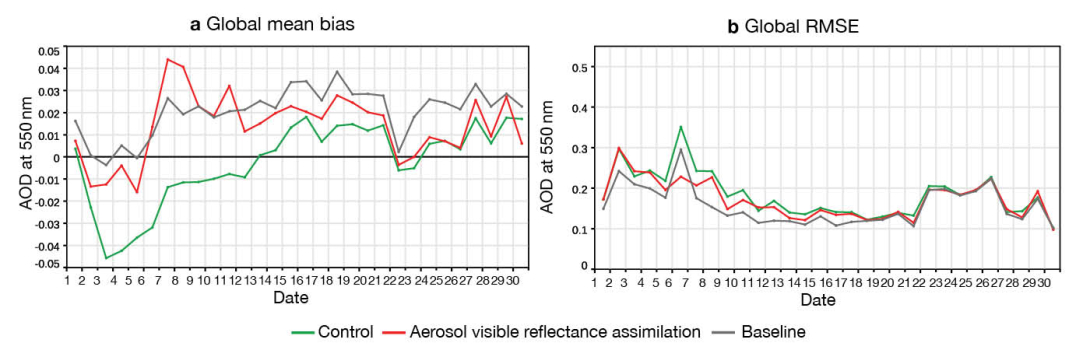
Figure 6 depicts the temporal evolution of the mean bias and the root mean square error (RMSE) between forecasted and observed AOD at 550 nm from the global AErosol RObotic NETwork (AERONET) network (Holben et al., 1998; https://aeronet.gsfc.nasa.gov/). Although the network is spatially sparse in some regions and most stations are located over land, it provides high-quality reference measurements of aerosol optical properties and is widely regarded as the state-of-the-art for aerosol validation. Three experiments are compared: a control experiment without AOD or aerosol visible reflectance assimilation; a aerosol visible reflectances assimilation experiment which only includes MODIS Level-2 cloud-screened visible reflectances from one single wavelength (665 nm); and a baseline experiment which includes the assimilation of AOD from the various sensors assimilated operationally in CAMS (e.g. MODIS, Polar Multi-Sensor Aerosol Product (PMAp), VIIRS). The assimilation of visible reflectances exhibits a smaller bias for most of the period compared to the AOD assimilation. The AOD assimilation experiment shows the smaller RMSE for most of the period. Visible reflectance assimilation shows, in general, lower RMSE than the control experiment, even improving upon the AOD experiment on specific days (e.g. on 6 June 2025).
Outlook and next steps
This article documents substantial progress in integrating aerosol-sensitive visible reflectances within the CAMS analysis framework. Historically limited by complex radiative transfer and aerosol modelling challenges, recent innovations, particularly the introduction of the MFASIS-Aerosol fast radiative transfer operator developed by DWD, have made operational assimilation feasible. While previous studies served primarily as demonstrators, this study has introduced the first implementation of aerosol visible observations in the IFS-COMPO. Directly assimilating observed aerosol-affected reflectances into ECMWF’s assimilation system is anticipated to enhance CAMS aerosol forecasts and atmospheric composition analyses. The methodological advancements constitute a robust basis for sustained innovation and the prospective operational implementation of aerosol-sensitive visible reflectance analyses.
B
Next steps towards operational application
The research conducted highlights the potential of direct visible reflectance assimilation for improved aerosol analysis and forecasts, while also identifying areas requiring further development:
- Scientific evaluation and expansion. Perform a comprehensive scientific evaluation using the MODIS MFASIS-Aerosol parameters for relevant periods, focusing on high-impact events such as dust outbreaks. Explore the integration of additional sensors, for example VIIRS or the Ocean and Land Colour Instrument (OLCI) on Sentinel 3A and 3B, subject to the availability of a Level-2 cloud-screened reflectance product.
- Multi-channel extension. Extend monitoring and assimilation capabilities beyond the 0.6 µm channel, incorporating additional visible wavelengths to exploit the full information content of satellite reflectances.
- Refinement of the assimilation system. Improve quality control, implement advanced screening techniques to ensure robust observation selection, use a bias correction to address systematic biases identified in the first guess departures, and improve observation and background error characterisation to optimise assimilation impact.
Further reading
Benedetti, A., S. Quesada Ruiz, J. Letertre‐Danczak, M. Matricardi & G. Thomas, 2020: Progress towards assimilating visible radiances. ECMWF Newsletter No. 162. https://www.ecmwf.int/en/newsletter/162/news/progress-towards-assimilating-visible-radiances
Holben, B. N., T. F. Eck, I. Slutsker, D. Tanré, J. P. Buis, A. Setzer et al., 1998: AERONET - A Federated Instrument Network and Data Archive for Aerosol Characterization. Remote Sensing of Environment, Volume 66, Issue 1, 1–16, ISSN 0034-4257. https://doi.org/10.1016/S0034-4257(98)00031-5
Necker, T., C. Lupu, S. Quesada-Ruiz, V. Firat, L. Scheck & A. Benedetti, 2025: Visible radiances in ECMWF’s analysis. ECMWF Newsletter No. 184, 17–24. https://doi.org/10.21957/tn61af97px
Saunders, R., J. Hocking, E. Turner, P. Rayer, D. Rundle, P. Brunel et al., 2018: An update on the RTTOV fast radiative transfer model (currently at version 12). Geosci. Model Dev., 11, 2717–2737. https://doi.org/10.5194/gmd-11-2717-2018
Scheck, L., 2021: A neural network based forward operator for visible satellite images and its adjoint. J. Quant. Spectrosc. Ra., 274, 107841. https://doi.org/10.1016/j.jqsrt.2021.107841
Turner, E., 2025: Diverse profile datasets from the ECMWF CAMS 137-level short range forecasts. Technical Report NWPSAF-EC-TR-044. https://nwp-saf.eumetsat.int/downloads/profiles/nwpsaf_cams137_2025_doc.pdf