

Accurate forecasts of snow depth and snow cover are essential for anticipating hazards such as avalanches, transport disruption, and impacts on water resources. Snow also influences surface–atmosphere interactions, affecting water and energy fluxes and playing a key role in albedo feedbacks. As part of ongoing work to extend machine-learning (ML) capabilities within the Artificial Intelligence Forecasting System (AIFS), ECMWF has developed a new representation of snow fields for AIFS v2.
AIFS v1 became operational in 2025, using the Anemoi framework developed in collaboration with our Member States. While the first version focused primarily on atmospheric variables, work is under way to provide a more complete representation of the Earth system using machine learning. This includes integrating components such as land, hydrology, oceans, waves, and sea ice. The addition of snow in AIFS v2 is a step toward that broader objective.
Representing snow with machine learning
The physical Integrated Forecasting System (IFS) model represents snowfall as snow water equivalent (SWE) – the amount of water stored in the snowpack. From this and snow density, the model calculates snow depth and continually updates it as snow falls, melts, or sublimates. Snow cover fraction is diagnosed from depth and density, with a non-linear transition from partial to full coverage as snow accumulates.
In the AIFS, these relationships are not hard-coded. Instead, the ML system is trained to predict snow depth directly, while snow cover fraction is learnt as a diagnostic variable using snow depth and related fields. This allows the model to infer accumulation and coverage patterns from the underlying data rather than from predefined equations.
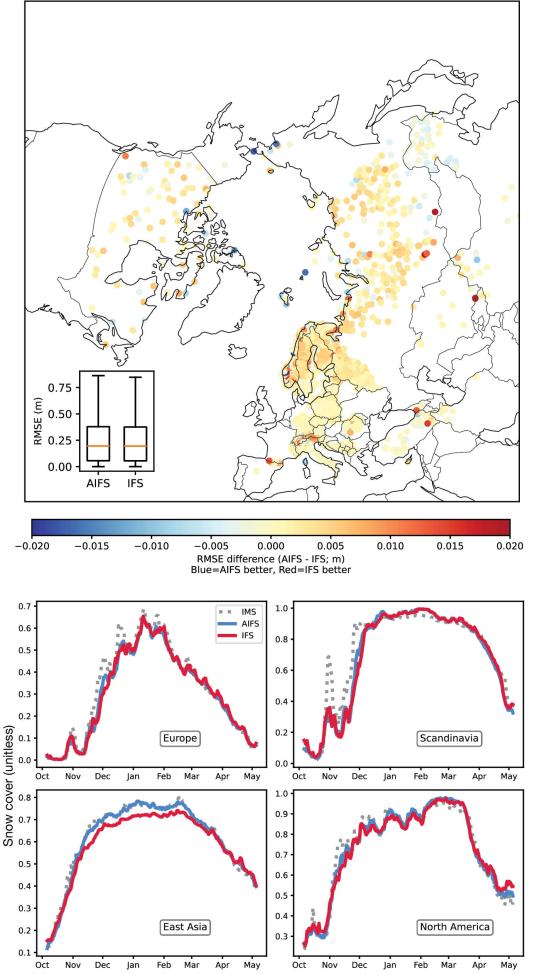
against (top) in-situ snow-depth measurements from SYNOP stations and (bottom)
satellite-retrieved snow cover from the Ice Mapping System (IMS) product.
Two approaches are being explored in parallel for extending ML-based Earth system modelling. One is to integrate additional variables directly into the AIFS, training a single joint model for atmosphere–land–ocean–ice fields. The second is to develop separate ML components for different domains, which are then coupled, similar to traditional physics-based modelling. The work on snow in AIFS v2 follows the first approach with contributions from the EU project CERISE (CopERnIcus climate change Service Evolution - grant agreement 101082139), while the EU Destination Earth (DestinE) initiative is testing the second.
Modelling challenges
Snow processes evolve more slowly than atmospheric variables and show strong spatial heterogeneity. Permanently snow-covered regions exhibit stable conditions, whereas regions with seasonal snow cover are characterised by shallow snow depths and highly variability. These regions are the most difficult for ML systems to capture.
ML models typically rely on normalised inputs, but for snow depth this proved less effective. Better performance was achieved when the model was trained on raw values, allowing it to learn first from persistent snow in glacier regions and then adapt to the more variable behaviour of seasonal snow. This approach helped the system capture both stable and rapidly changing conditions.
Performance compared to the physical model
The AIFS has learnt to forecast snow depth and snow cover using autoregressive training, in which the model predicts future values based on its own previous output. Its performance has been evaluated against ground-based measurements and satellite-derived snow cover.
Overall, the machine-learnt model shows skill comparable to that of the physical IFS. For snow depth, the IFS retains a small advantage, with root-mean-square errors differing by less than half a centimetre. For snow cover, the AIFS shows slightly better domain-averaged performance, particularly over East Asia (see the first figure). These differences reflect, in part, the contrasting resolutions of the models: the IFS operates at around 9 km, while the AIFS currently uses a 0.25° grid (approximately 28 km), favouring regional placement over local detail.

Improved snowline representation
A known limitation in the physical model is the tendency to retain snow for too long. Operational forecasts rely on data assimilation to correct these biases. The AIFS, however, is trained on the ERA5 reanalysis and operational snow-depth analysis data, which already include assimilation corrections. As a result, the ML system can reproduce realistic snowlines, even in forecasts extending beyond the period used for training (see the second figure).
Next steps
The integration of snow fields into AIFS v2 is an important step towards representing the entire Earth system with ML for weather prediction and reanalysis applications. Future developments, including in CERISE and follow-on projects, will explore the use of additional observational data sources, expand static inputs such as vegetation and soil type, and investigate whether the model can learn snow density or predict snow water equivalent directly. In parallel, work within DestinE continues to develop and couple ML components for waves, ocean, land, sea ice, and hydrology. Together, these efforts contribute to ECMWF’s mission of advancing data-driven forecasting systems and to DestinE’s objective of developing high-resolution digital twins to support climate adaptation and resilience.