

ECMWF assimilates clear-sky radiance observations from several key geostationary satellites (GEOs), including Meteosat, GOES, and Himawari. These satellites provide continuous coverage from the tropics to the mid-latitudes, observing Earth’s atmosphere across a relatively wide range of spatial scales – from planetary-scale patterns stretching across thousands of kilometres down to structures of 1 km in size, with updates every 10 minutes.
Currently, only clear-sky observations are assimilated from the infrared part of the spectrum. These observations provide information on water vapour in atmospheric columns and on winds via wind tracing in the four-dimensional variational data assimilation system (4D-Var). Although clear-sky observations represent only a fraction of the all-sky observations globally, they can reveal mesoscale and synoptic-scale water vapour gradients in troughs of extratropical cyclones, dry air in anti-cyclones or heatwaves, as well as enhance the representation of the wind in the mid-latitude jet-stream region.
Meteorological impact of denser observations
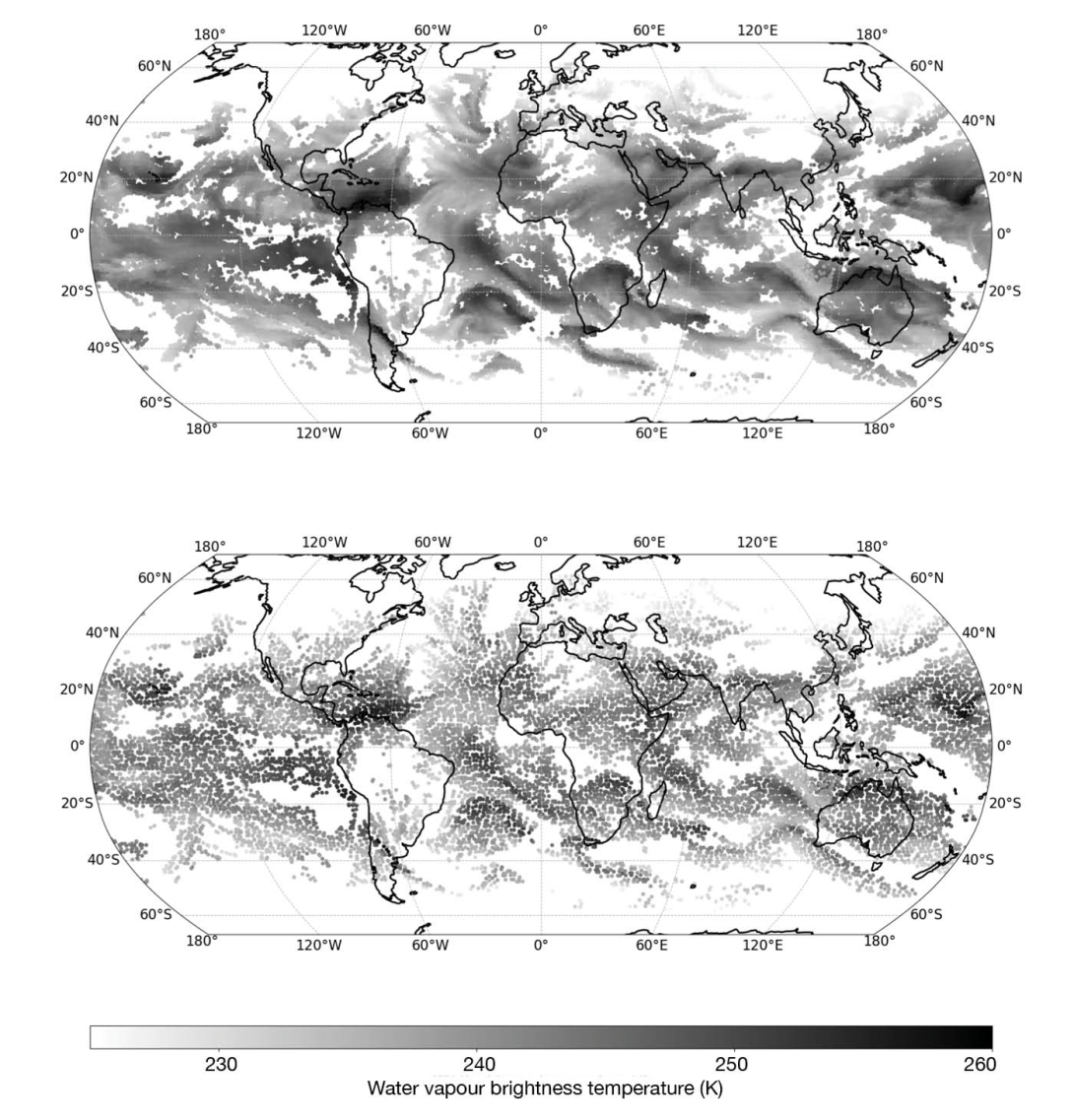
In Cycle 50r1 of the Integrated Forecasting System (IFS), ECMWF’s 4D-Var system will assimilate a denser set of GEO radiance observations – hourly and every 75 km globally, compared to the 125 km configuration (see the first figure). This improvement, achieved by adjusting spatial thinning parameters, leads to measurable gains in forecast skill.
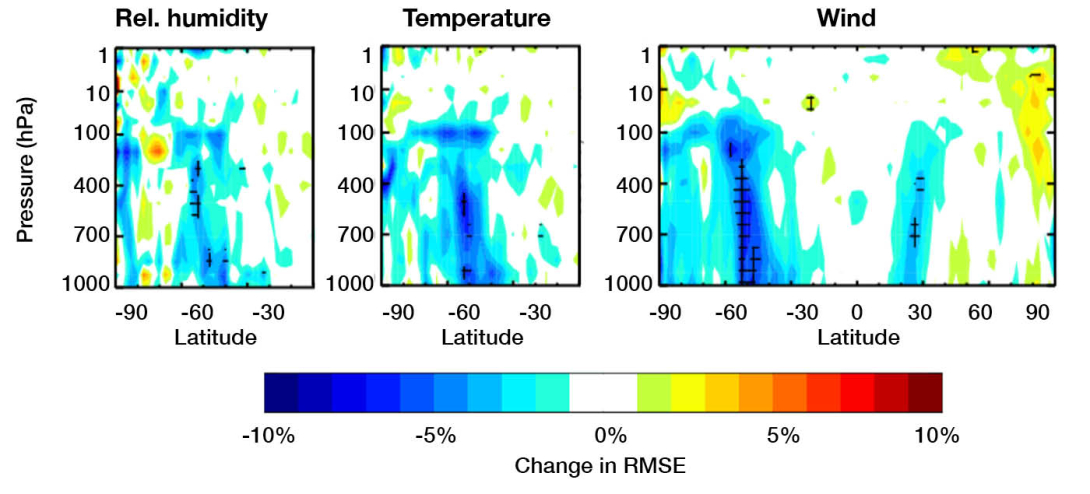
Experiments conducted at the operational resolution of 9 km (TCo1279) for the period 1 December 2022 to 15 January 2023 showed clear improvements in temperature, humidity, and wind forecasts up to five days ahead (see the second figure). The largest impact occurred in the southern hemisphere, where satellite observations play a larger role due to the relatively sparse network of conventional observations and possibly also due to the southern hemispheric summer period, which offers more clear-sky observations. Increased observation density led to significant improvements at the short range, as well as in the troposphere in medium-range forecasts. The fact that temperature, humidity and wind improvements reach throughout the full atmospheric column in the troposphere indicates that there are adjustment processes in the numerical model that are better represented in the 4D-Var system with higher observation density.
Higher frequency sampling
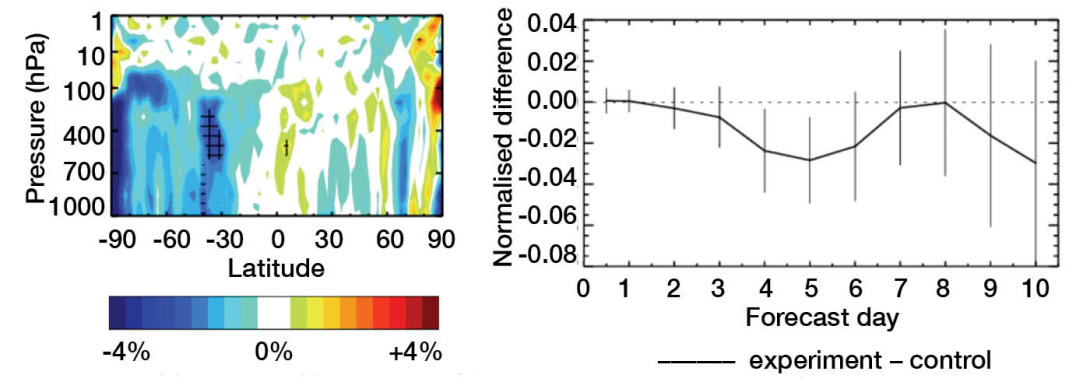
Research experiments have also been carried out assimilating clear-sky water vapour radiances at 30-minute intervals with higher temporal frequency as observed from GOES-16, -17 and -18, Meteosat-12, and Himawari-9. Forecasts based on assimilating higher-frequency observations are compared with a control experiment using an hourly update frequency. Improvements at the short range are consistent for all datasets tested, particularly for the wind field across tropospheric altitudes where GEO sensors have the highest sensitivity to the water vapour signal. Focusing on the assimilation of Himawari-9 observations at 30-minute frequency in TCo1279 experiments, the strongest impact is found in regions where the southern hemispheric jet stream occurs. This improvement is accompanied by a positive impact on the medium-range forecast of the 500 hPa geopotential for days 4 and 5 (see the third figure).
Outlook towards incorporating higher-resolution observations
Future work will exploit the exceptional spatial and temporal resolution of observations from geostationary satellites, such as the Meteosat Third Generation (MTG) series. These satellites will allow us to incorporate a greater portion of water vapour sensitive atmospheric features at finer spatial resolution, further improving the short- and medium-range forecast skill of the IFS down to the km-scale.