

Since August 2025, ECMWF’s AI Weather Quest has been challenging the forecasting community from around the world to deliver the best AI-driven forecasts at sub-seasonal timescales. ECMWF will continue the AI Weather Quest beyond its first forecasting year, establishing it as a longer-term benchmarking and learning framework for machine learning approaches to sub-seasonal forecasting.
The AI Weather Quest, endorsed as a WMO Integrated Processing and Prediction System (WIPPS) Pilot Project, is an international competition in which teams from around the world submit real-time forecasts for weeks three and four, using common rules and evaluation metrics. Scores and rankings are published weekly on the competition website. For more information on the initial framework, please consult The AI Weather Quest: an international competition for sub-seasonal forecasting with AI.
What we learned
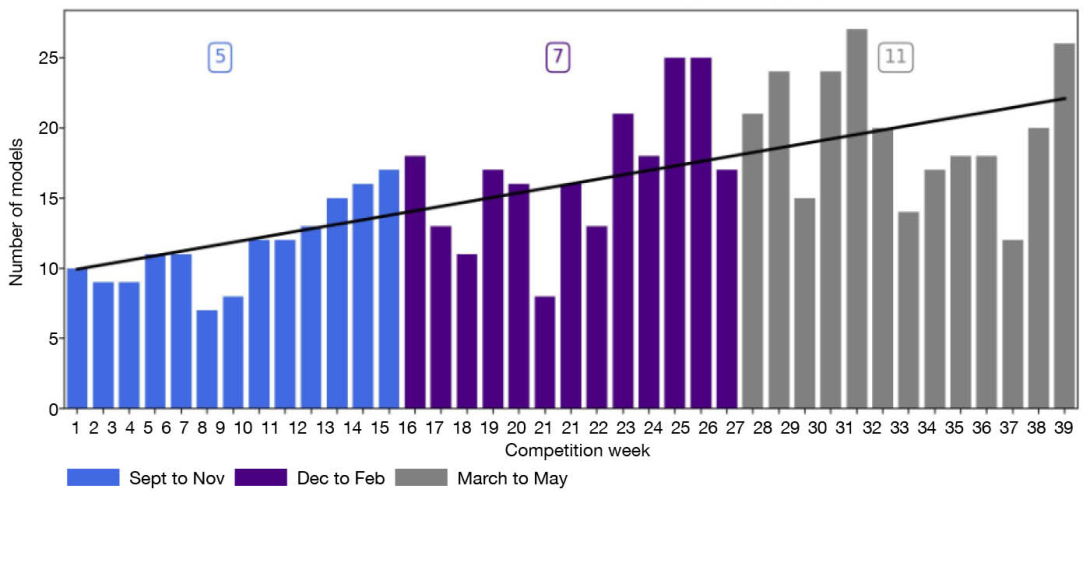
The first forecasting year has revealed strong interest in open, real-time benchmarking, with more than 45 teams and over 200 individuals from more than 20 countries competing.
The first forecasting year has shown where machine learning can add value for sub-seasonal forecasting. Over successive forecasting periods, more teams and models have achieved scores above the climatological baseline, illustrating how the AI Weather Quest is being used to encourage model development for operational-style forecasting. The results also point to the importance of post-processing and model combination: several skilful approaches use machine learning techniques to bias correct dynamical forecast model output, while multi-model approaches continue to show the benefit of drawing on complementary systems rather than relying on a single forecast alone. An overview of the competition’s preliminary scientific insights is available in the ECMWF Science Blog The AI Weather Quest: spotlighting the best of machine learning sub-seasonal prediction.
Knowledge exchange has been central to the Quest. Submitted forecasts visualisations and weekly updated scores are published transparently, and teams provide model summaries documenting their training data and computational infrastructure. Periodic award webinars have complemented these efforts by giving top-performing and standout teams a platform to present their approaches, discuss challenges and share lessons learned.
The final awards webinar of the first forecasting year will take place on 24 September 2026 and will also form part of the WMO Artificial Intelligence Webinar Series.
What’s next
For the future of the AI Weather Quest, the core scientific objectives of the first forecasting year will be retained: a focus on forecasting at three and four-week lead times, and on the three existing core variables: two-metre temperature, precipitation and mean sea-level pressure. The continuation of a global metric will allow to monitor methodological progresses.
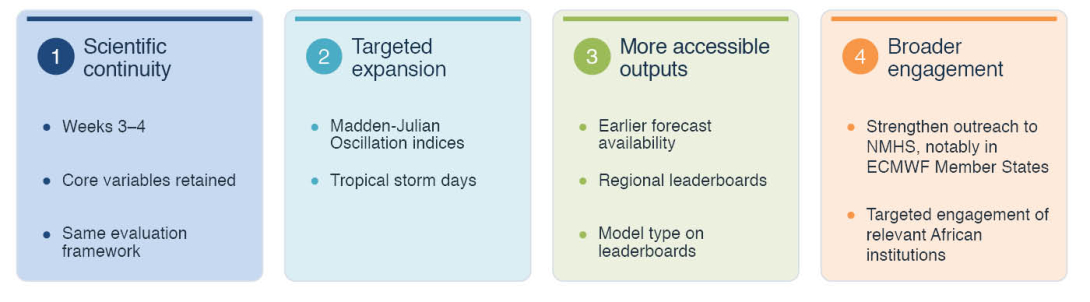
At the same time, the second forecasting year will introduce targeted extensions. Two new forecast diagnostics will be added: Madden-Julian Oscillation (MJO) phase probabilities and the number of tropical storm days, increasing the initiative’s relevance for sub-seasonal drivers and hazard-related signals.
Several updates will also strengthen the interpretation of results. Instead of making forecasts available only after a full 13-week period, forecasts in future periods will be available as soon as the submission window closes. This is intended to support exploratory analysis and application, including by institutions that may not directly participate in the Quest. Regional skill scores will be added to the leaderboards. The public leaderboards will also display model type, distinguishing between data-driven, post-processing and hybrid approaches.
The transition to this expanded framework will take place through a bridge period from September to November 2026. During this period, the competition website will continue to operate as before, with current variables, public scores and results remaining available.

Further information on the expanded framework, and a full demonstration on how to participate, is available through the “What’s next?” webinar recordings and materials on the AI Weather Quest resources page.
Join the Quest
The ECMWF AI Weather Quest remains open to new participants, and teams can join at any time. Future forecasting periods will aim to strengthen engagement with national meteorological and hydrological services, including in ECMWF Member States, as well as with African institutions, both as participants in the initiative and users of its outputs.