

ECMWF is working closely with partners from the Met Office, CERFACS, CNR and INRIA to advance ocean data assimilation science for climate reanalyses. These activities are supported through contracts funded by the EU’s Copernicus Climate Change Service (C3S), implemented by ECMWF. ECMWF initiated and leads these contracts, engaging the wider scientific community to improve the representation of the ocean and sea-ice state for forecasting, climate monitoring and coupled Earth system applications. By combining observations with numerical models, ocean data assimilation provides consistent estimates of the ocean and sea-ice state, forming a key component of both real-time forecasting and long-term reanalysis systems.
At ECMWF, these developments underpin the Ocean ReAnalysis System (ORAS), which provides initial conditions for re-forecasts, anchors the operational numerical weather prediction analyses, and supports climate monitoring. The latest generation, ORAS6, introduces important advances in the representation of forecast uncertainty and in the treatment of surface observations.
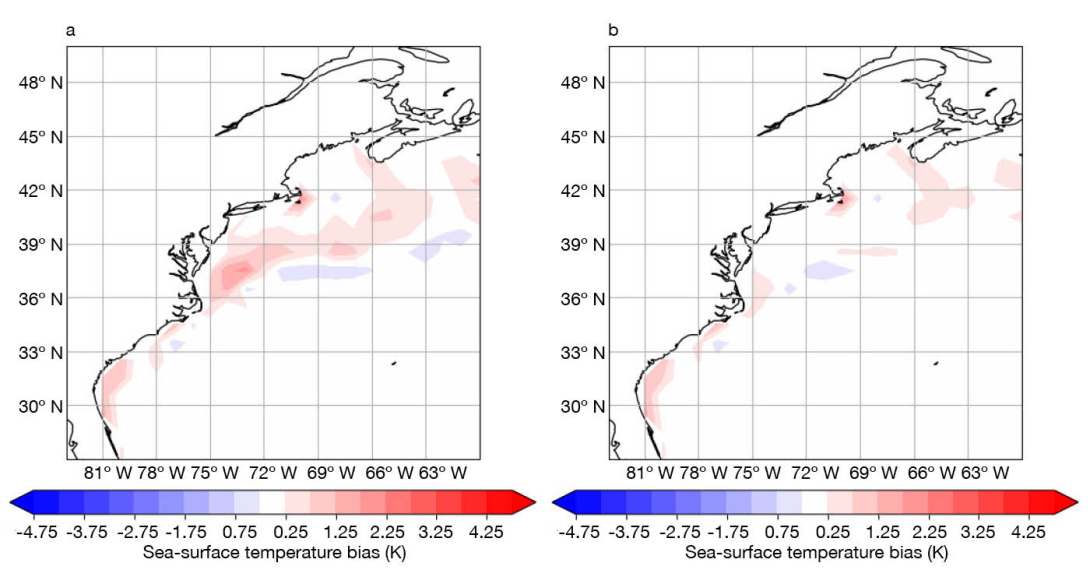
One such C3S-funded contract, Advancing an Ensemble-Based, Multi-Scale Ocean Data Assimilation System for Climate Applications, builds directly on earlier developments that led to the introduction of an Ensemble of Data Assimilations (EDA) for the ocean. This approach improves flow-dependent estimates of analysis and forecast uncertainties through ensemble-derived background-error covariances. This marked an important step beyond static, parametrized assumptions for background errors towards uncertainty estimates that adapt to the evolving ocean state. The introduction of the EDA not only reduced forecast errors, but also substantially addressed the sea-surface-temperature (SST) bias present in ORAS5, as shown in Figure 1. These developments have also been incorporated into operations with Cycle 50r1 of the Integrated Forecasting System (IFS), providing the foundation for ORAS6 and for coupled data assimilation at ECMWF.
Current priorities
Launched in February 2026, the current phase of work aims to advance data assimilation methods needed for future ocean and atmospheric reanalyses, with work intended to feed directly into ERA6, coupled data assimilation and next generation reanalysis. Its current focus is to improve the reliability (i.e. the consistency between ensemble spread and actual forecast uncertainty) and statistical consistency of the ocean data assimilation system, while maintaining a strong operational perspective.
A first priority is to improve the reliability of the ocean EDA through improved ensemble generation. This includes developing observation perturbations consistent with the specified observation-error covariances, including correlated errors, and testing calibration methods such as adaptive or posterior inflation to improve ensemble reliability. These developments are also being extended to sea ice, with new perturbation strategies and stochastic physics for the multi-category SI3 model.
A second strand focuses on improving background-error covariances in NEMOVAR, including modelling more realistic anisotropic error structures, an extended set of control variables to include horizontal ocean velocities, and the extension of the EDA framework to sea-ice variables for more consistent ocean–sea-ice reanalyses.
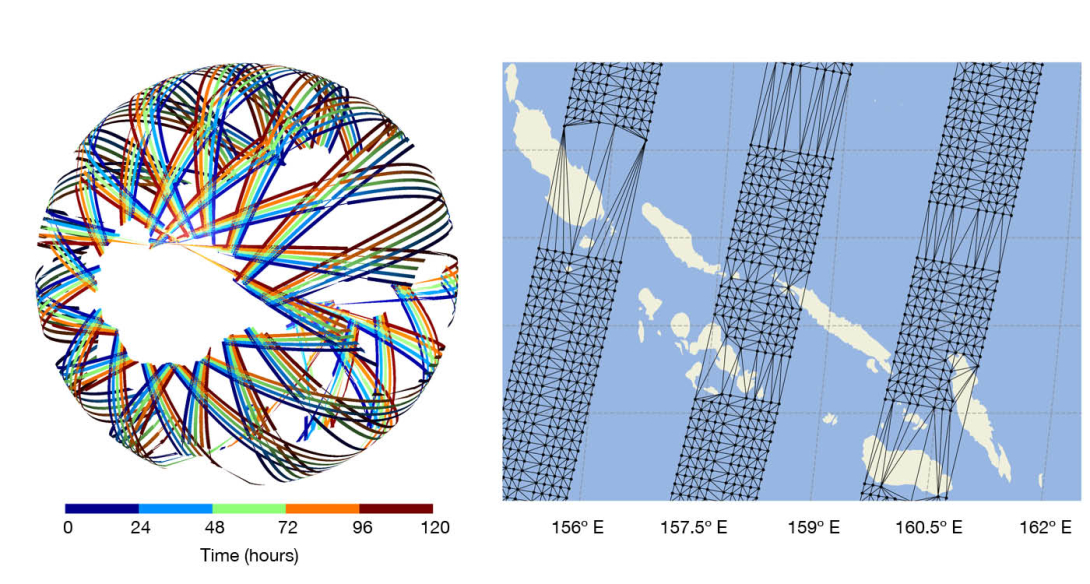
The project also continues the development of four-dimensional variational ocean data assimilation (4D-Var), improving both the scientific formulation and the computational efficiency needed for operational applications. In parallel, it is advancing the treatment of observations, including spatially correlated observation errors for altimeter and SST observations, as well as variational quality control for conventional data, and preparations for direct assimilation of Level 2 SST observations. Figure 2 illustrates part of this effort through the finite-element mesh used for correlated observation-error modelling with SWOT wide-swath altimeter data.
Taken together, these developments strengthen the foundations for the next generation of ECMWF ocean and coupled reanalyses. In practical terms, they help deliver improved ocean and sea-ice initial conditions, enhanced climate monitoring capability, and a more robust framework for further coupled Earth-system data assimilation developments.