

The European Union’s (EU) Copernicus Atmosphere Monitoring Service (CAMS), implemented by ECMWF, has delivered routine global and regional forecasts and analyses of atmospheric composition since 2014. Alongside this, CAMS delivers supplementary products such as emission inventories, policy support and solar radiation products.
As an operational service, CAMS focuses on turning mature scientific developments into operational capabilities in collaboration with European partner institutions through CAMS contracts.
To support more scientifically ambitious developments that can further strengthen CAMS and other Copernicus services, the EU launched Copernicus support calls under the Horizon Europe research programme. In addition to creating new research opportunities, these calls allow institutions outside the core CAMS contracts to help shape the future of Copernicus services.
One such initiative is the CAMEO (CAMS Evolution) project which ran from 2023 to 2025. Led by ECMWF, the project was designed to prepare CAMS for the use of new atmospheric composition satellite retrievals, improve data assimilation methods, and develop uncertainty information for a range of CAMS products that may have policy, health or industrial applications. Bringing together 23 partner institutions from 13 countries across Europe, many of which were already involved in CAMS, CAMEO is one of several Horizon Europe-funded projects led by ECMWF in recent years, including CERISE, CORSO and CATRINE.
Work packages 1 to 3 focused on data assimilation in the CAMS global and regional systems, while work packages 4 to 6 addressed uncertainty estimates for solar radiation products, emissions and policy support data.
Quantifying uncertainty
One major focus of CAMEO has been improving the way uncertainty is characterised across CAMS projects. Although users had identified uncertainty information as a priority, the most meaningful metrics and methods for deriving and verifying it were not always clear. Requirements vary depending on the application. For example, air pollution attribution studies focus on biases, while emission inversion relies on unbiased standard deviations. To address this, three dedicated workshops were held with users to discuss uncertainty products developed during CAMEO. These helped align scientific developments with user needs and improved the relevance of the resulting products.
Preparing for new observations
Several satellite instruments were launched in 2025 that will greatly enhance the observation capacity of atmospheric composition. The Sentinel-4 instrument aboard the geostationary Meteosat Third Generation (MTG-S) platform operated by EUMETSAT, allows, for first time, the observation of air quality over Europe at high temporal resolution during daytime. It will complete the geo-ring constellation of similar instruments over Asia (GEMS) and North America (TEMPO), which already provide geostationary air quality data.
The implementation of the capability to monitor and assimilate TEMPO and GEMS observations of tropospheric nitrogen dioxide and ozone columns was an important achievement of CAMEO. Operational monitoring of GEMS and TEMPO observations in CAMS paves the way for the use of Sentinel-4 data over Europe. The Multi Angular Polarimeter 3MI aboard the ESA and EUMETSAT MetOp-SG-A satellite promises to provide improved observations of aerosols, particularly aerosol components such as black carbon or mineral dust compared to current ultraviolet–visible (UV-VIS) instruments. In preparation, CAMEO used proxy 3MI data based on observations from the POLDER instrument. Further work focused on comparing and harmonising aerosol optical properties and size distributions used in aerosol retrievals and aerosol modelling, helping to reduce the impact of different assumptions during evaluation and data assimilation. While further development of observation operators will be required beyond CAMEO, offline versions were successfully developed.
The assimilation of radiance observations using ECMWF’s Integrated Forecasting System (IFS) 4D-Var has been a cornerstone of ECMWF’s success in weather forecasting. In CAMS, however, the IFS configuration applied has mainly assimilated atmospheric composition retrievals, such as aerosol optical depth or total column ozone. As part of CAMEO, the ability of the IFS to assimilate aerosol-impacted radiances (reflectance) over oceans has been technically finalised, allowing, for the first time, a thorough scientific and technical comparison of the two approaches.
The regional data assimilation work package brought together some partners involved in the CAMS regional multi-model ensemble system. In CAMS, regional data assimilation efforts have mainly focused on the assimilation of surface observations from the regulatory air quality networks. CAMEO provided the opportunity to advance the capability of the regional models to assimilate satellite retrievals from Sentinel-5P for sulphur dioxide (SO₂), carbon monoxide (CO) and formaldehyde (HCHO). Selected regional models were also prepared for Sentinel-4 retrievals of ammonia (NH₃) and nitrogen dioxide NO₂, as well as ozone- and carbon-monoxide-sensitive radiances from the Infrared Sounder (IRS).
Emission monitoring
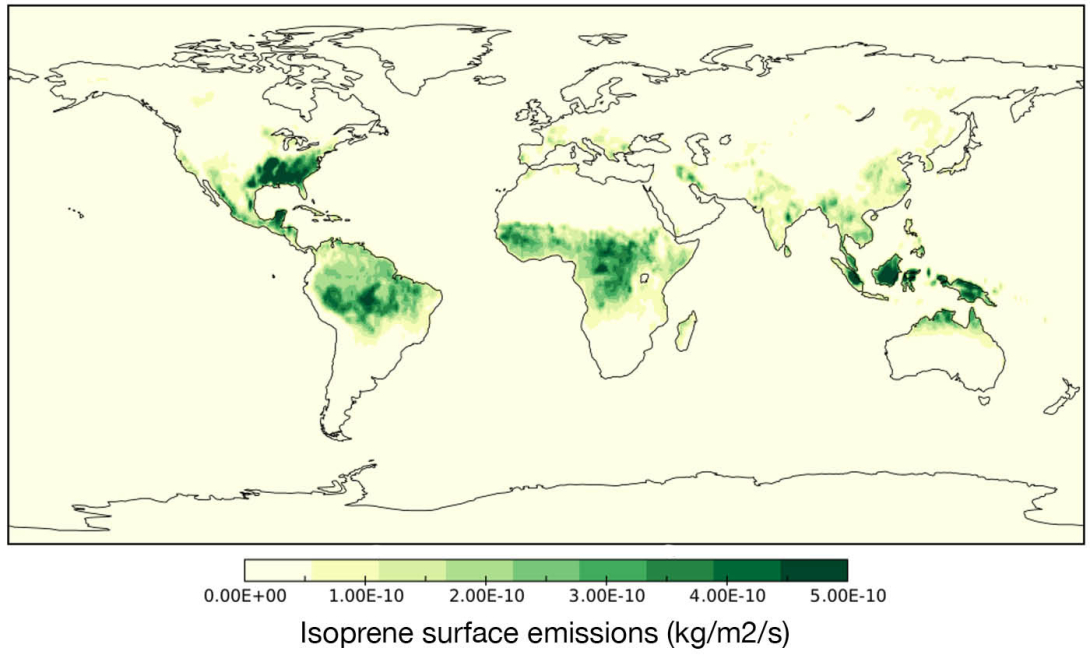
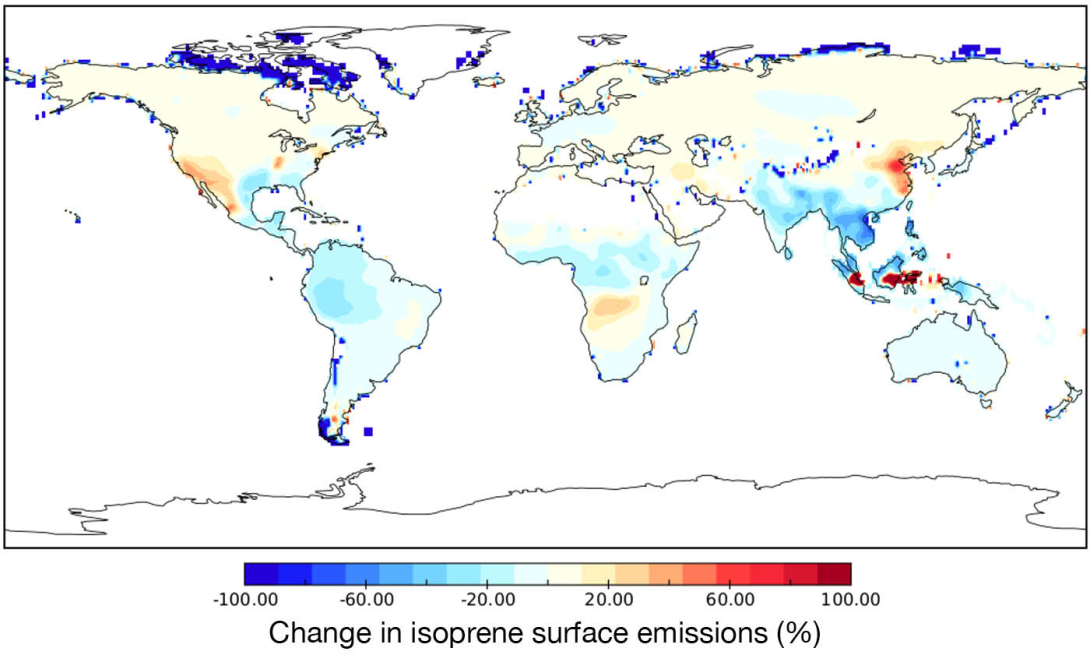
Developing a carbon dioxide (CO₂) and methane (CH₄) emissions monitoring and verification system (CO₂MVS) using the IFS is a major ongoing effort within CAMS. As a first step towards a quality-control framework for CAMS emission-inversion products, CAMEO compared CAMS nitrogen oxides (NOₓ) and CH₄ emission inversions with results from other inversion systems. The capacity to optimise emissions fluxes will also be used for reactive gases and aerosols. The project explored how biogenic emissions of isoprene can be constrained by satellite retrievals of formaldehyde, which is chemically coupled to isoprene (see Figure 1).
Delivering benefits for NWP
CAMS continues to benefit greatly from ongoing developments of data assimilation for numerical weather prediction (NWP) applications. CAMEO investigated the application of the weakly constrained 4D-Var, a method to better account for modelling errors in the assimilation, to ozone and water vapour. The work also enabled the activation of humidity assimilation in the stratosphere, which was introduced in the IFS Cycle 50r1 NWP suite. This outcome showcases how CAMEO also benefited ECMWF beyond direct applications in CAMS.
CAMEO partners shared progress and ideas through virtual and in-person General Assemblies, presented results at major conferences, and are now seeing many project outcomes move towards routine implementation in CAMS.
Many outcomes of the project are now progressing towards routine implementation within CAMS, further strengthening its ability to support air quality monitoring, climate applications and policy-relevant services.