

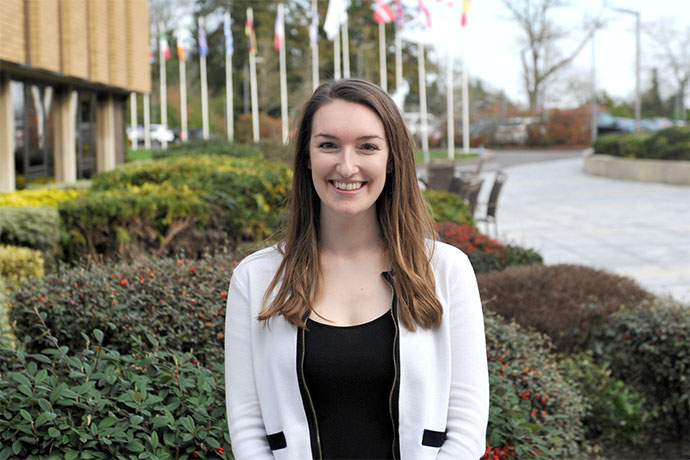
To mark International Women’s Day (8 March), we spoke to Meghan Plumridge, User Support Specialist for Machine Learning.
When Meghan joined ECMWF ten years ago, she wasn’t a computer scientist. She was a geologist with a love of the outdoors and a growing realisation that data was central to understanding the environment.
“If I’m honest, computing didn’t immediately appeal to me, but by the end of my degree it became clear that data is everything,” she says.
That curiosity led her to join ECMWF’s Data Services team straight from university on a temporary contract. “I remember hoping it would extend beyond the one year,” she laughs. This year, in 2026, she celebrates her ten-year anniversary.
Discovering machine learning through environmental data
Meghan began her career as an analyst in Data Services, initially drawn to ECMWF’s role in the Copernicus programme. The idea that satellite data could provide global visibility, freely available to users around the world, was fascinating.
“When I realised that ECMWF was involved in providing some of the operational services for Copernicus, I was really inspired.”
Working hands-on with environmental datasets sparked a new interest: machine learning. While continuing to work at ECMWF, Meghan pursued a master’s degree in environmental data science, followed by a PhD in computer science.
A systems perspective
Across three different roles at ECMWF, consistent themes have shaped Meghan’s career: user support, coordination of operational projects and service observability.
Today, as a User Support Specialist for Machine Learning in the Computing and Software Support team, she works at the intersection of users, data and infrastructure.
“We’re often the first point of contact,” she explains. “We see first-hand what users struggle with, what they need, and where services can improve. Then we translate that into structured service improvements.”
Her work supports users accessing ECMWF’s growing machine learning ecosystem. Services include ML software and data services, enhanced computing resources, and training assets.
That requires what she calls “systems thinking” – understanding how data pipelines, computing infrastructure, graphics processing units (GPUs), workflows and operational constraints fit together. “You need a genuine desire to understand how everything connects,” she says.
Her role has evolved alongside ECMWF’s machine learning services. What began as establishing baseline support has grown into shaping a coordinated support function as those services mature.
It’s a role that carries responsibility. ECMWF’s forecast data informs global decision-making, from extreme weather response to climate policy.
“It’s very important to strike a balance between innovation and reliability,” she says. “Especially with machine learning – we need to innovate, but we also need operational services that function reliably.”
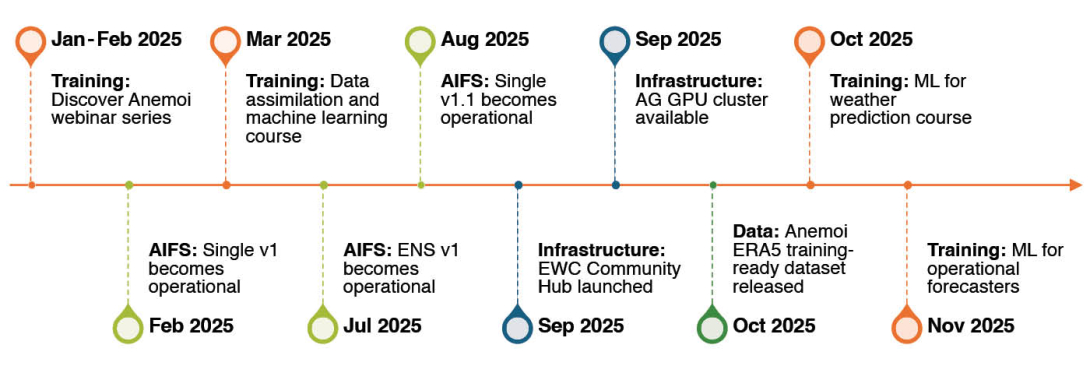
A snapshot of key machine learning developments at ECMWF in 2025. Read more in the ECMWF Newsletter article from the Winter 2025/26 edition.
Supporting transformation
One of Meghan’s proudest milestones was coordinating the migration of ECMWF’s operational dissemination service from Reading (UK) to the new ECMWF data centre in Bologna. She moved to Italy for four years to lead the transition and support users through the change.
“It was a big responsibility that came with many challenges, and an amazing opportunity,” she reflects.
More recently, she has found herself at the centre of another transformation: the integration of AI and machine learning into forecasting systems.
“It is such a privilege to work at ECMWF during this period of AI transformation,” she says. “Supporting users through the operational implementation of entirely new forecasting approaches makes every day different.”
Machine learning is not just about serving new models, she adds. It is increasingly shaping how data and computing services are designed and delivered.
“I’m particularly excited about embedding machine learning into the infrastructure of our operational services and expanding open, machine learning-ready datasets,” Meghan says. “As machine learning workloads become the norm across disciplines, having accessible, optimised data is increasingly essential.”
ECMWF is leading the way in this AI era. “It’s great to see more opportunities for collaboration and innovation through initiatives like the Machine Learning Pilot Project and Destination Earth,” Meghan says.
Mentoring and representation
Alongside her technical role, Meghan has invested time into the culture of ECMWF. She has served as Vice- Chair of the Staff Committee and helped initiate a book club, wellbeing network and hiking activities – small but meaningful ways to foster a sense of community.
She has also mentored participants in ECMWF’s Code for Earth innovation programme (formerly Summer of Weather Code), guiding teams as they develop innovative software tools in just a few months.
“It’s incredible what participants can create in such a short time,” she says. “Mentoring is rewarding and being mentored is equally valuable. At any stage of your career, that exchange of knowledge makes a difference.”
As we mark International Women’s Day, Meghan reflects on the importance of representation in technical fields.
“Representation shapes what you feel is possible,” she says. “Being mentored by another woman, for example, or by someone who understands your perspective, can build your confidence and encourage you to go for opportunities that might otherwise feel out of reach.”
Her own path has been anything but linear but Meghan notes that can also be a strength.
“A linear path isn’t essential,” she says. “Even if you are new to a field or project, your perspective is unique and valuable.”
Her advice to young women considering similar careers? Seek mentoring where you can and have courage.
“You’ll probably always feel some uncertainty,” she says. “But putting yourself forward for things that feel a bit scary often leads to the greatest growth.”
International Women's Day
For more information, visit the International Women's Day 2026 website.