

Fourteen teams from across Europe and Africa presented innovative solutions to real-world weather, climate and environmental challenges at the Code for Earth Final Day 2026, held at ECMWF's headquarters in Reading, UK, on 23 September.
The annual Code for Earth programme brings together early-career developers, researchers and data scientists with mentors from ECMWF and partner organisations to work on open-source projects addressing challenges in areas including weather forecasting, climate and environmental data, flooding and hydrology, air quality, wildfires, energy systems, Earth observation, artificial intelligence and software development.
During the celebratory Final Day event, teams presented their work and demonstrated how their projects could contribute to future environmental, atmospheric and climate data applications within ECMWF, partner organisations and the wider open-source community.
Athina Trakas, ECMWF Innovation Actions and Partnerships Specialist and lead of the Code for Earth Coordination Team, said: "The quality of the projects developed this year has been exceptional and has exceeded the expectations of our mentors in many cases. What makes Code for Earth so valuable is the vibrant community it creates, bringing together talented people from different backgrounds to work on challenges for the Earth sciences community and building lasting connections.
"The addition of the Africa stream has further strengthened the programme by broadening participation and supporting innovative solutions that respond to regional needs. It has been inspiring to see what the teams have achieved in just a few months."
Esperanza Cuartero, member of the Code for Earth Coordination team added: “It has been fantastic to see the enthusiasm and engagement of the participants throughout the Coding Phase and the Final Day. Their commitment has been a real highlight of this year’s edition.”
Supporting open-source innovation
Running since 2018, Code for Earth is organised by ECMWF with support from the European Union’s Copernicus Climate Change Service (C3S) and Copernicus Atmosphere Monitoring Service (CAMS), both implemented by ECMWF; the European Commission’s Destination Earth initiative, implemented by ECMWF, EUMETSAT and ESA under the leadership of DG Connect; and the EU’s Africa Regional Centres of Excellence Programme (ArcX), in line with the EU’s Global Gateway strategy.
The idea of the programme is to provide a sandbox environment in which participants can develop and test new ways of accessing, analysing, visualising, and communicating Earth system data, with the goal of addressing some of today’s most pressing environmental, atmospheric, and climate issues.
A new focus on Africa
This year’s edition introduced a dedicated Africa Stream, developed in collaboration with partners through ArcX. The new stream broadens the geographical reach of Code for Earth and supports projects addressing regionally relevant challenges in Africa, complementing ECMWF’s wider activities under ArcX and the Strengthening Early Warning in Africa (SEWA) initiative. Through these activities, ECMWF is helping to strengthen scientific capacity, foster innovation, and co-develop digital tools and climate services with African partners.
Partner organisations, not only those involved in the Africa Stream, play an important role in each edition. Working alongside ECMWF colleagues, these challenge partners help shape the programme through co-designing some of the challenges, providing mentoring support, and contributing specialist expertise. Each year, their contributions broaden the programme’s reach and relevance across climate, energy, artificial intelligence, and resilience-related applications.
The 2026 edition was strengthened through collaboration with three key challenge partners, including the European Network of Transmission System Operators for Electricity (ENTSO-E), which brought expertise on challenges facing the European power sector; AfriClimate AI, a pan-African initiative advancing the use of artificial intelligence for a climate-resilient Africa; and the ICPAC/IGAD Climate Prediction and Application Centre, the climate centre of the Intergovernmental Authority on Development supporting climate services and early warning systems across Eastern Africa. Both AfriClimate AI and ICPAC were the challenge partners for the new Africa Stream.
The 2026 projects
This year, 100 proposals were received, with 14 projects selected to progress to the four-month Coding Phase. During this phase, the teams worked closely with their mentoring teams from ECMWF and challenge partners to develop and refine their solutions as open-source projects.
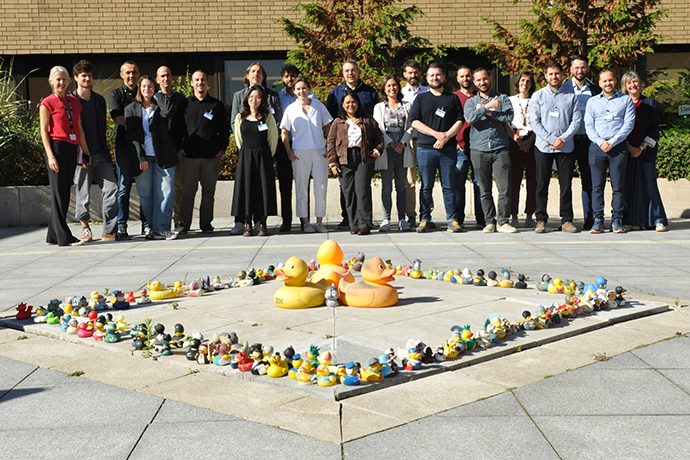
Code for Earth participants who attended the Final Day in Reading. Additional participants joined remotely.
Beyond the coding work and technical achievements, participants highlighted the real-world scenarios and the collaborative nature of the programme as one of its most valuable aspects. Working alongside mentors, challenge partners, and fellow participants from different backgrounds provided opportunities for learning, networking, and tackling real-world challenges.
Reflecting on her experience, Tarannum Tabassum (TriHydra) said: “What I found particularly valuable about Code for Earth is that it brings together people with very different backgrounds to work on problems that might otherwise not be addressed. Experienced researchers can identify challenges, and then people from industry, academia or other backgrounds can bring different perspectives and approaches to solving them. It brings together a versatile group of people who can contribute in many different ways.”
Ilias Machairas and Konstantinos Fokeas (GeoBridge) added: “Contributing to a project from ECMWF was really fulfilling for us because we were able to work on something that could have a real impact. We wanted to contribute to solutions that support communities affected by extreme climate events.”
The participants brought a wide range of experiences and perspectives to the 2026 edition, reflected in the diversity of projects they developed. The 14 selected projects were:
- Tabula Caloris – A web visualisation tool for fire products. Team: Jean-Baptiste Filippi, Ronan Paugam.
- PowerClimate Vision – Interactive Dashboard for Pan-European Climate-Energy Projections. Team: Alexandru Dumitrescu, Vlad Amihaesei.
- Project Atlantis - A Scalable STAC/Zarr Pipeline for ML-Ready Multi-Source Flood Inundation Observations. Team: Stylianos Lagaras, Ioannis Kalfas.
- AIr-wise - AI-Based Uncertainty-Aware Air Quality Assessment. Team: Judongyang Zhou, Linfeng Li.
- TriHydrA – A Three-Layer Verification Framework for Streamflow Anomaly Detection. Team: Tarannum Tabassum.
- CausaLCEI – A Regime-Conditioned Causal Compound Event Index for Energy System Stress. Team: Irene Schicker, Sebastian Lehner, Annemarie Lexer.
- Weather to Grid – Subseasonal Energy Forecasting using ML. Team: Quentin Nicolas, Emma Scharfmann, Nora Zilibotti, Vishnupriya Selvakumar.
- VAE Toolbox – Making recently published deep learning methods for identifying targeted teleconnections usable to the scientific community. Team: Antonia Bahr, Alexander Hempel.
- GeoBridge – Toolkit integrating Copernicus Data Stores with GIS platforms. Team: Ilias Machairas, Konstantinos Fokeas.
- CLAM – A Reproducible WRF/WPS Template for Local Area NWP on the European Weather Cloud. Team: Iliija Jovicic.
- AtmoLens – An automated, end-to-end Python pipeline for detecting significant air-quality events. Team: Debjit Majumder.
The projects selected under the Africa Stream were:
- Mvula – Compressing ECMWF’s AIFS for Edge Deployment. Team: Chimwemwe Chanda, Mthetho Sovara, Samuel Mathekga, Gabriel Elim, Fima Sichone.
- GIK-IceChain – Zero-Cost Cloud-Native Pipeline for Retrospective Flood Risk Decision Support in East Africa. Team: Donald Feudjio, KEMEKOUM Dylan, Vincess DONGMO, Njie Kemi Steve.
- MUST – Cloud-native flood risk decision-support toolkit for East Africa. Team: Brian Koome, Betty Linda Adongo, Lester Kiluma, Mark Ochieng, Allan Oware, Christine Maswi, Lekeni Shukare, Mikael Ashorn.
The innovative outcomes will be available on GitHub soon and may be incorporated into operational systems, providing opportunities for further development and use by ECMWF, partner organisations and the wider open-source community.
Recordings of the presentations will also be published online shortly.
Code for Earth 2027
Applications for Code for Earth 2027 are expected to open in February 2027, providing a new cohort of participants with the opportunity to create innovative solutions to challenges across weather, climate and Earth system science.