

ECMWF’s work is closely connected to a wide network of stakeholders across Europe and beyond.
National meteorological and hydrological services, research institutions, universities, European agencies, policymakers, industry partners and users all play an important role in developing, applying and shaping the services and technologies that ECMWF helps deliver.
In June and early July, a series of major events brought many of these communities together.
Across these events, the importance of collaboration in advancing weather and climate services was highlighted.
They also provided opportunities for ECMWF and its partners to listen to users and stakeholders across Europe, understand evolving needs and ensure that scientific and technological developments translate into services that are useful, accessible and relevant to the communities they are intended to support.
- Using ECMWF's Forecasts Event (UEF2026)
-
The Using ECMWF’s Forecasts (UEF) forum took place in Reading, UK from 1 to 4 June 2026, bringing together users of ECMWF forecast products to share experiences, feedback, and discuss applications of forecast data.
This year’s theme, Extreme Temperature Forecasts, focused on temperature forecasting with particular emphasis on extreme hot (heatwave) and cold (cold wave) events.
More than 170 external attendees registered from around the world to join in person and online.
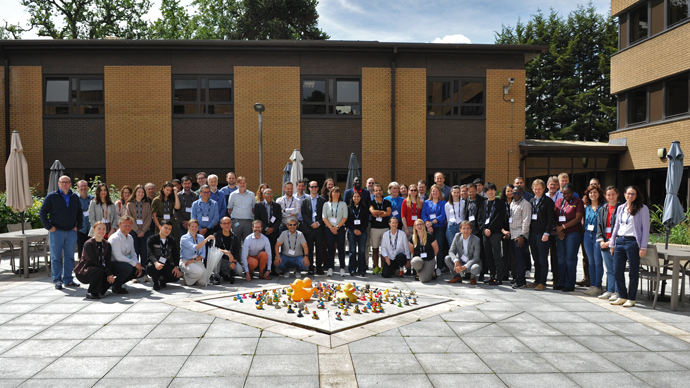
In person attendees at UEF2026.
Alongside the main presentations, the event featured interactive sessions designed to encourage discussion and hands-on engagement. A highlight was the half-day “Weather Stations” activity, where attendees rotated between themed stations, to explore and discuss different ECMWF topics in an informal setting.
Participants also took part in a live demonstration of applications developed by ECMWF and the Copernicus Climate Change Service (C3S). Attendees were encouraged to explore the applications on their own devices and follow the demonstrations in real time, creating an engaging and interactive experience.
A regular feature of UEF is the User Voice Corner, which offers attendees the opportunity to speak directly with ECMWF staff, share their views on products and services, discuss future priorities, and provide valuable feedback.
Becky Hemingway, ECMWF Liaison and Outreach Team Leader and lead organiser of UEF2026, said: "It was fantastic to welcome such a diverse group of users to ECMWF and to see so much engagement throughout the week. Hearing directly from those who rely on our forecasts helps us better understand how our products are used in practice and informs the continued development of services that support decision-making across the globe."
Recordings and presentation slides are now available on the UEF2026 web page.
- The 9th Copernicus Climate Change Service (C3S) General Assembly
-
From 3 to 5 June 2026, ECMWF, in collaboration with HungaroMet, held the the 9th Copernicus Climate Change Service (C3S) General Assembly in Budapest, Hungary.
The C3S General Assembly brought together C3S users, service providers, EU institutions and agencies, national stakeholders, and ECMWF partner organisations to exchange knowledge, build new connections, and help define priority actions for the next generation of climate services.
The event welcomed over 200 participants onsite, with a peak of 350 participants joining online, reflecting strong engagement across the community.
The programme featured plenary and poster sessions, side meetings, and dedicated networking opportunities, alongside interactive discussions focused on three overarching themes: authoritative climate knowledge across past, present and future; enabling use through methods, tools and capacity; and translating climate information into decisions and impact.
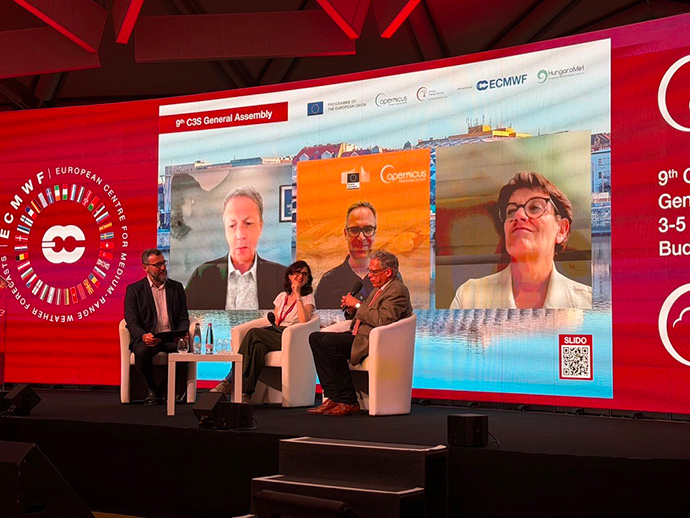
Panel discussion at the C3S General Assembly.
Training and interactive sessions supported a user-centric and outcome-driven approach, enabling participants to reflect on ongoing developments, address emerging challenges and identify new opportunities for C3S. Discussions highlighted the growing importance of usability, co-production and decision support, as climate services continue to evolve from providing data towards delivering actionable climate intelligence.
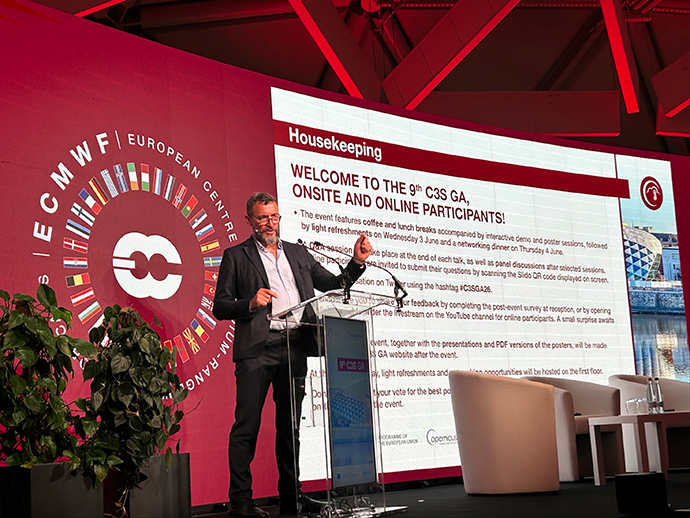
Carlo Buontempo, Director of C3S welcoming participants.
Carlo Buontempo, Director of C3S, said: “The General Assembly is an opportunity for us to take stock of what we have achieved together and shape the future direction of C3S. As we look towards the next phase of the service, engagement with our users and partners is more important than ever. The discussions at the General Assembly help us understand evolving needs, identify new opportunities, and ensure that C3S remains user-driven, impactful and capable of supporting decision-making across sectors and timescales."
The event recordings are now available on the 9th C3S GA event webpage.
- The Fifth Destination Earth User eXchange
-
The fifth Destination Earth (DestinE) User eXchange took place from 9 to 10 June 2026 in Brussels and online, bringing together 350 participants onsite and a further 300 online from across the growing community of users and partners involved in the European Commission’s DestinE initiative.
Hosted by ECMWF and co-organised with the European Space Agency (ESA), and the European Organisation for the Exploitation of Meteorological Satellites (EUMETSAT), in collaboration with the Royal Meteorological Institute of Belgium (RMI), the hybrid event highlighted the initiative’s latest developments.
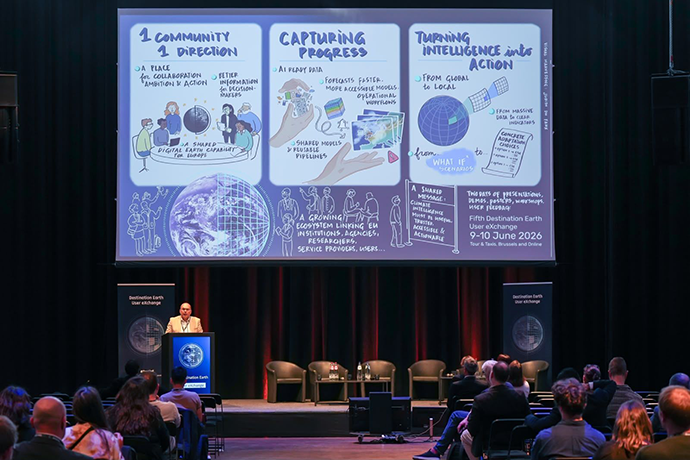
DestinE User eXchange 2026.
The programme showcased key achievements and updates, including progress on the DestinE Digital Twins, the Digital Twin Engine, and advances in artificial intelligence for Earth system modelling.
Training sessions provided participants with hands-on experience of the DestinE platform, supporting users in exploring its applications and capabilities. Sessions covered topics such as working with DestinE edge services, applying DEFAIR (Destination Earth Framework for Preparing AI Ready Data) principles and tools, accessing and exploiting Climate Digital Twin data, co-designing services, and improving interactivity and interoperability with digital twins.
The event also featured a keynote speech from Maarten van Aalst, Director General and Chief Science Officer of the Royal Netherlands Meteorological Institute (KNMI) who reflected on the value and innovation of DestinE and its role in enhancing weather and climate resilience and preparedness.
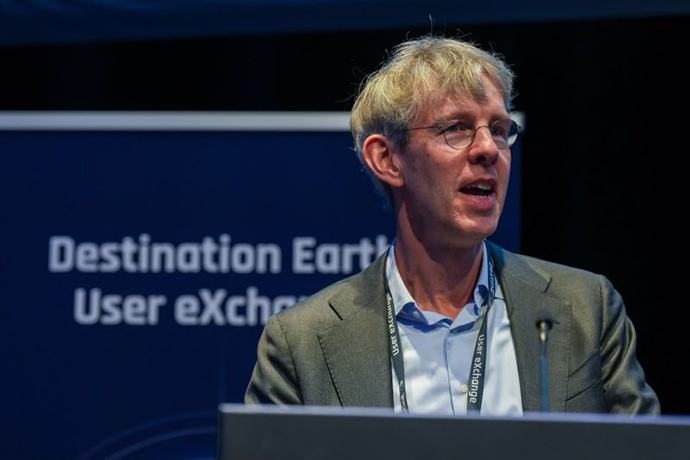
Maarten van Aalst delivering a keynote speech.
Florian Pappenberger, Director-General of ECMWF, said: "The User eXchange showed the strength and diversity of the community working to make DestinE a reality. Bringing users, partners and technical experts together is essential as we move into the next phase, helping ensure that the capabilities being developed can be translated into practical benefits through existing national and European services."
Stefan Siemen, Project Lead for Destination Earth at ECMWF, said: “The User eXchange is the central engagement event for DestinE. It was great to see how the event brought users and partners together from across Europe for fruitful exchanges and discussions. DestinE has shown again its great potential on how it can support climate resilience at a policy level and complement the existing work and initiatives of the European National Meteorological Services.”
DestinE is jointly implemented by ECMWF, ESA, and EUMETSAT, under the leadership of DG CONNECT.
The event came shortly before the launch of Phase three in which ECMWF and its partners will focus on operating and further evolving the Climate and Extremes Digital Twins and the Digital Twin Engine. Work will also focus on advancing the AI models and solutions developed in Phase two, and on transforming digital twin data into high-quality AI-ready datasets that can feed into Europe’s AI Factories.
- The 16th Meeting of the International Cooperative for Aerosol Prediction (ICAP)
-
Organised by the Copernicus Atmosphere Monitoring Service, the 16th Meeting of the International Cooperative for Aerosol Prediction (ICAP) took place in Bonn, Germany from 10 to 12 June 2026, and gathered around 50 participants from aerosol forecasting centres and aerosol observation providers.
The ICAP meetings provide an opportunity to share and present the latest perspectives on global aerosol modelling and observations, including new satellite instruments, science, and methodologies.
A key focus was the growing range of new observing capabilities, including instruments that provide more detailed information on aerosol properties and vertical profiles. Participants also discussed how these new observations can be incorporated into operational forecasting systems, alongside developments in artificial intelligence, data assimilation and modelling.
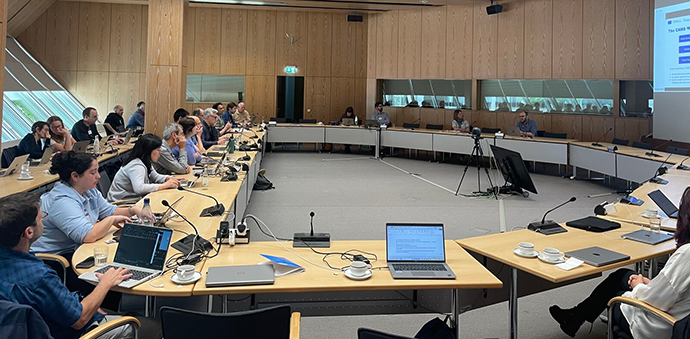
The 16th ICAP meeting.
“Like every year, the ICAP meeting has proven a substantial tool to advance aerosol prediction and observation, share the best practices and explore the new opportunities opened by emerging instruments. It is an exciting time for our community,” said Melanie Ades, Data Assimilation specialist at ECMWF, who co-organised the meeting in Bonn.
“It’s a great honour and responsibility to host and organise an ICAP meeting. But the event was a success, the discussions were incredibly productive and dynamic, and hopefully the meeting in Bonn will be very useful across all the centres to advance in the integration of new data and observations,” said Enza Di Tomaso, Scientist in ECMWF's Research Department, also a co-organiser.
The meeting highlighted the rapid advances taking place across aerosol forecasting and observation, and the importance of continued international collaboration in making the most of new observing systems and emerging technologies.
Read more about the 16th ICAP meeting on the CAMS website.
- 2026 AR Recon workshop and 2nd Observational campaigns workshop for better weather forecasts
-
Two closely linked workshops brought together experts involved in Atmospheric River Reconnaissance (AR Recon) and observational campaigns at ECMWF in Reading, UK, from 29 June to 3 July 2026.
The AR Recon Workshop, held on 29 and 30 June, was jointly organised by ECMWF, NOAA and the Center for Western Weather and Water Extremes (CW3E). Around 90 researchers and operational experts from meteorological services, research institutions and universities came together to share the latest scientific findings and operational developments from the 2026 AR Recon season.
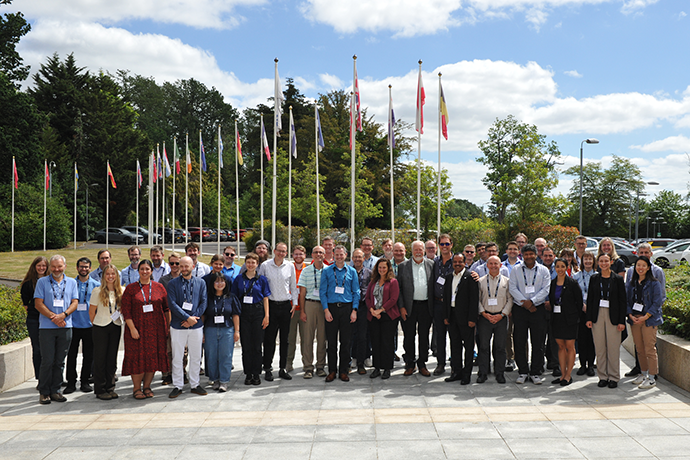
AR Recon workshop participants.
David Lavers, Scientist in the Forecasts and Services Department and workshop organiser said: “It was a real pleasure to welcome our friends and colleagues to ECMWF to share and discuss the latest AR Recon results. The observations gathered by AR Recon are helping to fill in gaps in the Global Observing System (GOS), leading to more skilful weather forecasts and improved process understanding.”
This event was followed by the 2nd Observational Campaigns Workshop for Better Weather Forecasts, held from 1 to 3 July. The workshop initially focused on northern hemisphere observational campaigns conducted during January and February 2026, following discussions initiated by the World Meteorological Organization (WMO) World Weather Research Programme, but also had a strong participation from Arctic campaigns. The workshop explored how observations from these campaigns can contribute to improved weather forecasts and future forecast system development. There were also presentations and discussions on historic campaigns, including those during THORPEX.
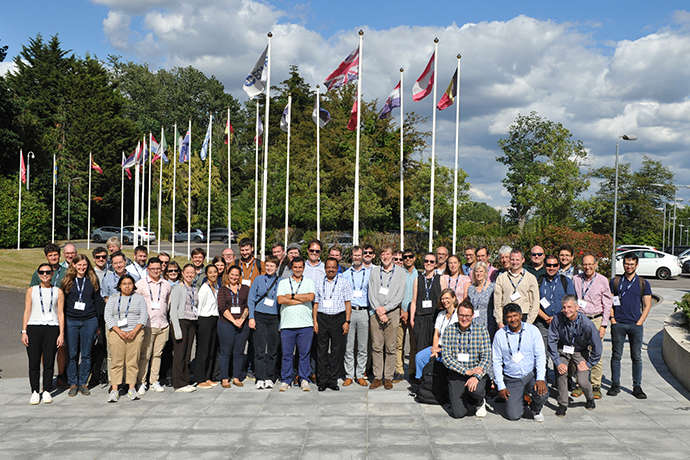
Participants at the 2nd Observational Campaigns Workshop for Better Weather Forecasts.
Through presentations and discussion sessions, participants considered the lessons learned from past campaigns, how campaign observations have contributed to advances in forecasting systems, and how to strengthen links between observational campaigns and the wider forecasting community. Discussions also looked at remaining observational gaps and how campaign data could support the development and training of machine-learning models.
Linus Magnusson, Senior Scientist in the Forecasts and Services Department and workshop organiser said: “The workshop was a great success and talks were of very high quality. It is amazing to see all the work that goes into the campaigns. It was a fruitful week to connect the modelling and observation communities.”
Presentations, recordings and posters are available on the workshop web page.
- 22nd International Workshop on Greenhouse Gas Measurements from Space (IWGGMS-22)
-
The 22nd International Workshop on Greenhouse Gas Measurements from Space (IWGGMS-22) took place in Bonn, Germany, from 29 June to 2 July 2026.
Hosted by ECMWF in collaboration with the German Aerospace Center (DLR), the workshop brought together more than 280 scientists, researchers and experts from around the world, both in person and online.
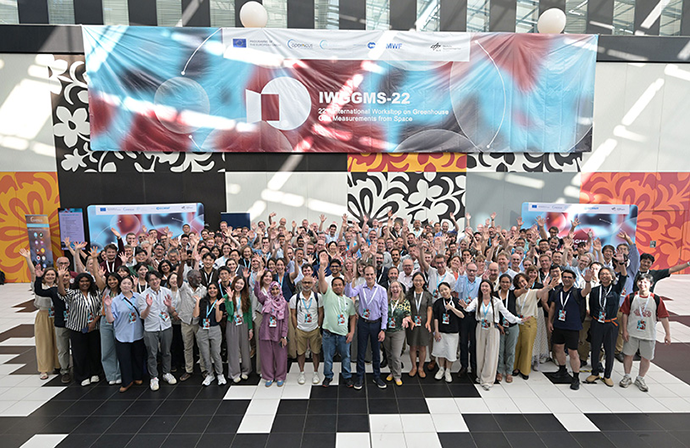
Participants at IWGGMS-22.
The workshop provided a forum for the international greenhouse gas community to discuss satellite monitoring of greenhouse gases, atmospheric modelling, data assimilation and emissions monitoring, while strengthening collaboration across the scientific and operational communities.
The programme covered the status and future plans of greenhouse gas satellite missions, retrieval algorithms and products, calibration and validation, and methods for estimating greenhouse gas fluxes through atmospheric inversion. Sessions also explored regional and urban emissions, the detection of emission hotspots, and the needs of stakeholders using greenhouse gas observations and related products.
The strong international participation made IWGGMS-22 one of the best-attended editions of the workshop in recent years, reflecting the growing importance of greenhouse gas monitoring and the value of international collaboration in advancing the science.
The workshop also highlighted ECMWF’s continued contributions to the international greenhouse gas community, including through the Copernicus Atmosphere Monitoring Service (CAMS).
Richard Engelen, CAMS Deputy Director and workshop organiser, said: “It was a pleasure to welcome such a strong international community to IWGGMS-22 in Bonn. The high level of presentations and the many engaging discussions during the breaks and poster sessions demonstrated the importance of international collaboration as we work to improve our understanding and monitoring of greenhouse gas emissions."
Read more about IWGGMS-22 on the CAMS website.
See our events calendar for upcoming workshops and meetings.