

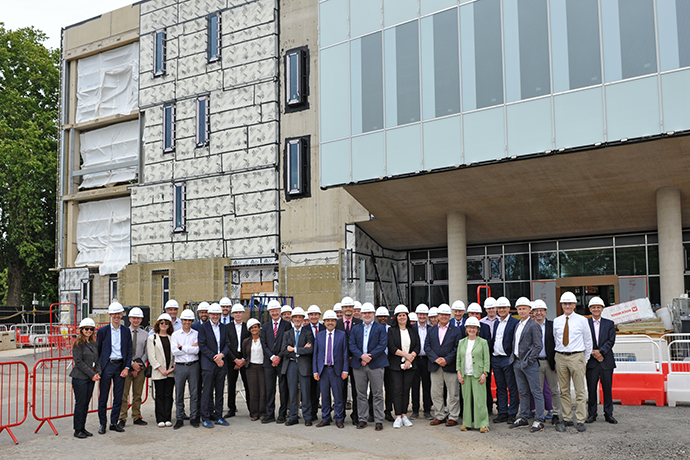
ECMWF Council members at the site of ECMWF’s new headquarters on the University of Reading campus
The ECMWF Council met in Reading on 16 June 2026 to review recent developments across the Centre’s activities.
A central theme was the strengthened collaboration between ECMWF and its Member and Co-operating States to ensure that services meet the evolving needs of national meteorological and hydrological services and the wider European meteorological community.
Advancing forecasting and Earth system capabilities
The discussions highlighted how advances in numerical weather prediction, AI, observations, computing and data are increasingly interconnected, and how they support improvements in the weather, environmental and climate services delivered by ECMWF.
New leadership appointments
The Council welcomed the appointment of two new Deputy Director-Generals: Jørn Kristiansen as Deputy Director-General and Director of Forecasts, and Irina Sandu as Deputy Director-General and Director of Science and Innovation. Both will play a central role in shaping ECMWF’s future scientific and operational priorities and in strengthening collaboration with Member and Co-operating states.
Strengthening collaboration with Member States
The Council also discussed ways to make collaboration with national meteorological and hydrological services more practical and more closely aligned with operational needs. The Machine Learning Project exemplifies this approach: through Anemoi, ECMWF and participating national meteorological services are co-developing a shared machine-learning framework for weather prediction, supporting wider reuse across the European meteorological community and beyond.
Latvia, Morocco and Slovenia are the latest countries joining the project, bringing the number of participating services to 17.
Investing in future capability
High-performance computing is of strategic importance to ECMWF, enabling advances in Earth system monitoring and prediction, the management and processing of huge volumes of data, and AI. The Council discussed the computing capability that ECMWF will need in the coming years, as well as the risks to the meteorological community and to Europe of failing to reach the capacity needed for the Centre to remain a world leader.
Working with European and international partners
ECMWF’s activities also depend on strong links with European and international partners, including the World Meteorological Organization (WMO), the European Organisation for the Exploitation of Meteorological Satellites (EUMETSAT), and the European Meteorological Network (EUMETNET). The Council reviewed the many activities supporting a more connected meteorological infrastructure – from observations and data exchange to common standards, operational coordination and the wider use of weather and climate information.
The Council also discussed progress towards a European meteorological data space: a trusted framework that makes it easier for users across Europe to find, access, and use weather and climate data, while allowing data providers to retain control of their own data. This work aims to reduce fragmentation, support common standards and enable wider use of weather and climate information across sectors.
New facilities in Reading
Members of the Council visited the site of ECMWF’s new headquarters on the University of Reading campus. The new building, expected to be ready in 2027, will provide a modern, accessible and sustainable working environment for staff and support closer collaboration with nearby institutions and partners.
ECMWF gratefully acknowledges the support of the United Kingdom, through the Department for Science, Innovation and Technology, in providing and funding these facilities.
Together, these developments support ECMWF’s mission to deliver trusted weather, environmental and climate services for and with its Member and Co-operating States.