

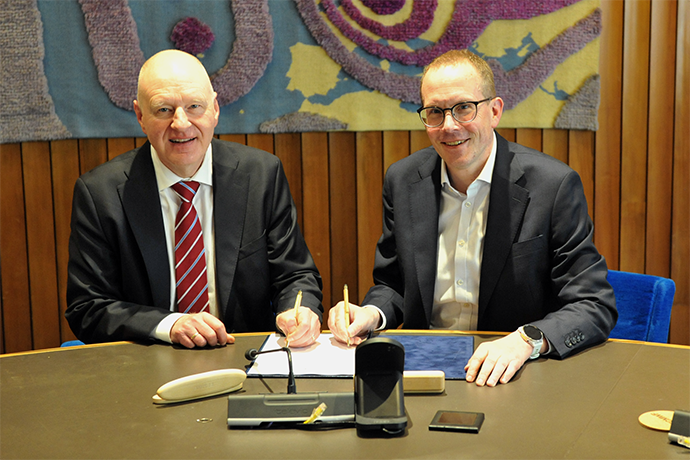
Roar Skålin and Florian Pappenberger sign an amendment to the grant agreement for the Machine Learning Project (MLP)
ECMWF Director-General Florian Pappenberger and Director-General of MET Norway Roar Skålin have signed an amendment to the grant agreement for the Machine Learning Project (MLP).
Launched in 2024, the MLP is a collaborative initiative between ECMWF and partners from across its Member and Co-operating States, which is led by MET Norway and MeteoSwiss. The project falls under the umbrella of the EUMETNET Artificial Intelligence and Machine Learning for Weather, Climate and Environmental Applications (E-AI) programme and aims to advance the use of machine learning (ML) in numerical weather prediction.
With the amendment to the MLP grant agreement, three additional national meteorological services are joining the project:
- Latvian Environment, Geology and Meteorology Centre (LEGMC), from 1 January 2026
- Morocco’s General Directorate of Meteorology (DMN), from 1 January 2026
- Environmental Agency of Slovenia (ARSO), from 1 January 2027
Florian Pappenberger, Director-General of ECMWF, commented: “I am delighted to welcome Latvia, Slovenia and Morocco to the Machine Learning Project. Through this initiative, ECMWF is actively investing in collaborative machine learning developments across our Member and Co-operating States – bringing together expertise and resources to accelerate innovation and ensure that advances in ML are translated rapidly into operational forecasting.”
Roar Skålin, President of the ECMWF Council and Director General of MET Norway, added: “It is very encouraging to see the Machine Learning Project continue to grow. Seventeen national meteorological services now participate in the project, and its strength lies in its collaborative approach. Rather than developing ML capabilities independently, we are joining up our expertise to advance collectively and accelerating development in the process. This is exactly why ECMWF was created in the first place – to enable us to bring resources together to drive the science behind our forecasts and make it operational in a swift and effective way.”
Fostering collaboration
The MLP fosters collaboration across key areas, namely data-driven forecasting, ensemble forecasting, data assimilation and machine learning operations (MLOps). It supports the development and evaluation of ML-based models, their integration into operational workflows, and improved readiness through robust infrastructure and evaluation.
National meteorological services participating in the MLP receive funding from ECMWF to accelerate research, training and implementation in these areas.
Fourteen national meteorological services already participate in the MLP:
- the Spanish State Meteorological Agency (AEMET)
- the Danish Meteorological Institute (DMI)
- the German National Meteorological Service (DWD)
- the Finnish Meteorological Institute (FMI)
- GeoSphere Austria
- the Italian Meteorological Service (ITAF)
- the Royal Netherlands Meteorological Institute (KNMI)
- the Irish Meteorological Service (Met Éireann)
- Météo-France
- MeteoSwiss
- Met Norway
- Belgium’s Royal Meteorological Institute (RMI)
- the Swedish Meteorological and Hydrological Institute (SMHI)
- UK Met Office
The addition of Latvia, Slovenia and Morocco to the Machine Learning Project marks a further step in strengthening international collaboration on AI for weather forecasting.