


ECMWF and its partners have received two awards in the 2026 HPCwire Readers’ and Editors’ Choice Awards: Best Use of HPCAI in Physical Sciences and Best Use of HPCAI in Response to Societal Plight. The awards recognise work to advance AI-based weather forecasting models and develop portable forecasting workflows.
The awards were announced on 16 November at SC26, the international conference for high-performance computing, networking, storage and analysis, held in Chicago, United States.
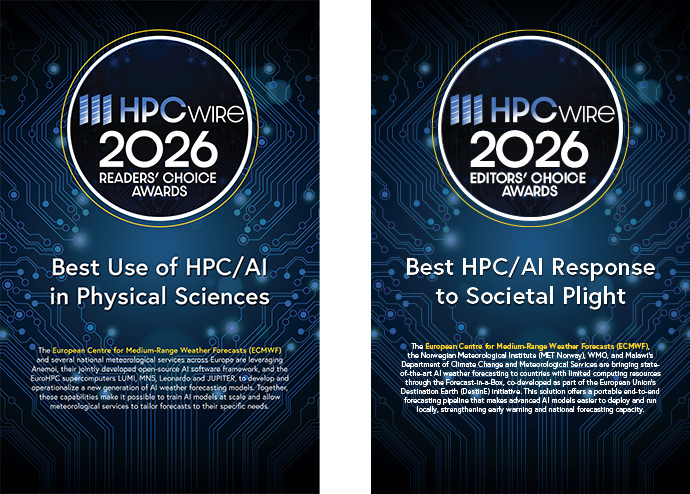
The 2026 awards
Best Use of HPCAI in Physical Sciences
The European Centre for Medium-Range Weather Forecasts (ECMWF) and several national meteorological services across Europe are leveraging Anemoi, their jointly developed open-source AI software framework, and the EuroHPC supercomputers LUMI, MN5, Leonardo and JUPITER, to develop and operationalize a new generation of AI weather forecasting models. Together, these capabilities make it possible to train AI models at scale and allow meteorological services to tailor forecasts to their specific needs.
Best Use of HPCAI in Response to Societal Plight
The European Centre for Medium-Range Weather Forecasts (ECMWF), the Norwegian Meteorological Institute (MET Norway), WMO, and Malawi’s Department of Climate Change and Meteorological Services are bringing state-of-the-art AI weather forecasting to countries with limited computing resources through the Forecast-in-a-Box, co-developed as part of the European Union’s Destination Earth (DestinE) initiative. This solution offers a portable end-to-end forecasting pipeline that makes advanced AI models easier to deploy and run locally, strengthening early warning and national forecasting capacity.
A new recognition for Anemoi
The award for Best Use of HPCAI in Physical Sciences recognises work by ECMWF and national meteorological services across Europe to develop and operationalise a new generation of AI weather forecasting models.
At the heart of this collaboration is Anemoi, a Python-based, open-source framework jointly developed by ECMWF and European national meteorological services. The Anemoi ecosystem covers the full life cycle of data-driven modelling, with each component addressing a crucial aspect of the AI weather forecasting pipeline, from creating training datasets to training models and using them for forecasting.
Leveraging EuroHPC supercomputers LUMI, MareNostrum 5, Leonardo and JUPITER, and the Anemoi framework national meteorological services can develop and tailor AI-based forecasting systems to their own requirements. Indeed, Anemoi underpins the development of ECMWF’s Artificial Intelligence Forecasting System (AIFS), as well as other European AI weather forecasting models, including MET Norway’s Bris regional model and the German National Meteorological Service (DWD)’s AICON global model. It also supports the development of an AI Earth-system model within the European Commission funded flagship initiative, Destination Earth (DestinE).
The Anemoi collaboration brings together ECMWF and national meteorological services from across Europe: the Spanish State Meteorological Agency (AEMET), the Danish Meteorological Institute (DMI), the German National Meteorological Service (DWD), the Finnish Meteorological Institute (FMI), GeoSphere Austria, the Royal Netherlands Meteorological Institute (KNMI), Météo-France, MeteoSwiss, MET Norway, Belgium’s Royal Meteorological Institute (RMI), the Swedish Meteorological and Hydrological Institute (SMHI) and the UK Met Office.
Recognising the Forecast-in-a-Box
The second award, Best Use of HPCAI in Response to Societal Plight, recognizes Forecast-in-a-Box, which builds modular AI-based forecasting workflows by combining ECMWF and Member States’ open-source software and AI models, including Anemoi, earthkit, AIFS and MET Norway’s Bris.
These workflows cover the key stages of the forecasting process, from data inputs drawn from ECMWF’s analyses to AI model execution, post-processing and visualization. They can be containerised to be portable across computing environments, from high-performance computing facilities to local systems and cloud infrastructure. This approach can help meteorological services with limited computing resources adapt AI-based forecasting tools to their needs, strengthening national forecasting capabilities and supporting early warning initiatives.
Within Destination Earth, ECMWF is using global AI-based models to illustrate how these components can be combined into portable pipelines covering the full forecasting production chain. In parallel, a WMO-endorsed pilot project MET Norway, Malawi’s Department of Climate Change and Meteorological Services and ECMWF explore how these workflows can support forecasting in Malawi. The pilot deploys MET Norway’s regional AI model, Bris, over Malawi, combining open-source forecasting tools with local operational expertise and requirements.
The deployment of Bris over Malawi has enabled the exploration of how an AI model trained over one region performs in a very different geographical setting. This work helps assess how transferable the approach is and provides a starting point for training with local data.
Irina Sandu, Director of Science and Innovation at ECMWF said: “Receiving this recognition for the third year running is incredible and demonstrates the power of collaboration across Europe and beyond. By bringing together scientific expertise, shared computing resources and a commitment to open innovation, we can achieve far more than any organisation could alone. Together with our Member and Co-operating States and partners across the world, we are turning advances in AI and supercomputing into weather forecasting capabilities that can benefit communities worldwide.”
Roar Skålin, Director General of MET Norway “This is a good demonstration of how AI innovation can be turned into something practical, putting advanced AI-based weather forecasting directly in the hands of meteorological services. It shows how shared efforts can make these tools available where they are most needed.”
Dr Lucy Mtilatila, Director and Permanent Representative with WMO for the Malawi Met Service “Addressing the global climate emergency requires unprecedented innovation. This prestigious award reflects the strength of multilateral cooperation and effective partnerships, demonstrating the strength in shared technological advancements for the global good.”
Both awards highlight the value of sharing expertise, infrastructure and open technologies across national meteorological services, research institutions, supercomputing centres and international organisations. These partnerships connect advances in AI and high-performance computing with practical forecasting needs in Europe and beyond.
Destination Earth provides a wider setting for this collaboration. ECMWF implements the European Union initiative together with ESA and EUMETSAT, under the lead of the European Commission’s DG CONNECT and in close collaboration with the EuroHPC Joint Undertaking. Working with national meteorological services, supercomputing centres, academic and industrial partners, the initiative develops physics- and AI-based Earth-system modelling to support understanding and action on climate change and extreme events.
Roberto Viola, Director-General, DG CONNECT of the European Commission said "Destination Earth is a flagship initiative of the European Union, demonstrating how world-class supercomputing and artificial intelligence can directly serve society. By building ultra-high-resolution digital twins and AI models of the Earth System on the EuroHPC infrastructure, we are providing decision-makers and scientists with powerful capabilities to anticipate climate risks and shape effective adaptation strategies."
Ioan Hadade, Team Lead for HPC Applications at ECMWF, who collected the award, said: “To be recognised with an HPCwire Award for the third consecutive year is an extraordinary honour, reflecting the dedicated work of many partners and individuals, as well as the power of collaboration to advance AI-driven weather and climate knowledge. It underscores the sustained momentum of what we are building together to redefine high-performance computing for global weather and climate science.”
The annual HPCwire Readers’ and Editors’ Choice Awards recognise organisations, individuals and technologies across the global high-performance computing community. Winners are selected through nominations and voting by the HPCwire community alongside selections by HPCwire’s editors.
Further reading:
Find out more about the HPCwire awards received in 2024 and 2025 in the articles below.
DestinE awarded twice at HPCwire Reader's Choice Awards 2024
European collaboration on AI for weather and climate wins HPCwire award