

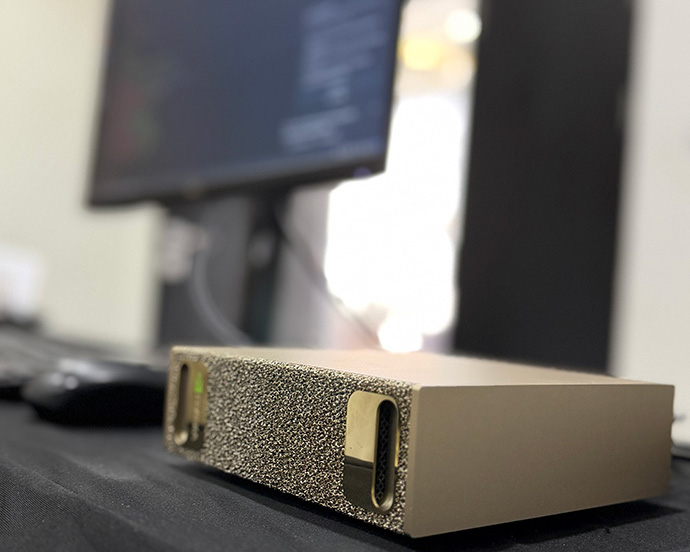
A portable system that enables AI-based weather forecasts to be run on desktop-like machines is being piloted as part of a collaboration between the European Centre for Medium-Range Weather Forecasts (ECMWF), the Norwegian Meteorological Institute (MET Norway) and Malawi’s Department of Climate Change and Meteorological Services (DCCMS).
Forecast-in-a-Box is a software package designed to allow public institutions such as national meteorological services, as well as industry, to run AI forecasts using their own infrastructure.
Whilst high-performance computing remains central to generating the underlying initial conditions, training AI-based models, and running physics-based numerical weather prediction, the Forecast-in-a-Box offers a portable option for running pre-trained machine learning models. It is being tested in Malawi as well as being trialled in the European Commission’s Destination Earth initiative.
The system gives users early access to emerging AI forecasting technologies. This could be particularly useful for national meteorological services in WMO Member States; many of the countries are highly affected by climate change but have limited access to advanced technology such as computing capacity.
The WMO-endorsed pilot project in Malawi is testing how the Forecast-in-a-Box could support accurate, timely and accessible forecasts, and ultimately improve decision-making in the event of extreme weather. Droughts, floods, and tropical cyclones threaten public health and food security in Malawi; there is a high dependence on the agricultural sector which employs 80% of the workforce, making early warnings about extreme weather vital. The Forecast-in-a-Box is enabling DCCMS Malawi to run AI weather prediction systems locally and independently.

Malawi. Credit: Mai-Linn MET Norway
Lucy Mtilatila, Director of DCCMS, said: “We are proud to be piloting and testing AI in weather forecasting in Malawi, and we look forward to implementing the Forecast-in-a-Box and Bris forecasting model to operationalize and integrate it into our meteorology and climate services. This collaboration, which ensures our involvement throughout the entire process, means that the capacity and knowledge remain with us, and we greatly appreciate that”.
The Forecast-in-a-Box pilot in Malawi builds on a cooperation between MET Norway and DCCMS that began in 2019. Through the partnership, meteorologists in Malawi have gained access to, and training in, meteorological analysis systems, and have developed a weather app based on data from Yr, a leading online weather service formed through a collaboration between MET Norway and the Norwegian Broadcasting Corporation.
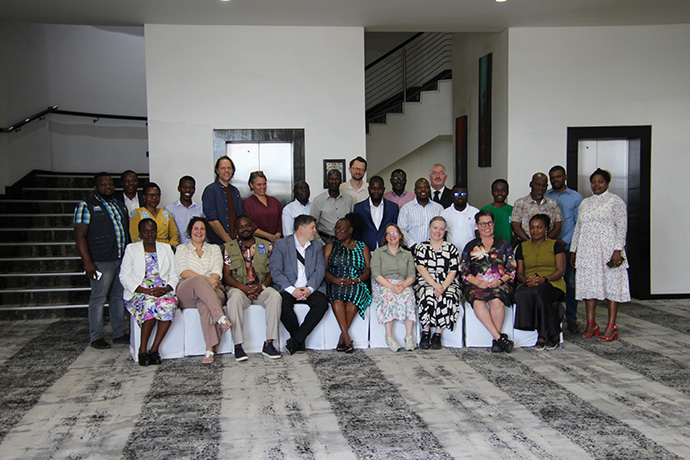
Some of the collaborators came together in Malawi recently. Credit: Svein Olav Sundal/MET Norway
Through Forecast-in-a-Box, the Malawian team can now run a variant of MET Norway’s AI weather prediction model Bris, which builds on ECMWF’s Artificial Intelligence Forecasting System (AIFS). This variant of the Bris model is specifically tuned for Africa using local expertise.
Florian Pappenberger, Director-General of ECMWF, said collaboration has been central to the project:
“A portable forecasting system such as Forecast-in-a-Box literally puts forecasting into the hands of those who need it. The system puts users in control, strengthens their sovereignty and enables them to generate the products they need. Our collaboration with meteorological services such as MET Norway and our close work with Malawi’s DCCMS have helped us steer the development of Forecast-in-a-Box”.
After being deployed in Malawi for the first time last year, Forecast-in-a-Box was completely redesigned in 2026, leading to the upcoming second stable release presented in Malawi.
“With the latest improvements we think the model is good enough for this pilot”, said Lene Østvand, researcher and project manager for MET Norway’s capacity-building project in Malawi. “We know there will be adjustments to be made, but a pilot gives us valuable feedback to further improve the AI weather model Bris”.
Forecast-in-a-Box includes a range of AI-based weather forecasting models: lightweight models for trying the system on a laptop, operational models from ECMWF, MET Norway, and the Finnish Meteorological Institute (FMI), and experimental models from the research community.
All these AI-based models have been trained using the open-source framework Anemoi, developed by ECMWF and national meteorological services in its Member and Co-operating States. Results can be explored in the built-in map viewer or served to external visualisation tools such as GeoWeb. By tuning the configuration and developing their own plugins, users can also bring their own models and processing pipelines.
Corentin Carton de Wiart, who leads the ECMWF team behind Forecast-in-a-Box, said ECMWF’s move towards open development has been crucial for the project:
“I believe the key to Forecast-in-a-Box’s success is its openness: anyone can download it and try it out, running open models initialised with ECMWF open data. The whole system is built on open-source software such as Earthkit and Anemoi. We really hope Forecast-in-a-Box will make a positive impact”.
Roar Skålin, Director-General of MET Norway, said:
“We have made significant progress in using AI-based models and tools for weather forecasting. The question is when these models and tools will become operational, and what services they will provide. MET Norway shows together with ECMWF and DCCMS Malawi how AI can support the UN's Early Warnings for All program and help countries with limited resources for traditional forecasting systems”.
Malawi is among the countries working towards the UN's Early Warnings for All (EW4All) goal of universal early-warning coverage by the end of 2027. About 70% of countries globally now report having early warning systems capability according to the EW4All initiative. This represents a significant increase since the initiative was launched in 2022. ECMWF supports the scheme through a range of data, products and services that help national meteorological and hydrological services strengthen their forecasting capabilities.
In addition to Malawi, Forecast-in-a-Box will be made available to several countries in Africa through the Africa Regional Centres of Excellence (ArcX) programme, and MET Norway is also collaborating with Ethiopia, Mozambique, and Tanzania. Forecast-in-a-Box will also be deployed on the Destination Earth (DestinE) Platform in 2027, where DestinE users will be able to test a collection of AI models.
The Forecast-in-a-Box is an open-source project, funded by ECMWF and by the European Commission through DestinE and ArcX. It can be downloaded from ECMWF’s GitHub.
Top photo credit: Mai-Linn MET Norway