

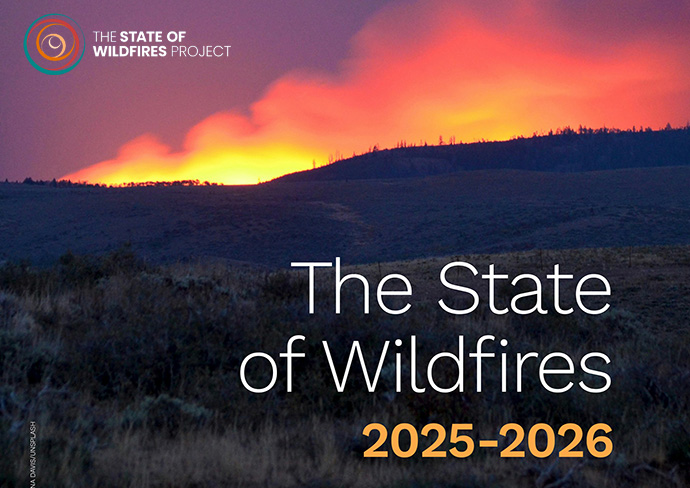
The State of Wildfires report for 2025-2026 shows that the extreme fire-prone weather experienced across Spain and Portugal in 2025 was three times more likely due to human-caused climate change, and the area burned was larger by around a factor of three.
2025 saw the largest wildfire burned area on record - even surpassing figures already in for 2026 - across the European Union according to the European Forest Fire Information System (EFFIS), one of the datasets used in the analysis.
The report shows the wildfire season was particularly severe in Iberia, where more than 40,000 people were evacuated as 14 megafires* raged in the region. Spain recorded its highest burned area since 2002, and Portugal saw the largest single wildfire on record. Fires similar to those experienced in Europe during 2025 could burn around one-third more area within the next 20 years. However, the study suggests that strong anthropogenic greenhouse gas emission cuts could substantially limit how much worse extreme fires become later in the century.
The report also finds that climate change is making severe wildfires more likely, more intense, and more damaging in many regions across the world. Its case studies of extremely destructive fires in Canada, Northwest Iberia, and Chile illustrate just how devastating the consequences can be for both people and important ecosystems.
However, the report also makes clear that reducing anthropogenic greenhouse gas emissions responsible for climate warming, can make a significant difference to how large such events could be in the future.
The State of Wildfires 2025–2026 report brings together contributions from scientists at the UK Met Office, the European Centre for Medium-Range Weather Forecasts (ECMWF), the University of East Anglia (UEA), and the UK Centre for Ecology & Hydrology (UKCEH) alongside leading global experts from over 20 countries.
The full details can be found on the UK Met Office website.
ECMWF scientists contributed analysis to the report, leading the analysis of the drivers and predictability of extreme wildfires, examining how weather, vegetation and ignition conditions combined to produce exceptional events.
The findings highlight two recurring pathways: prolonged drying in carbon-rich ecosystems, and unusually wet conditions that encourage vegetation growth before a rapid transition to heat and drought.
Dr Francesca Di Giuseppe, State of Wildfires Project co-lead, said: “Enhanced vegetation growth after unusually wet conditions in regions like Iberia, followed by extreme heat and drought, exacerbates fire risk through a process known as hydroclimatic rebound, setting the stage for severe fires.”
Joe McNorton, who performed ECMWF’s analysis of wildfire drivers, added: "Europe’s record-breaking wildfire season in 2025 showed how fire risk builds over time. Climate change is making extreme fire weather more common, but the factors driving fire danger vary between ecosystems. Understanding how rainfall, vegetation growth and drying work together helps us anticipate the most damaging fires."
ECMWF’s AI-based SPARKY fire modelling system was used in the analysis; it combines weather information with vegetation conditions and ignition-related factors to help predict fire activity and identify its drivers. SPARKY builds on ECMWF’s experience of delivering fire danger forecasts through the Copernicus Emergency Management Service since 2016.
Assessing smoke and air quality
ECMWF also contributed to wildfires emissions estimates and atmospheric modelling to assess wildfire smoke exposure, with scientists Enza Di Tomaso and Mark Parrington working alongside international collaborators.
The Global Fire Assimilation System (GFAS), part of the Copernicus Atmosphere Monitoring Service implemented by ECMWF on behalf of the European Commission, uses satellite observations to detect and estimate fire emissions. This system is operated by ECMWF and co-developed with partners. These emissions feed into ECMWF’s atmospheric composition modelling system, IFS-COMPO, which simulates how pollutants are transported, transformed and removed from the atmosphere.
Comparing simulations using observed fire emissions and using a fire emission climatology has allowed researchers to uncover the contribution of anomalous fires to air pollution. The assessment focuses on fine particulate matter, PM2.5, and combines modelled concentrations with population data to estimate exposure.
“By comparing factual and climatological model runs, we can quantify the pollution due to anomalous fire activity during 2025-26. Working as a team we have been able to assess the impact of wildfires on the number of days with pollution exposure exceeding the WHO guideline,” said Enza Di Tomaso, air quality scientists who contributed to the report.
Together, these contributions connect the conditions that drive extreme fires with their consequences for communities, including those far from the flames.
You can read the full paper here.
Top image credit: State of Wildfire 2025–2026