

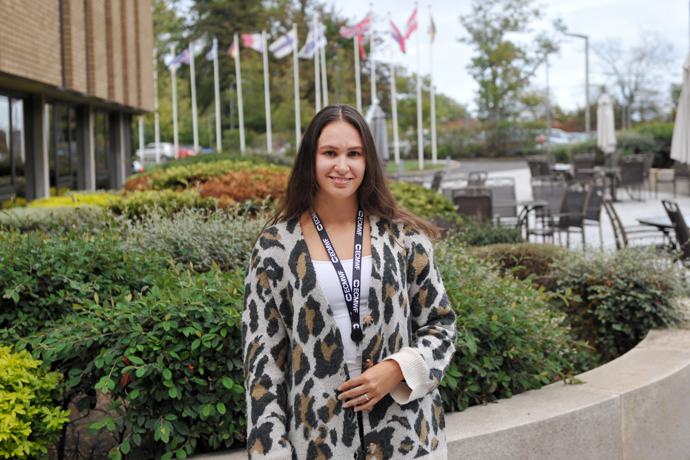
For Alina Lerner-Vilu, a year-long secondment to ECMWF has been an opportunity to see inside a leading weather forecasting centre, building on her experience of using its data and resources at the Estonian Meteorological Service.
Working as a Computing and Software Support Specialist, she has helped a broad range of users make the most of ECMWF's data and software, developed new learning resources and taken on a project to create a dataset of tropical cyclone track forecasts.
When she returns to Estonia in January, she will bring back more than technical knowledge. Her experience has also given her the confidence to take on larger projects, explore new tools and help her colleagues prepare for changes to their forecasting systems.
“I wanted to learn more about ECMWF, and I thought it could be useful both for me and for my numerical weather prediction team in Estonia,” she says.
“Now I have a much better understanding of what's happening here and how we can make use of it back home.”
Helping users find solutions
Before joining ECMWF, Alina spent almost five years at the Estonian Environment Agency, Estonia’s national meteorological service, as a numerical weather prediction (NWP) specialist.
With bachelor's and master's degrees in meteorology, she was already familiar with ECMWF's data, forecasting models and high-performance computing resources.
“ECMWF is one of the world's leading forecasting centres, and I had worked so much with its data that I really wanted to see everything from the inside,” she says. “It was a dream opportunity to understand more about how things work here.”
Since joining ECMWF, Alina has become part of the User Solutions team, a relatively new team created to act as a bridge between users and specialists across the Centre. Working with experts from different areas, the team helps identify user challenges and find solutions.
Emma Pidduck, User Solutions Team Leader, says Alina’s experience of working with ECMWF’s data and systems at the Estonian Environment Agency has brought a valuable user perspective to the team.
“Alina joined us when the team was still quite new, and she’s had a real hand in how we work. She’d spent many years on the other end of our data and model upgrades, so she tended to spot the things users would trip over before they did. That’s not something you can easily teach or hire directly.
"I’ll miss having her around, but I’m really looking forward to seeing what she goes on to achieve in Estonia, and I’m happy that we’ll still be in touch,” said Emma.
Her role gives her a broad view of how people interact with the Centre's resources. She provides technical support to internal colleagues and external users, including ECMWF's Member States and Co-operating States, helping with everything from data access and software problems to more complex technical questions.
“The users I help are diverse and spread all over the world,” she says. “It could be a colleague in Reading asking about a software issue or a PhD student in Australia looking for a more efficient way to request data.”
The role has also introduced her to parts of ECMWF's services that she had not previously used herself, including the range of datasets available through its open data service.
“I hadn't realised just how much data ECMWF makes freely available online. That's a really useful message to take back to Estonia. In some cases, we can direct users to the open data service rather than arranging access through MARS.”
Making ECMWF resources easier to use
Alongside day-to-day support, Alina has contributed to making ECMWF's data and software easier to use.
She has developed a series of Jupyter notebooks for ecCharts, ECMWF's interactive weather-chart service. The notebooks provide users with step-by-step guidance, helping them learn how to work with the service independently.
“I really enjoy creating these learning materials,” she says.
“It's so satisfying to go to the ecCharts website, see a link to a notebook and know that I created it and am helping people with something practical they can work through themselves.”
Alina has also been involved in a major project to develop a dataset of tropical cyclone track forecasts. She has created a programme, which uses Cyclops software developed by the Product Development team, to process around 15 to 16 years of archived data.
She is now preparing the documentation and a Jupyter notebook to explain how future users can work with the dataset. The resource is still in development but is expected to be launched next year.
“I'm really proud of this project. When I think about everything involved, I'm amazed at how much I've done. It's one of the biggest projects I've taken on, and I've learnt a lot from seeing it through.”
The experience has also helped Alina build confidence in her ability to manage complex technical work, from developing a solution to preparing it for other people to use.
Embracing new technologies
Working at ECMWF has exposed Alina to new ways of approaching technical challenges. One example is the use of AI agents, something she had not worked with before joining the Centre.
“I hadn't used AI agents before, and discovering how they can help has been a real change for me. They can make work more efficient, and I want to explore how we could use them at the Estonian Met Service.”
More broadly, she has become more comfortable exploring unfamiliar technologies rather than relying on approaches simply because they are familiar.
“Smaller teams can sometimes be cautious about changing things that have worked well for many years. But meteorology is evolving quickly and we need to keep up with that progress and explore new opportunities.”
For Alina, the change has been as much about confidence as technical skills.
“Before, I sometimes wondered whether I was capable of taking on something new, or worried about making a mistake. Having worked through a large project here, I feel more confident about doing it again. The next time, it won't seem quite so scary.”
Bringing the experience back to Estonia
Alina's secondment will prove particularly useful as the Estonian Environment Agency prepares for the transition to GRIB2, the internationally used standard format for storing and exchanging gridded meteorological data.
The change involves technical adjustments and testing, and her time at ECMWF has given her a clearer understanding of what is involved and how to prepare.
“Having learnt about the technical changes here and how we can test them, I feel much better prepared to help lead this work when I return to Estonia,” she says.
Her experience will also help colleagues in Estonia understand developments at ECMWF through the eyes of those who use its systems every day. Having worked on both sides, she can relate technical changes at the Centre to the practical realities of a national meteorological service.
That exchange of knowledge benefits ECMWF as well. Feedback from people who work directly with national services helps the Centre understand how its tools, data and model upgrades are experienced by users, and where clearer guidance or new solutions might be needed.
“Working at the Estonian met service meant I could bring the perspective of someone who uses ECMWF's systems. I could explain how people might react to changes or model upgrades, and I think that perspective is important.”
The Estonian Environment Agency also sees the secondment as an investment that will benefit the wider team when Alina returns.
“Alina’s experience shows how investing in one person’s development can benefit an entire team. We are proud that she has contributed to tools and learning resources that will benefit ECMWF users well beyond Estonia. She will return with deeper technical expertise, valuable professional connections and greater confidence to take on new challenges. This exchange of knowledge strengthens both our team at home and our cooperation with ECMWF,” says Taimar Ala, Director of the Estonian Environment Agency.
Alina’s advice to others considering a similar opportunity is simple: “Stay curious and keep learning. You don't have to embrace every new technology all at once, but it's important to explore what's possible.”