

© CoinUp / AdobeStock
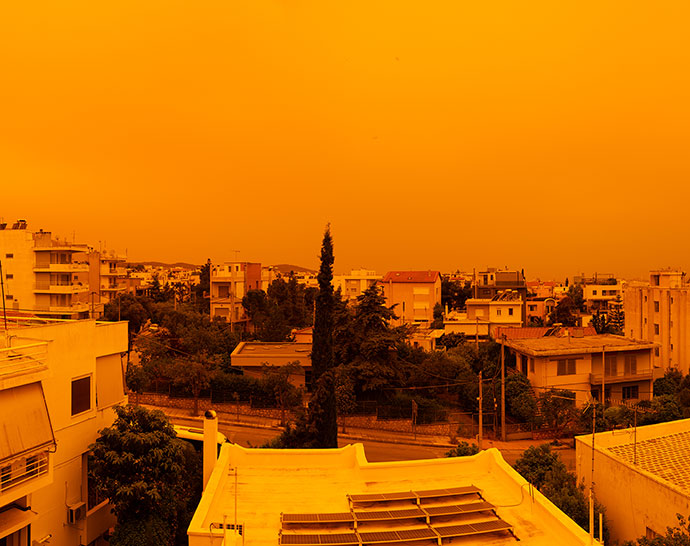
Countless tiny particles are suspended in the air we breathe. From dust and sea salt to smoke and pollen, these aerosols have myriad effects on our weather and health.
Forecasts of aerosol concentrations can therefore provide organisations and decision-makers with important information. To this end, the EU’s Copernicus Atmosphere Monitoring Service (CAMS) – implemented by ECMWF – creates twice-daily aerosol forecasts for up to five days ahead.
Aerosols can be solid or liquid particles, and they range in size from a few nanometres (e.g. molecular clusters) to 100 micrometres (e.g. dust grains). Aerosols emitted directly into the atmosphere – known as primary aerosols – include sea spray; mineral dust blown off deserts and soils; black carbon (soot) and organic matter from combustion sources including wildfires and fossil fuel burning; volcanic ash; and biological materials such as plant debris and spores.
Secondary aerosols, on the other hand, are formed when gases in the atmosphere undergo chemical reactions. For example, sulphate aerosols are formed from the oxidation of sulphur dioxide gas, which is released by power plants, vehicle exhausts and volcanic eruptions.
A breath of fresh air?
Inhaling aerosols – often called particulate matter (PM) in a health context – can cause coughing, throat irritation and shortness of breath.
The smallest PM can go deep into the lungs and even enter the bloodstream, increasing the risk of stroke, cardiovascular disease, respiratory disease, dementia and lung cancer.
Long-term exposure to PM with a diameter of 2.5 micrometres or less (PM2.5) – often emitted by human sources such as fossil fuel burning and industrial activities – contributed to an estimated 4.9 million deaths globally in 2023.
Aerosol forecasts can therefore be crucial for those monitoring significant aerosol events, such as the suffocating haze caused by the current wildfires in Indonesia – linked to over 170,000 cases of respiratory illness since August 2026.
The global forecasts of atmospheric composition produced by CAMS simulate seven different types of aerosol, including desert dust, sea salt, black carbon, organic matter, and sulphates.
A version of ECMWF’s Integrated Forecasting System (IFS) is used to create the forecasts, with additional modules for simulating atmospheric chemistry.
Called IFS-COMPO, the system captures processes including the transport of aerosols via winds, chemical reactions in the troposphere and stratosphere, and the removal of aerosols through either precipitation or ‘dry deposition’ onto the Earth’s surface. It also categorises the aerosols according to size, providing forecasts of health-related variables such as PM2.5 concentration.
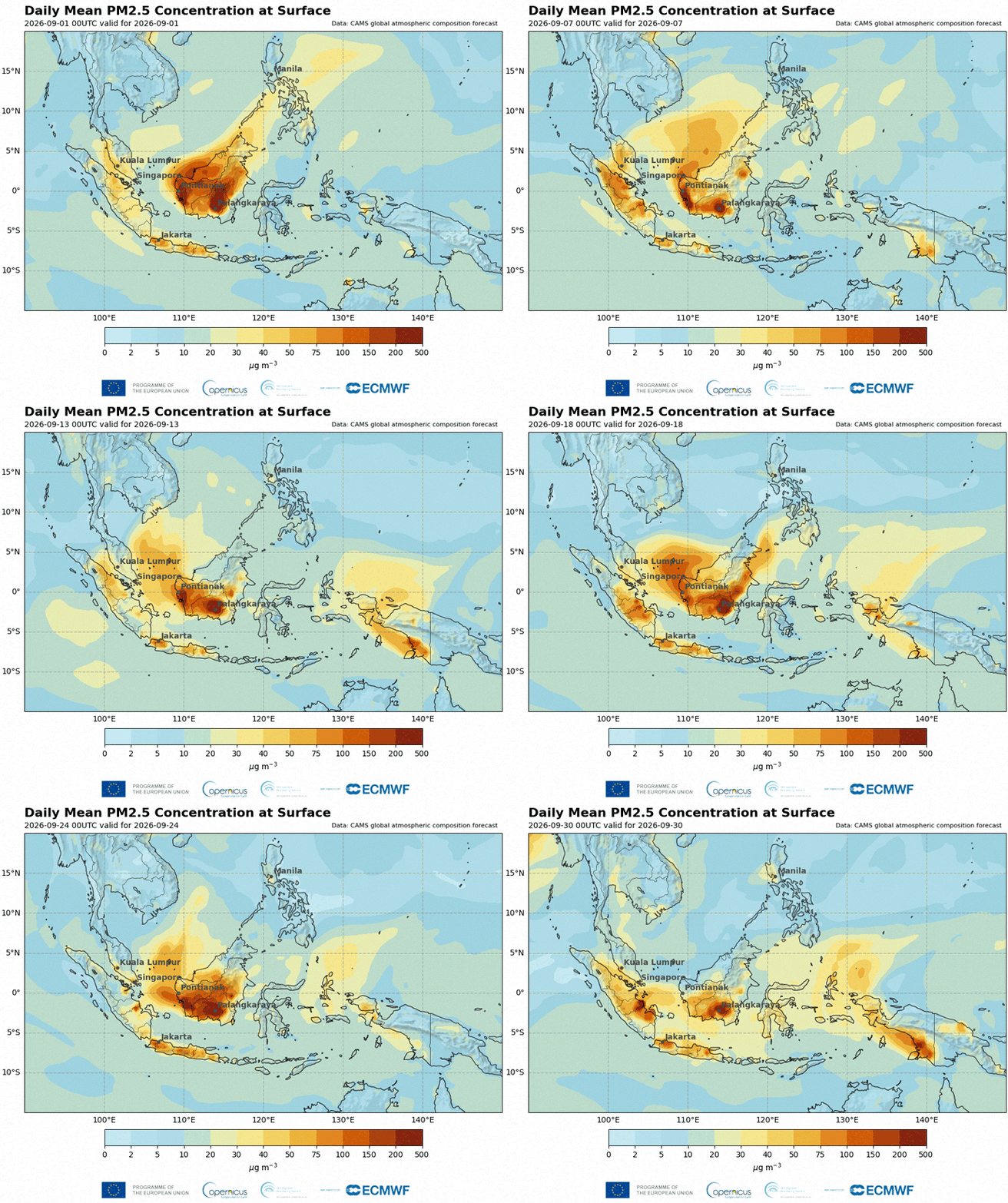
CAMS forecast of daily mean surface PM2.5 concentrations across Indonesia and surrounding Southeast Asia in September 2026. Credit: CAMS
Finessing forecasts
The initial conditions for each forecast are calculated using a process called data assimilation, which combines a previous forecast with measurements of total aerosol optical depth (AOD) from several orbiting satellites (AOD is a dimensionless measure of how much aerosols absorb and scatter sunlight within a vertical column of the atmosphere).
The need to model not just physical but also complex chemical processes, involving multiple types and sources of aerosols, makes aerosol forecasting more challenging than standard weather forecasting.
“We also lack observational data on individual aerosol types, so the system has to make assumptions about how the total assimilated AOD is split,” says Melanie Ades, Senior Scientist at ECMWF.
“Weather forecasters typically have far more information on the variables they are forecasting, such as temperature and pressure, which helps to constrain their model and keep their forecasts as close to reality as possible.”
Fine-tuning the data assimilation aspects of IFS-COMPO is providing a way to enhance its forecasts.
“One approach is to improve how the existing satellite AOD observations are used,” says Enza Di Tomaso, Scientist at ECMWF.
“For example, we are reviewing how our data assimilation scheme takes into account uncertainties in the satellite observations, with the aim of creating a more accurate picture of the atmosphere’s initial state.”
Other researchers at ECMWF are working on increasing the variety of data that the system can assimilate.
“When there’s a difference between the modelled and observed AOD, the system has to estimate which type of aerosol needs to be corrected in order to improve the forecast,” says Melanie.
“Assimilating richer data on aerosol properties, such as their size, will help the model to get better at identifying the relevant aerosol type.”
There is also the potential to use data from new satellites, such as MetOp-SGA1, which launched in August 2025.
Developed by ESA and EUMETSAT, this carries a sensor that measures the polarisation of sunlight scattered by the Earth’s atmosphere, which can allow researchers to distinguish between different aerosol types such as smoke, dust and salt.
“This will be valuable data,” says Melanie, “so we’re hoping to assimilate it into our system.”
Dust aerosol optical depth for Europe on 2 March 2026. Credit: CAMS
Early warnings
Aerosol data from IFS-COMPO feed into several resources for tracking aerosol events such as wildfires or spikes in urban pollution.
For example, CAMS operates a Fire Emissions Watch tool for mapping global wildfire emissions and smoke, and an Aerosol Alerts service that provides advance warning of AOD or PM values exceeding predefined thresholds in the three days ahead.
IFS-COMPO also supplies the boundary conditions (the data at the edge of a model’s geographic range) for a high-resolution system used by CAMS to create European air pollution forecasts at a regional level.
In addition, data from IFS-COMPO is used in the World Meteorological Organization’s Sand and Dust Storm Warning Advisory and Assessment System, which provides daily forecasts of atmospheric dust.
These are particularly useful during sand and dust storms, like the one that swept over Mali, Africa, in September 2026. Early forecasts can help communities to prepare for the significant impacts of these storms on health, transport and agriculture.
Aerosols come in many flavours, and their impacts are equally diverse. They play an important role in the climate system, too, both through direct effects (reflecting or absorbing solar radiation, which cools or warms the atmosphere respectively) and indirect effects (acting as ‘seeds’ for cloud formation).
Our aerosol forecasting activities are thus part of a growing international effort to understand and simulate both the short- and long-term trends in these particles, whose tiny size belies their considerable influence on our lives.