


© royyimzy/Adobe Stock
Authors: Sarah-Jane Lock, Manuel Fuentes, Mio Matsueda (University of the Ryukyus), Richard Mladek, David Richardson, Douglas Schuster (NCAR), Simon Thompson (UK Met Office) and Helen Titley (UK Met Office)
Every forecast contains uncertainty. Small differences in the atmosphere today can lead to very different weather several days ahead.
This is why forecasting centres run an ensemble – a set of forecasts that start from slightly different initial conditions – to show the range of outcomes that could occur.
But no single forecasting system represents uncertainty in exactly the same way. Different centres use different models, data-assimilation approaches and ways of representing uncertainty, so the strengths and weaknesses of their ensembles can vary.
Comparing them can therefore reveal where forecasts agree, where they diverge and how well they capture the uncertainty in differing weather situations.
Combining forecasts from multiple centres can also provide a way to test whether they can be used together to improve prediction.
This was the idea behind TIGGE – a shared archive of operational ensemble forecast data from 13 global numerical weather prediction (NWP) centres (Figure 1).
In October 2026, the TIGGE archive marks 20 years since data delivery began. What started as an ambitious international endeavour has become a sustained global resource for weather research through archive portals at ECMWF and the China Meteorological Administration (CMA).
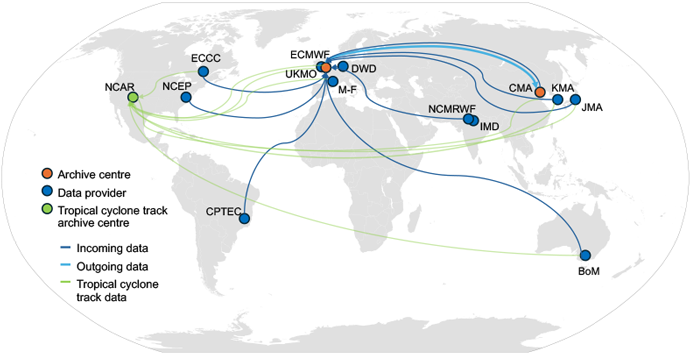
Figure 1: TIGGE data flows (2026) between operational centres and the data archives. The map shows the global centres involved with TIGGE (L-R): National Center for Atmospheric Research (NCAR); National Centers for Environmental Prediction (NCEP); Environment and Climate Change Canada (ECCC); Centre for Weather Forecasting and Climate Studies (CPTEC); UK Met Office (UKMO); ECMWF; Météo-France (MF); German Meteorological Service (DWD); National Centre for Medium Range Weather Forecasting (NCMRWF); India Meteorological Department (IMD); China Meteorological Administration (CMA); Korea Meteorological Administration (KMA); Japan Meteorological Agency (JMA); Bureau of Meteorology (BoM).
Building a global forecast archive
TIGGE was established as a key initiative under “THORPEX” (The Observing System Research and Predictability Experiment), a World Meteorological Organization (WMO) research programme under the World Weather Research Programme, designed to accelerate improvements in the use and accuracy of weather forecasts up to two weeks ahead.
In March 2005, ECMWF hosted an initial workshop to agree a strategy towards the new archive, establishing what data should be contributed, how it should be exchanged and how users would access it.
The original name, the “THORPEX Interactive Grand Global Ensemble”, captured the central idea: to bring together global medium-range ensemble forecasts from leading operational centres and make them available in a form that would encourage comparison, collaboration and innovation.
Following the completion of THORPEX in 2014, TIGGE has continued, and the current five-year phase of the archive runs from 2024 to 2028.
“TIGGE was designed to strengthen international collaboration on ensemble prediction, bring together ensembles from different centres and correct systematic errors, and to better understand how observational, initial-condition and model uncertainties contribute to forecast error.
Its uninterrupted operation for 20 years, supporting research and the monitoring and benchmarking of operational ensemble forecasts, demonstrates the success of the original initiative,“ said David Richardson, former Head of Evaluation at ECMWF.
Keeping a global archive alive
Behind every scientific dataset is a great deal of technical work.
TIGGE depends on the regular contribution of forecast data from operational centres, careful handling of changing model configurations, consistent metadata, robust archiving and user access services that have had to evolve with technology and demand.
Data volumes, formats, infrastructure and user expectations have all changed substantially since 2006, but the core requirement has remained the same: users need to find, understand and retrieve reliable ensemble forecast data.
"When TIGGE started in 2006, our objective was not simply to store forecast data. We needed to build a reliable operational service capable of receiving, checking, archiving and publishing contributions from centres across the globe in a consistent way.
Twenty years later, the archive's greatest success is its continuity. Researchers can still analyse forecasts from many different centres through a common framework, knowing that the data have been managed, curated and preserved with the same commitment to quality that guided the project from the beginning," said Manuel Fuentes, Principal Analyst and Data Archives and Dissemination Services Team Leader and Richard Mladek, Analyst, both at ECMWF.
“It has been incredibly rewarding to watch the TIGGE archive grow over the years since I first submitted data from the Met Office as a technical co-ordinator in 2006. In that time the Met Office ensemble has undergone numerous updates, with a large positive impact on its accuracy and spread, while also presenting the challenge of maintaining a complete archive.
I feel very proud to have overseen the continuous delivery of our contribution for a significant proportion of my career and witnessed the extensive collaboration and the wealth of research that has resulted from it,.” said Simon Thompson, from the UK Met Office.
Science enabled by TIGGE
Most researchers usually work with forecasts from a single model. One of TIGGE’s greatest strengths is that it allows questions to be asked across multiple forecasting systems.
Researchers can examine, for example, how ensemble spread relates to forecast error; when multi-model combinations add value; how different models describe uncertainty in particular flow regimes or high-impact events; and how probabilistic guidance should be evaluated and communicated.
By providing access to multi-centre forecasts in a common framework, the archive has enabled systematic studies of ensemble performance, forecast uncertainty, predictability and model error. It has supported research on severe and high-impact weather, including tropical cyclones, heavy precipitation, strong winds, blocking regimes, the Madden–Julian Oscillation and probabilistic forecast products.
As importantly, it has provided a long-running time-series for assessing how ensembles can be combined, calibrated and verified across centres.
Case study: comparing uncertainties
Rodwell and Wernli (2023) used TIGGE data to explore how the growth of forecast uncertainties differs between ensemble forecasts from different centres. They focused on the North Atlantic storm track in winter, when uncertainties can be large. By extracting forecast data for four operational models from the TIGGE archive, they illustrate multiple features for a particular case of cyclone intensification off the North American east coast (Figure 2).
While the large-scale flow patterns appear very similar for the four models (indicated by the wind vectors and the green contours for geopotential height), there are clear differences in the uncertainty growth rates (colour contours). Exploring these differences can help direct research questions to target improvements in the design of the ensemble forecast systems, for example, through revised representations of initial conditions or model uncertainties.
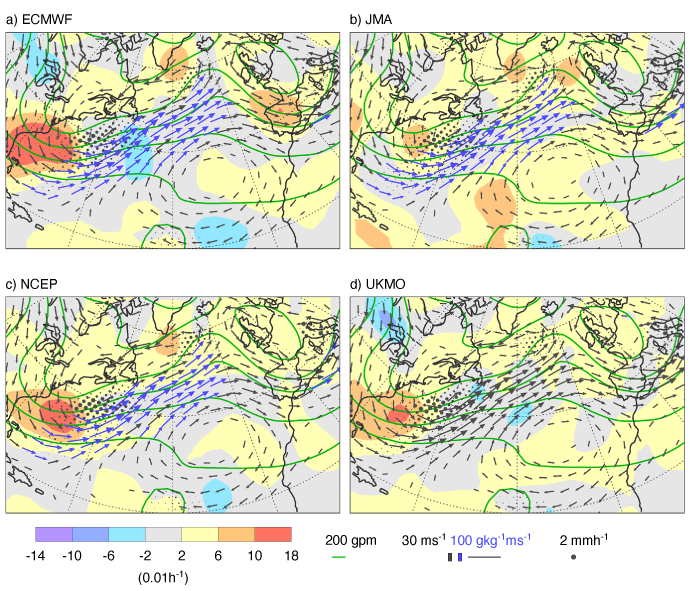
Figure 2: Lagrangian Growth Rate of forecast uncertainty (LGRZ) for geopotential height at 250 hPa for TIGGE models (shaded), centred at 12:00 UTC on 8 December 2020. The case also corresponds to an event of cyclone intensification off the North American east coast associated with a warm conveyor belt. Also shown, for the unperturbed ensemble members, are geopotential height at 250 hPa (green contours) and Wind speed at 850 hPa (arrows, which are plotted blue if the moisture flux at 850 hPa exceeds 100 g kg−1 m s−1). Ensemble mean precipitation is indicated by black dots, with a radius proportional to the precipitation rate up to the maximum size at 2 mm h−1. The models shown are from (a) ECMWF, (b) Japan Meteorological Agency (JMA), (c) National Centers for Environmental Prediction (NCEP), and (d) UK Met Office (UKMO). Adapted from Figure 4 in Rodwell and Wernli (2023).
Supporting tropical cyclone research
The archive has also supported specialist datasets and applications, including the TIGGE tropical cyclone (TC) track archive, hosted by the Geoscience Data Exchange at the National Center for Atmospheric Research.
The archive provides ensemble TC track and intensity forecasts in a common data format: the Cyclone Extensible Markup Language (CXML). It was developed alongside the TIGGE gridded archive to support routine exchange of TC forecast information from multiple ensemble prediction systems.
The CXML archive enables researchers to compare forecast performance, investigate sources of uncertainty, develop and evaluate probabilistic guidance, and demonstrate the value of multi-model ensemble forecasting for improving forecast skill and characterising uncertainties.
The success of this research collaboration also helped inspire the operational exchange of TC vortex parameter data in standardised BUFR format, helping to bridge the gap between research and operations while extending the concept of globally consistent TC forecast exchange beyond the original TIGGE framework.
“TIGGE has driven international collaboration – not only through scientific research, but also at the level of data access: it has fostered the development of scalable open-source data curation, delivery, and access technologies.
Technologies that subsequently power systems like the Copernicus Climate Data Store and NCAR’s Geoscience Data Exchange. I am proud to have been involved since the start, valuing both the professional relationships built and NCAR’s ongoing work supporting the Tropical Cyclone Track archive,” said Doug Schuster, NCAR.
Opening the door to new users
In the early years, the enormous value of TIGGE data was not always obvious to potential users. To help demonstrate what the archive could offer, Mio Matsueda at the University of the Ryukyus in Japan created the ‘TIGGE Museum’, a website that visualises forecasts of atmospheric phenomena including tropical cyclones, blocking regimes and severe weather, alongside verification scores and sample scripts for data analysis.
Over time, initiatives such as these helped raise awareness of the archive and broaden its user community. The scale of this community is reflected in a 2024 survey by the World Meteorological Organization’s Working Group on Predictability, Dynamics and Ensemble Forecasting (PDEF), which identified at least 403 peer-reviewed papers using TIGGE data.
“The expansion of TIGGE continues today, as its application begins to transcend the traditional boundaries of meteorology and hydrology.
Alongside its potential as training data for AI and machine learning, the archive is supporting work on real-world societal challenges from renewable energy forecasting to predicting sea ice and severe environmental hazards like large-scale wildfires, ozone anomalies, and dust storms.
In this way, TIGGE data has become a critical resource across diverse academic and practical domains, including energy management and environmental disaster prevention, which continue to unlock new possibilities for the archive,” said Mio Matsueda, University of the Ryukyus, Japan.
The decades ahead
The next decade will bring new opportunities. Ensemble prediction systems continue to evolve, growing more complex as more components of the Earth system are coupled. Ensembles are growing in size, helping to better capture forecast variability, while higher resolution is improving descriptions of extreme events.
At the same time, the emergence of data-driven forecasts creates fresh demand for consistent datasets that can support evaluation and comparisons across different prediction methods.
“Through my role with the PDEF Working Group, it has been a pleasure to help with recent efforts to enhance the value of the TIGGE database: first, agreeing a common grid for future TIGGE contributions, enabling fairer comparisons between forecasts; and most recently, preparing a route for an extension to accommodate emerging data-driven ensemble forecasts,” said Sarah-Jane Lock, Scientist at ECMWF.
For TIGGE, the future is therefore technical and scientific. It includes preserving the continuity and trust that make the archive valuable, while adapting access methods and documentation for changing research practices.
It will also continue to depend on international collaboration: data providers, archive centres, technical teams and users working together to ensure that ensemble prediction research remains open, comparable and global.
Twenty years after the first TIGGE data were collected, the archive stands as more than a repository of data. It is a record of scientific cooperation, operational commitment and community use.
Its anniversary is an opportunity to thank the many people and institutions who have contributed to it – and to look ahead to the questions that the next 20 years of global ensemble forecast data will help answer.
Visit the TIGGE archives