

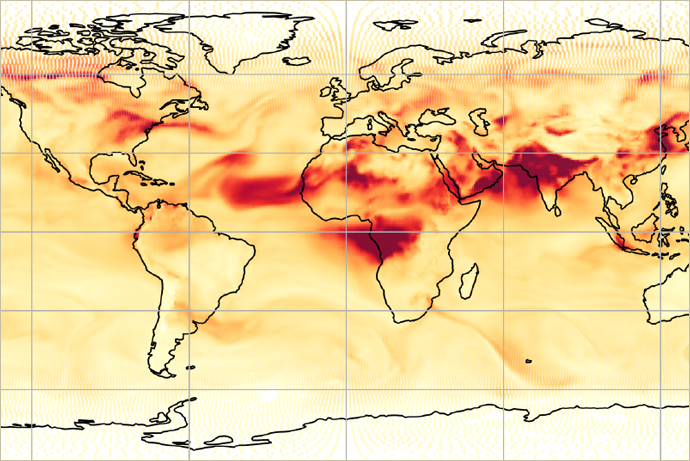
ECMWF has introduced AIFS-COMPO, a new data-driven forecasting system for global atmospheric composition.
Adapting ECMWF’s Artificial Intelligence Forecast System (AIFS) to aerosols and reactive gases, AIFS-COMPO can produce global forecasts up to 10 days ahead and explores the potential of AI for a new area of Earth-system prediction.
Atmospheric composition forecasts are important for monitoring air quality and supporting applications related to public health, since exposure to air pollutants can affect respiratory and cardiovascular health.
The European Commission’s Copernicus Atmosphere Monitoring Service (CAMS), implemented by ECMWF, provides global forecasts of atmospheric composition, including pollutants such as particulate matter, ozone, nitrogen dioxide and carbon monoxide, as well as different types of aerosols.
AIFS-COMPO explores how AI could complement the numerical modelling approaches currently used to produce these forecasts.
Laurence Rouil, Director of CAMS at ECMWF said: “It is a very exciting moment for us at CAMS, opening new possibilities for atmospheric composition forecasting. The fact that our data has been used both to train the model, through the Atmospheric Composition Reanalyses (EAC4), and to evaluate its performance against the current operational forecasting set-up, with very promising results, also confirms the robustness of our operational system. While the operational CAMS forecasting system remains the benchmark for accuracy and reliability, this experimental system offers valuable insights into how AI could help deliver atmospheric-composition forecasts more efficiently, faster and with limited computational resources, and support future innovation in air-quality and atmospheric monitoring services.”
From AIFS to data-driven atmospheric composition forecasting
Atmospheric composition is particularly challenging to forecast. Many different species interact with each other and with the atmosphere, with their evolution depending on processes such as emissions, transport, chemistry and meteorology.
The operational CAMS global forecasting and analysis system, Integrated Forecasting System (IFS)-COMPO, represents these processes using a detailed model based on physical and chemical equations. To further improve the realism of the initial conditions of the forecast, the global CAMS system assimilates satellite retrievals of aerosol optical depth, ozone, carbon monoxide, nitrogen dioxide and sulphur dioxide in near-real-time. It currently provides forecasts for five days updated twice a day.
While AI-based forecasting has advanced rapidly in weather prediction, its application to global atmospheric composition forecasting has remained much less developed. AIFS-COMPO explores this emerging field by applying the AIFS approach to atmospheric composition.
AIFS-COMPO builds on the AIFS transformer-based architecture and is implemented within Anemoi, the open-source framework for data-driven weather and climate modelling co-developed by ECMWF and many national meteorological services in Member States.
It jointly forecasts meteorological and atmospheric composition variables and is trained using CAMS reanalysis and operational analysis and forecast data. This allows the model to learn the evolution of atmospheric composition from the large datasets generated by the CAMS forecasting system. AIFS-COMPO starts its forecasts from the operational CAMS analyses, which have been produced by the data assimilation component of the global CAMS system. It is therefore a forecasting model only, and not (yet) a data assimilation system: it relies on the satellite data assimilation carried out for IFS-COMPO to provide its initial conditions.
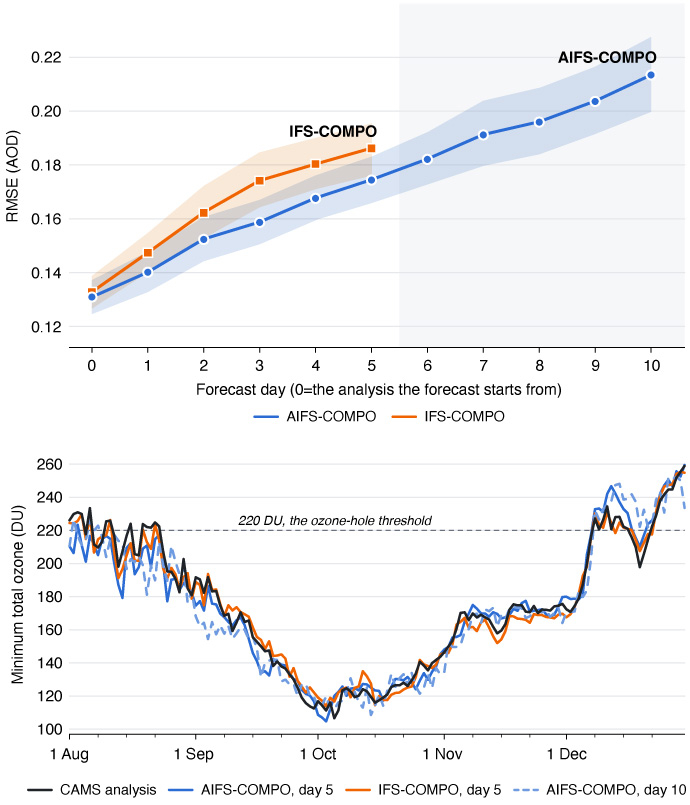
AIFS-COMPO compared with the operational IFS-COMPO system. Top panel: error of aerosol optical depth (AOD) forecasts against Aerosol Robotic Network (AERONET) observations for June to August 2024. Bottom panel: minimum total column ozone over the Antarctic in 2024, in the CAMS analysis and in day-5 and day-10 forecasts. AIFS-COMPO has a lower aerosol root mean square error (RMSE) over the five days both systems cover, and its 10-day forecasts still capture the ozone hole.
Fast forecasts with a longer horizon
Initial evaluation of AIFS-COMPO shows that the data-driven approach can provide competitive forecasts at substantially lower computational cost. Verification against independent atmospheric composition observations shows comparable or improved forecast skill for several key species compared with the operational IFS-COMPO system.
The efficiency of the AI approach also makes it possible to extend the forecast range. AIFS-COMPO currently produces forecasts out to 10 days, extending beyond the five-day horizon of the operational CAMS global atmospheric composition forecasts.
Explore AIFS-COMPO forecasts
The first AIFS-COMPO charts are now available on the ECMWF website. They provide a view of the model’s global predictions for a range of important atmospheric composition variables.
The charts cover six groups of products: aerosol fields for dust, sea salt, biomass-burning aerosol and sulphate; particulate matter (PM2.5 and PM10); and carbon monoxide, nitrogen dioxide, ozone and sulphur dioxide shown at pressure levels, at the surface and as total columns.
Developing AIFS-COMPO further
AIFS-COMPO is currently an experimental system, with several areas of development under way. This model does not explicitly include time-varying emissions as forcing inputs, it forecasts a smaller set of variables than IFS-COMPO, with fewer chemical species and no quantities such as deposition fluxes at a lower spatial resolution.
Ongoing work is integrating fire emissions from the CAMS Global Fire Assimilation System (GFAS) alongside other emission datasets, enabling the model to support different emission scenarios. We are also investigating how atmospheric composition observations could be used to further improve the forecasts.
Further evaluation will be important as the system develops, including a closer analysis of specific atmospheric composition events and their evolution. The underlying AIFS-COMPO data will be made available in the future as the system matures and undergoes further validation.
A full description of AIFS-COMPO, including its architecture, training data and evaluation, is available in the accompanying arXiv preprint.