

Air quality across Europe continues to improve overall, driven by sustained reductions in emissions of key regulated pollutants, according to the latest Assessment Report on European Air Quality 2025 from the EU’s Copernicus Atmosphere Monitoring Service (CAMS), implemented by ECMWF.
However, the report also highlights that pollution episodes persist in parts of Europe when emissions from human activities combine with meteorological conditions such as heatwaves, stagnant atmospheric conditions and winter temperature inversions.
Florian Pappenberger, ECMWF Director-General, said: “This report shows that sustained efforts to reduce emissions are delivering real improvements in air quality across Europe.
At the same time, it highlights the importance of maintaining independent European capabilities for monitoring and forecasting atmospheric composition.
Services such as CAMS provide Member States with trusted information that helps protect citizens, supports evidence-based policies and strengthens Europe's resilience to environmental risks.”
Prepared under ECMWF supervision by NILU with contributions from the French National Institute for Industrial Environment and Risks (Ineris), MET Norway, and the Netherlands Organisation for Applied Scientific Research (TNO), the report provides a comprehensive assessment of air quality across Europe. It supports policymakers and national authorities by providing a consistent picture of air quality across Europe, helping to identify emerging risks and inform evidence-based decision-making.
The assessment draws on CAMS European air quality reanalysis data, which combines observations from monitoring stations with an operational ensemble of 11 state-of-the-art European air quality modelling systems, coordinated by Météo-France.
It assesses key pollutants regulated under European legislation: ozone (O₃), nitrogen dioxide (NO₂), and particulate matter (PM10 and PM2.5), while also examining selected pollution episodes in 2025 and placing them in the context of recent trends and changing meteorological conditions.
Declining emissions
The report shows the impact of sustained downward trend in emissions of major air pollutants across Europe, reflecting the long-term impact of air quality legislation, technological advances, and cleaner practices in industry and transport.
Since 2015, emissions of sulphur oxides (SOx) and nitrogen oxides (NOx) have fallen by approximately 3–5% per year across the European Union, with the most significant reductions achieved in the industrial and road transport sectors.
Industrial emissions of SOx have fallen by 59%, while NOx emissions from industry have declined by 39%. Road transport emissions have also fallen substantially, with reductions of 40% for NOx and 34% for PM2.5.
Laurence Rouil, CAMS Director at ECMWF, said: “Our report is designed to provide national authorities, policymakers and air quality experts with insightful information to better understand both long-term trends and the origins of pollution episodes, enabling more effective evidence-based decision-making.
Europe continues to make steady progress in improving air quality thanks to sustained efforts to reduce emissions from transport, industry, residential heating, and other key sectors.
At the same time, our report highlights and explains situations when the combination of emissions and meteorological conditions can still trigger significant large-scale episodes with exceedances of the limit values set for health and environmental protection.”
These reductions underline the effectiveness of coordinated European policies, including measures introduced under the National Emission Reduction Commitments (NEC) Directive, which sets binding national targets for key pollutants. The report notes that emissions are increasingly becoming decoupled from economic activity, reflecting cleaner technologies and more efficient production systems.
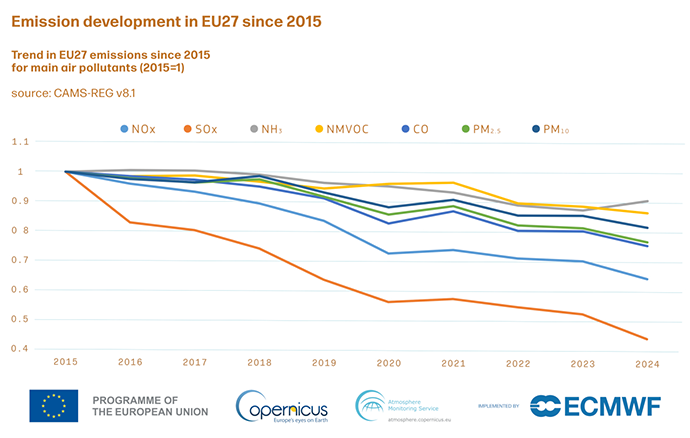
Trend in EU27 emissions since 2015 for main air pollutants (2015=1). Source: CAMS REG v8.1
Emissions and weather extremes combine to shape pollution episodes
Despite this progress, the report highlights the importance of understanding how a certain combination of meteorological conditions and emissions influence air quality across Europe.
According to the European State of the Climate 2025, Europe experienced its third warmest year on record, with marked regional contrasts. These conditions had important implications for air quality across Europe.
Several major transboundary air pollution episodes during the year illustrated how emissions from human activities, and in some cases natural sources, combined with specific meteorological conditions, can lead to exceedances of air quality limits.
In February, colder-than-average temperatures across parts of Europe contributed to elevated PM2.5 concentrations, particularly in eastern regions, where residential heating was a dominant source. Additional contributions from transport, agriculture and industry further increased pollutant levels, resulting in exceedances of health-based thresholds.
During the summer months, high temperatures, strong solar radiation and stagnant atmospheric conditions contributed to elevated ozone formation. The most significant episode occurred between 8 and 17 August, affecting large areas of western, central and southern Europe.
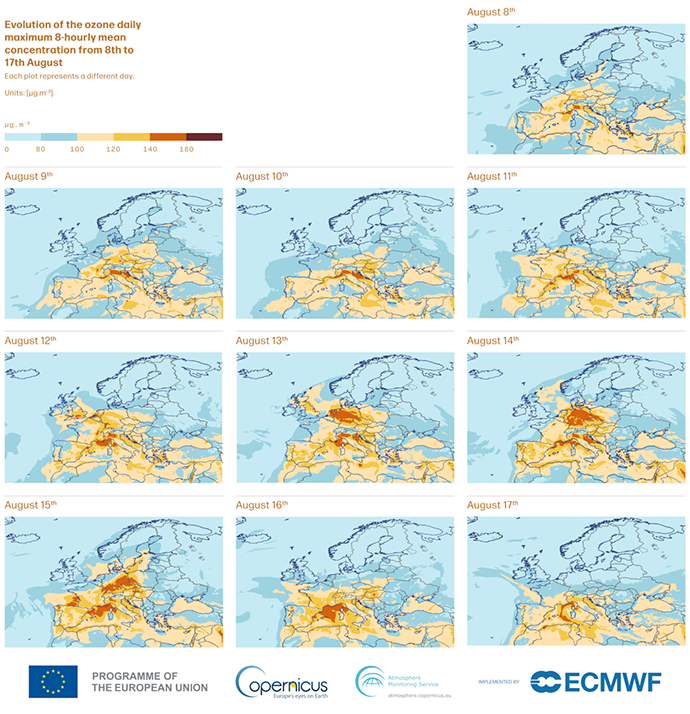
Evolution of the ozone daily maximum 8-hourly mean concentration from 8 to 17 August Units: [µg.m–3]. Source: CAMS
Extended dry conditions also exacerbated wildfire activity in parts of southern Europe, further affecting air quality.
In mid-August, severe wildfires in Portugal and Spain led to widespread exceedances of PM2.5 limit values across the Iberian Peninsula. For the first time, CAMS was able to quantify the contribution of wildfire emissions to particulate matter concentrations using advanced source attribution methods, providing new insight into how wildfire smoke affects regional air quality and public exposure to pollution.
Natural sources also contributed to air pollution during the year. Long-range transport of Saharan dust led to elevated PM10 concentrations across southern and western Europe, reinforcing the transboundary nature of air pollution and the importance of understanding both anthropogenic and natural contributions.
A continuing evidence base for policy
The findings underline the success of long-term efforts to reduce emissions across Europe. At the same time, they highlight the need to better understand how heatwaves, wildfires, winter conditions and other meteorological factors influence air quality in a changing climate.