

© U. Eisenlohr / iStock / Getty Images Plus
ECMWF is preparing the release of the Ocean ReAnalysis System 6 (ORAS6), its sixth-generation ocean and sea-ice reanalysis system. This marks an important step forward in how past ocean and sea-ice conditions are reconstructed and used in weather and climate monitoring.
The global ocean plays a vital role in Earth’s climate system. It absorbs and stores heat and carbon, influences weather patterns, and interacts continuously with the atmosphere.
Reconstructing how the ocean and sea ice have changed over decades is a complex scientific challenge. Observations are uneven in time and space, especially in the early decades of the record, meaning observations alone struggle to provide a consistent, complete picture of past ocean and sea-ice conditions.
Ocean and sea-ice reanalyses address this challenge by combining observations with numerical models grounded in physical laws to produce the best possible estimate of past conditions.
This provides valuable information for climate monitoring and is an essential component of weather forecasting across timescales, from medium-range weather prediction to seasonal outlooks.
ORAS6 also provides ocean and sea-ice initial conditions for the upcoming global reanalysis dataset ERA6, part of the EU-funded Copernicus Climate Change Service (C3S), implemented by ECMWF. In addition, as a robust physics-based ocean dataset, ORAS6 has been used to help train ECMWF data-driven models, supporting efforts to extend machine-learning systems to more components of the Earth system.
“The ocean strongly influences weather and climate. By improving how we represent upper-ocean conditions, in particular surface temperatures and sea ice, ORAS6 gives us a more realistic starting point for Earth system forecasts and reanalysis,” said Phil Browne, Senior Scientist in Coupled Ocean-Atmosphere Data Assimilation.
ORAS6 builds on ECMWF’s current operational system, ORAS5, which has been in use since 2016. The upgraded system reflects more than eight years of development, including an updated ocean and sea-ice model (NEMO4/SI3), improved use of observations, and a new approach to data assimilation.
A key advance is the introduction of an ensemble-based data assimilation system, which enables more sophisticated use of observations and a better representation of uncertainty. For the first time, this allows the system to directly assimilate sea-surface temperature (SST).
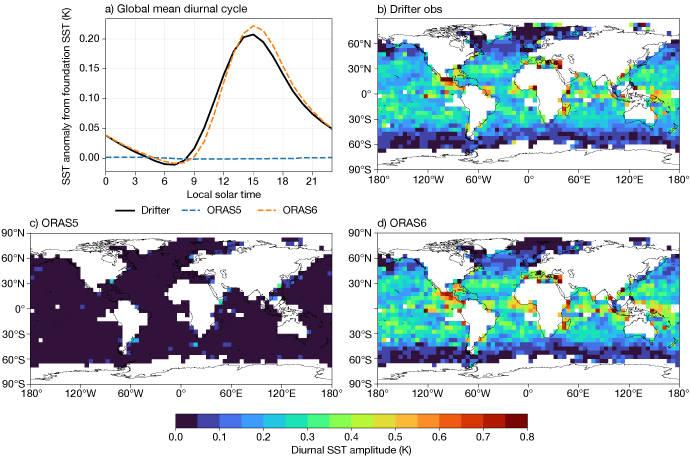
Global sea-surface temperature diurnal cycle from ORAS5, ORAS6 and drifter observations in 2021.
Earlier systems captured broad patterns in SST well, but ORAS6 can better represent shorter-term variations, including the daily warming and cooling cycle at the ocean surface. This improvement is made possible by combining hourly atmospheric information from ERA5 with direct assimilation of SST observations. Comparisons with drifting ocean observations show much closer agreement with observed daily temperature changes than in previous versions.
ORAS6 also improves the representation of important ocean regions and variables. These advances include a better simulation of the Gulf Stream, improved sea-surface height, and better performance for sea-ice concentration.
Overall, ORAS6 provides a substantially improved estimate of the upper ocean and ocean transports, which are crucial for understanding how heat and water move around the globe.
“ORAS6 brings together more than eight years of development and introduces important advances, including improved representation of sea-surface temperature, ocean circulation, and sea ice. Together, these changes provide a more accurate picture of the evolving ocean state,” said Hao Zuo, Senior Scientist in Ocean Data Assimilation.
These advances matter because a more accurate representation of ocean conditions helps improve forecasting systems across a range of timescales. In medium-range forecasting, improvements in ORAS6 mean that ECMWF no longer needs the previous workaround of restricting full ocean–atmosphere coupling outside the tropics. Benefits are also seen in sub-seasonal and seasonal forecasting, particularly for sea-surface temperature.
The system will eventually provide a record from 1950 to the present day, offering a long-term view of changes in the global ocean and sea ice. This long record will support climate monitoring, provide the ocean and sea-ice foundation for ERA6, and offer a framework for assessing and designing the global ocean observing network for applications such as weather forecasting and real-time monitoring.
ORAS6 production and data release
ORAS6 for the altimeter period (from 1993 onwards) has been produced, and data consolidation is now under way. Hourly two-dimensional fields and daily three-dimensional fields for this period will be released shortly to Member States and external collaborators.
Production of the early ORAS6 stream from 1950 onwards is continuing, with completion expected in August 2026.
Further information
Acknowledgements
ORAS6 benefits from projects funded by the EU's Copernicus Climate Change Service (C3S, implemented by ECMWF), including ERGO and ERGO2, as well as projects funded by the EU's Copernicus Marine Service (CMEMS, implemented by Mercator Ocean International), including GLORAN2 and GLORAN3.