

© ZambeziShark / iStock / Getty Images Plus
A new scoping study carried out under the Strengthening Early Warning in Africa (SEWA) initiative has explored how impact-based forecasting and early warning systems could be strengthened across Sub-Saharan Africa through improved coordination, data access and regional collaboration.
Commissioned by ECMWF, as part of the Africa–EU Space Partnership Programme (AESPP), the study provides a comprehensive assessment of the current landscape of early warning and impact-based forecasting initiatives across the continent.
Through a number of regional “storylines”, the study examines how forecasts, exposure data and institutional coordination systems interact within the broader warning chain during severe weather and climate events.
The scoping study was conducted by a consortium led by HKV, together with the Netherlands Red Cross 510, Deltares and TAHMO.
Karolin Eichler, SEWA Partnership Management and Training Specialist at ECMWF, said: “The SEWA scoping study provides an important evidence base for understanding the current early warning landscape across Africa and identifying areas where collaboration, capacity development and impact-based forecasting approaches could help strengthen preparedness for hazardous weather and climate events.”
Understanding the current early warning landscape
The scoping study is intended as a foundational step to help inform future activities under SEWA. Across Africa, severe weather and climate events such as floods, heatwaves and tropical cyclones are posing increasing risks to lives, infrastructure and livelihoods. At the same time, many institutions face challenges in accessing, processing and applying advanced weather and climate data within operational early warning systems.
To support future planning, the study examined existing early warning and impact-based forecasting initiatives, stakeholder needs, hazard priorities, sustainability considerations and opportunities for regional cooperation. The work covered literature reviews and initiative mapping, stakeholder workshops, hazard and impact assessments and came with concrete sustainability pathways and regional action planning.
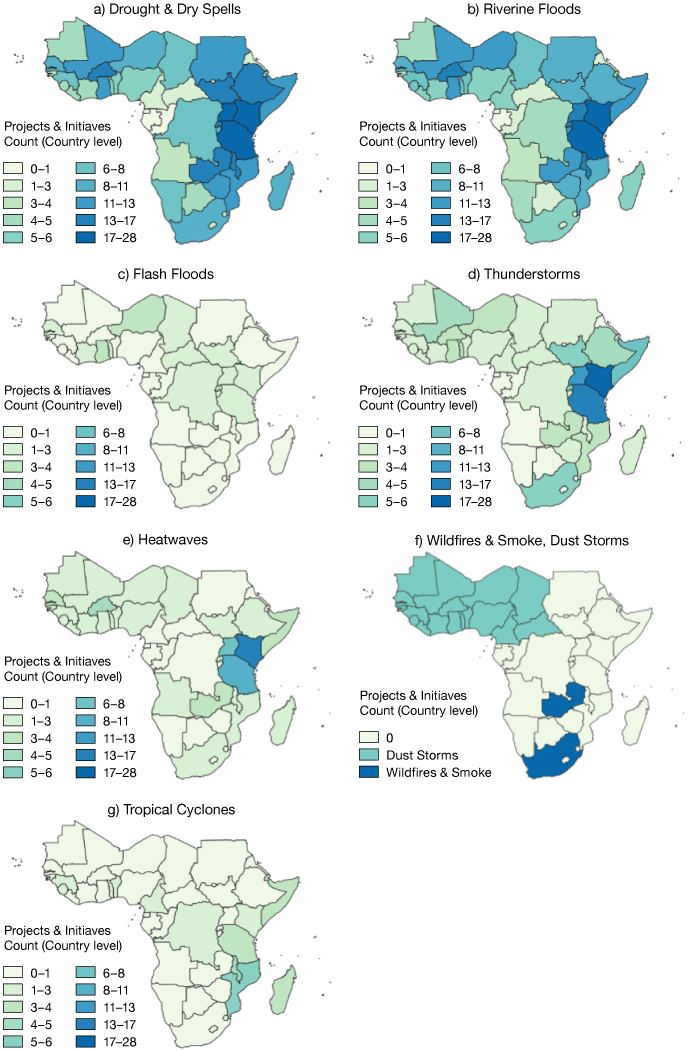
Number of existing projects and initiatives by hazard type identified in the scoping study.
Learnings from real-world events
The regional storylines developed through the study illustrate how severe weather events have affected different regions of Africa and how improved impact-based forecasting approaches could help strengthen preparedness and response.
The storylines examine real-world events and related impacts including the 2024 Sahel heatwave, heavy rain and widespread flooding across Eastern Africa in 2024, riverine flooding in West and Central Africa, and Tropical Cyclone Freddy in Southern Africa in 2023.
Katie Egan, SEWA Scientific Officer in the Forecasts and Services Department at ECMWF, said: “Forecasting is only one part of an effective early warning system. The challenge is ensuring that warnings are translated into meaningful information that helps authorities, responders and communities take action before impacts escalate.”
The scoping study also explores how datasets generated by European and African communities, forecasting systems and regional coordination mechanisms could complement existing national and regional early warning efforts. These include the use of ECMWF and Copernicus data and services, alongside partnerships with African Regional Climate Centres, National Meteorological and Hydrological Services, Regional Specialised Meteorological Centres and other stakeholders.
Deliverables from the study are available on the SEWA webpage, including a synthesis report, hazard prioritisation assessment, storylines and an interactive dashboard bringing together information on hazards, exposure, vulnerability, datasets and training initiatives across Africa.
Strengthening early warning through international collaboration
As climate- and weather-related risks continue to grow, initiatives such as SEWA form part of a wider international effort to strengthen anticipatory action and improve access to risk-informed warning systems. Recently, ECMWF joined the Risk-informed Early Action Partnership (REAP), which works to strengthen early warning and early action financing worldwide.
SEWA forms part of the AESPP, a programme supported by the European Union under the Global Gateway strategy, to strengthen cooperation between African and European institutions through the use of space-based technologies and services. Within this, SEWA focuses on strengthening early warning systems for hazardous weather- and climate-related events.
The four-year SEWA Action began in January 2025 and is implemented by ECMWF, the African Union Commission and the European Organisation for the Exploitation of Meteorological Satellites (EUMETSAT). Under the programme, ECMWF focuses on promoting the use of ECMWF, Copernicus (the Earth observation component of the EU’s space programme), and other European datasets, with the aim of co-developing impact-based forecasting demonstration services and tools with African partners at a regional level.
SEWA also contributes to the broader objectives of the United Nations Early Warnings for All initiative, which aims to ensure that everyone on Earth is protected by multi-hazard early warning systems.