

The third phase of Destination Earth (DestinE) was confirmed by the European Commission on 1 February 2026.
DestinE is an initiative of the European Commission to build a highly accurate digital replica of the Earth system to enable the exploration of past, present and likely future climate conditions and extreme events, including through the simulation of tailored ‘what-if’ scenarios. This helps European and national institutions better understand, prepare for, and adapt to climate- and weather-related risks.
Roberto Viola, Director-General for Communications Networks, Content and Technology (DG CNECT), European Commission, said: “Destination Earth demonstrates how Europe can transform major investments in supercomputing and artificial intelligence into concrete benefits for its citizens. By uniting world-class EuroHPC infrastructure, cutting-edge AI Factories, and Europe's unparalleled expertise in climate and weather science, DestinE strengthens our collective capability to anticipate climate and weather threats — and to act decisively on them. This is how Europe builds resilience.”
The initiative is jointly implemented by three entrusted entities: ECMWF, the European Space Agency (ESA), and the European Organisation for the Exploitation of Meteorological Satellites (EUMETSAT), under the leadership of DG CNECT.
During phases one and two, ECMWF worked in close partnership with over 100 partner organisations across Europe, including many national meteorological and hydrological services. This collaboration implemented the Climate Change Adaptation Digital Twin, the Weather-Induced Extremes Digital Twin and the Digital Twin Engine, which enables the digital twins to be run on the world-class systems of the European HPC Joint Undertaking. At the same time, significant progress was also made on a range of artificial intelligence (AI) capabilities, including the development of AI models for Earth system components.
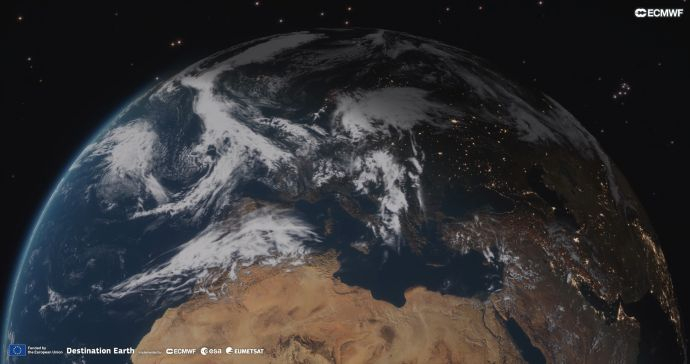
A view of the Digital Twin: an ultra‑high‑resolution 5 km simulation from the European Union’s Destination Earth initiative, visualising global cloud systems through liquid and ice water distribution with unprecedented clarity. Created by Andreas Mueller, ECMWF in the framework of the European Union Destination Earth Initiative with acknowledgement to EuroHPC Joint Undertaking. Credit: ECMWF Destination Earth.
Phase three: consolidation
In phase three, which will run from June 2026 to June 2028, ECMWF and its partners will focus on operating and further evolving the Climate and Extremes Digital Twins and the Digital Twin Engine. Work will also focus on advancing the AI models and solutions developed in Phase two, and on transforming digital twin data into high-quality AI-ready datasets that can feed into Europe’s AI Factories.
Florian Pappenberger, ECMWF Director-General, said: “Phase three allows us to consolidate the digital twins while taking the next major steps towards delivering an AI Earth-system model, building on the combined expertise of ECMWF, our Member States and partners. By integrating physical understanding with innovative AI approaches, we will further enhance Europe’s weather and climate prediction capabilities.
“This will support European national meteorological and hydrological services and other public institutions in preparing for extreme events in a changing climate and protecting communities. At the same time, the combination of high-resolution, AI-ready digital-twin datasets and Europe’s AI ecosystem, including AI Factories, creates the conditions for a new generation of AI applications for weather and climate and supports innovation across European industry and the public sector. Together, these developments strengthen Europe’s leadership in trustworthy AI for environmental intelligence, while supporting preparedness, resilience and innovation across Europe.”
Foundations from phases one and two
During phases one and two, ECMWF and partners across Europe implemented the core foundations of DestinE:
- The Climate Change Adaptation Digital Twin (Climate DT), which creates an operational framework for producing global, high-resolution, multi-decadal climate projections and for exploring tailored “what-if” scenarios.
- The Weather-Induced Extremes Digital Twin (Extremes DT), which sets up a flexible, modelling framework to simulate extreme weather events and their associated impacts at high-resolution, both globally and over European domains.
- The Digital Twin Engine, which orchestrates the digital twin workflows and data flows on EuroHPC supercomputers and DestinE infrastructure, enabling the production, handling and access of the high-resolution digital-twin data.
Since Phase two, DestinE has also seen a substantial expansion of AI activities. This included the development of machine-learning components for different parts of the Earth system (land, ocean, sea ice, waves and hydrology), making progress towards an AI Earth-system model that complements physics-based simulations, supports uncertainty quantification and rapid ‘what-if’ experimentation. It also included the prototyping of AI-based solutions, such as “forecast-in-a-box” and a digital twin assistant, designed to enhance interactivity with AI models and digital-twin data.
Irina Sandu, Director of Destination Earth at ECMWF, said: “Destination Earth is, above all, a collaborative European effort. It brings together expertise in Earth system modelling, software engineering, high-performance computing, and artificial intelligence, and leverages European and national investments in these areas. By pooling resources and working closely with our partners across Europe, we are building capabilities that complement existing national and European services and help European institutions and Member States prepare for the challenges posed by climate change and extreme events.”
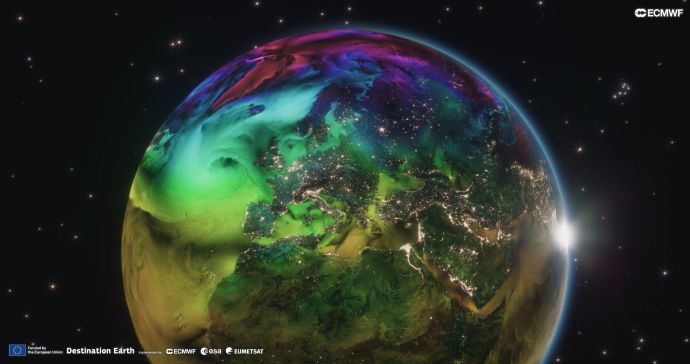
The digital twin: a global view of 2 m temperatures and 10 m wind speeds, where colour brightness reflects wind intensity. This high-resolution rendering blends scientific data with atmospheric effects and city night lights. Created by Andreas Mueller, ECMWF in the framework of the European Union Destination Earth Initiative with acknowledgement to EuroHPC Joint Undertaking. Credit: ECMWF Destination Earth.
More information on DestinE