

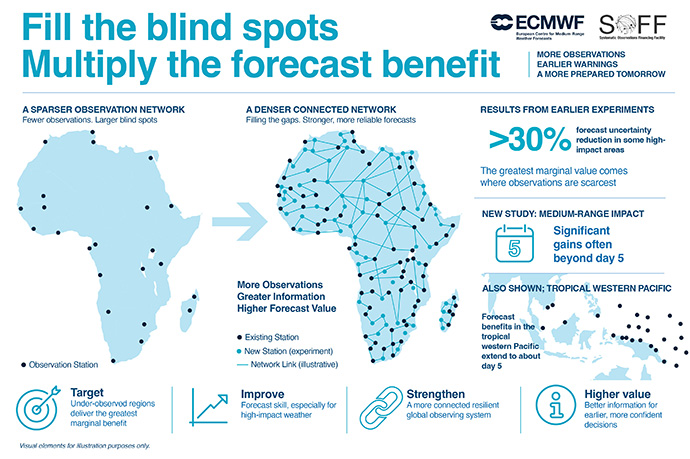
A new study from the European Centre for Medium-Range Weather Forecasts (ECMWF) provides evidence that increasing surface-based in-situ weather observations in data-sparse regions has the potential to improve the quality of forecasts given seven days ahead, both locally and globally.
Accurate weather forecasts are known to protect lives and livelihoods, and yet vast areas of the world are under-observed when it comes to in-situ surface-based measurements. Closing gaps where data is scarce strengthens the forecasting systems that all countries depend on.
To assess the potential benefits of bridging these gaps, the Systematic Observations Financing Facility (SOFF), commissioned ECMWF to carry out a series of science-based impact studies and experiments. The work was carried out in coordination with the World Meteorological Organisation (WMO).
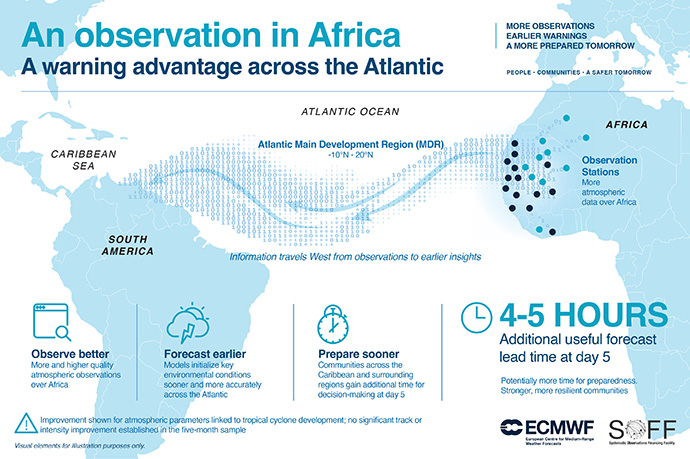
The study found that closing the observation gap has the potential to reduce short-range forecast uncertainty by around 30 percent in Africa and reduces uncertainty in forecasts of winds and humidity over the tropical Atlantic five days ahead, including in areas where many hurricanes develop. Improvements in the forecast of conditions that lead to hurricanes are potentially important for preparedness, such as in Caribbean Small Island Developing States.
The research also showed that expanding surface and upper-air observation networks in Pacific Small Island Developing States can reduce forecast uncertainty by up to 20%. In the Tropics, where 40% of the world population lives, additional observations improve forecasts of upper-air temperature and winds up to around seven days ahead.
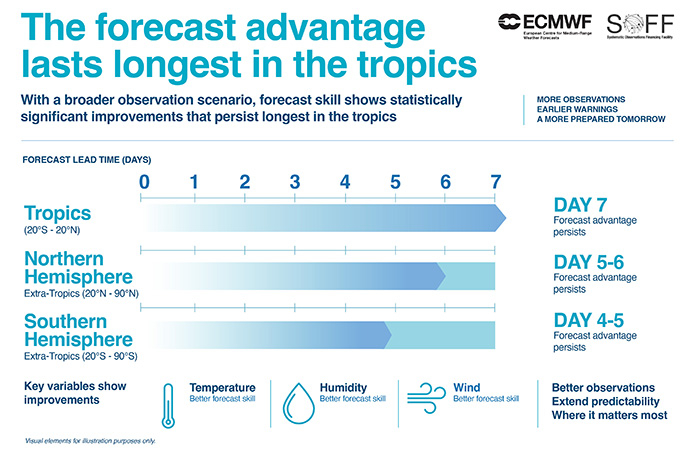
Beyond the tropics, improvements generally extend to forecasts given five to six days ahead in the Northern Hemisphere and four to five days in the Southern Hemisphere, depending on the weather measure.
The study showed that adding new stations where weather data is scarce, such as in Least Developed Countries and Small Island Developing States (SIDS), can contribute substantially more to forecast quality than when they are placed in an already well-observed region. Overall, closing gaps across all countries eligible for development assistance and Small Island Developing States generally delivers greater improvements than covering Least Developed Countries and SIDS alone.
Professor Celeste Saulo, WMO Secretary General, said: “An observation is like a streetlight. It lights the whole street, not just the house that paid for it. Every station a SOFF country brings online is a new light on that street. And the more lights we have, the better our observations, the better our forecasts and the more lives we save”.
To test how far forecasts could be improved if basic weather and climate in-situ observation gaps were closed, ECMWF simulated the additional observations that would be available if countries met WMO’s Global Basic Observing Network (GBON) requirements and compared forecasts with and without those observations.
The experiments were carried out in three phases. The first phase reviewed existing evidence and confirmed that surface-based observations remain essential alongside satellite data, helping improve forecasts locally and globally. Satellites provide broad coverage, while stations and balloons directly measure temperature, humidity, pressure and winds at the surface and higher in the atmosphere. Together, these observations help produce more accurate forecasts and surface and upper-air observations help calibrate and correct satellite measurements.
The second phase simulated different expansions of surface, upper-air and marine observing networks, finding that additional observations improve short-range forecasts (up to two days ahead).
The final phase extended the analysis to medium-range forecasts (three to ten days).
Principal Scientist at ECMWF, Sean Healy, said:
“In our study we aim to show that improved in-situ measurement coverage could lead to improvements in forecasting. With the surface measurements likely to become even more important as forecasting technology evolves and machine-learning forecasting and data-assimilation methods develop, we hope the study shines a light on the need to keep improving access to observations and that our predicted improvements in forecasting can materialise”.
Volkan Mutlu Coşkun, Director-General of the Turkish State Meteorological Service (TSMS), stated:
“High-quality weather forecasts begin with reliable observations. At the Turkish State Meteorological Service, we continuously invest in strengthening and modernising our surface and upper-air observing systems, recognising that accurate and timely observations are essential for improving forecasts and early warnings. As a WMO Regional WIGOS Centre, we also contribute to regional efforts to improve observation quality, data availability and international data exchange. This study clearly demonstrates that investments in observing systems benefit not only individual countries but the entire global meteorological community. Strengthening observation networks, particularly in data-sparse regions, must remain a shared international priority.”
Florian Pappenberger, Director-General of ECMWF, concluded:
“Closing the gap in observations is a crucial part of the puzzle when it comes to improvements in forecasting. Whether it is satellite, or in-situ surface-based, in one corner of the globe or another, every additional observation provides us with important information for the benefit of all. When combined with sophisticated numerical models and computing capabilities, our forecasts provide the information needed by decision-makers to help protect lives and livelihoods”.
The results are the third and final phase of a three-phase report which is available here.
Notes to editors
ECMWF Media contact:
For further information, please contact: pressoffice@ecmwf.int
About ECMWF
The European Centre for Medium-Range Weather Forecasts (ECMWF) is a world leader in numerical weather prediction, providing high-quality data for weather forecasts and environmental monitoring. As an intergovernmental organisation, ECMWF collaborates internationally to serve its 35 Member and Co-operating States and the wider community with global weather predictions, data, and training. ECMWF’s research and operational centre operates 24/7, focusing on medium- and long-range forecasts, and maintains one of the world’s largest meteorological data archives, including ERA5, funded by the EU Copernicus programme.
Our mission: Deliver global numerical weather predictions focusing on the medium-range and monitoring of the Earth system to and with our Member States.
About SOFF
The Systematic Observations Financing Facility (SOFF) is the United Nations fund innovating finance to close the basic weather and climate data gap in the world’s most resource-constrained regions. SOFF provides grants and peer-to-peer technical assistance to generate and sustain surface-based observations that meet the internationally agreed Global Basic Observing Network (GBON) standards. SOFF delivers a global public good that strengthens forecasts, improves early warnings, and supports climate-resilient development everywhere.
Image credit: ECMWF