

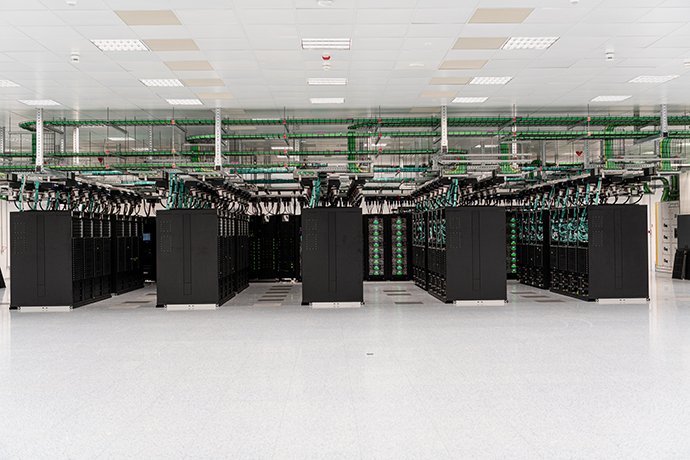
ECMWF's high-performance computing facility, in Bologna, Italy. Photographer: Stefano Marzoli
ECMWF has emphasised the critical role of high-performance computing (HPC) in securing Europe’s leadership in weather and climate prediction, during the ISC High Performance conference held this week in Hamburg, Germany.
Chairing a session on Earth system modelling at the conference, Peter Dueben, Head of Earth System Modelling at ECMWF, emphasised that: "Earth system modelling is advancing at extraordinary pace from kilometre‑scale physical models powered by exascale computing to a new generation of AI forecasts driven by GPUs. But none of this is possible without sustained, strategic investment in HPC.”
For over 50 years, ECMWF has delivered world-leading forecasting capability by bringing together the expertise and resources of its Member and Co-operating States. Today, that collaborative model faces a new challenge: forecast performance is increasingly defined by access to computing power, data and artificial intelligence (AI).
“HPC is not simply infrastructure for ECMWF: it is a uniquely shared asset, benefiting all, and is the engine of Europe’s forecasting capability,” said Florian Pappenberger, Director-General of ECMWF.
“International collaboration is achieved through trusted, shared capabilities, resilience, and expertise. Investing in the next HPC dedicated to ECMWF will ensure that the collaborative European model remains a source of European strength in the AI era. The next HPC is critical and benefits every Member State, while reinforcing Europe’s strategic autonomy.”
A shared European capability
The next generation of HPC will enable advances in AI-driven prediction, operational forecasting and European services, including Copernicus services and digital twin initiatives within Destination Earth (DestinE), ensuring Europe remains at the forefront of scientific and technological innovation.
Florian Pappenberger adds: “By investing together, ECMWF and Europe protects its ability to deliver trusted, independent weather and climate intelligence across numerous sectors, that saves lives, supports decisions and strengthens resilience. This is European cooperation at its best: the whole is far greater than the sum of its parts.”
Investing now to protect lives, unlock innovation and strengthen European resilience
In a rapidly evolving global landscape, greater computing capacity enables better forecasts, faster innovation and more trusted, independent services for governments, businesses and citizens.
As the conference closes, ECMWF sends a clear message: investing in computing power is not optional; it is essential. Without it, Europe falls behind. With it, every Member State can deliver life‑saving early warnings, meet global commitments such as Early Warnings for All and the Sendai Framework, and accelerate better forecasts, faster innovation, and trusted, independent services for governments, businesses and citizens, delivering a public good no one else can.
With strategic HPC investment, ECMWF can:
- Keep Europe at the forefront of forecasting and AI-enabled prediction
ECMWF’s competitive advantage depends on the ability to run increasingly complex Earth-system models, larger ensembles and AI/ML workflows at operational speed. By adequately investing in the next generation of computing capacity, Europe can turn its scientific expertise into better operational forecasts more quickly, supporting governments in their mandate to protect life and property.
- Turn Europe’s satellite, science and service investments into real-world value
Satellite missions, observational networks, Copernicus services and digital twin initiatives deliver their full value when their data can be processed, assimilated, stored and transformed into usable products. As a major user of satellite data, ECMWF makes the most of these upstream investments by ensuring better data is matched with the computational power needed to exploit it fully.
- Secure Europe’s independence in critical weather and climate intelligence
ECMWF’s computing capability is a shared European asset that supports Member and Co-operating States, national meteorological services, Copernicus and EU digital twin initiatives. Continued investment strengthens Europe’s strategic autonomy by reducing dependence on external infrastructures and ensuring that critical weather and climate intelligence remains trusted, independent and available when it is most needed for resilience, security, energy, transport and climate adaptation.
“Maintaining capability is far more effective than trying to rebuild it later,” added Pappenberger. “The choices we make now will determine whether Europe remains a global leader for critical weather and climate intelligence or not.”
A timely opportunity for governments to work together
ECMWF emphasised that continued progress depends on the collective commitment of its 35 supporting nations. By investing together, ECMWF can sustain a model that delivers excellence, efficiency and resilience. It ensures all countries benefit and brings resilience and added value to any existing national capacity and capabilities.
With global competition accelerating, the message from ISC is clear: Europe has the expertise and the collaborative model but must match it with the computing power required to lead.