

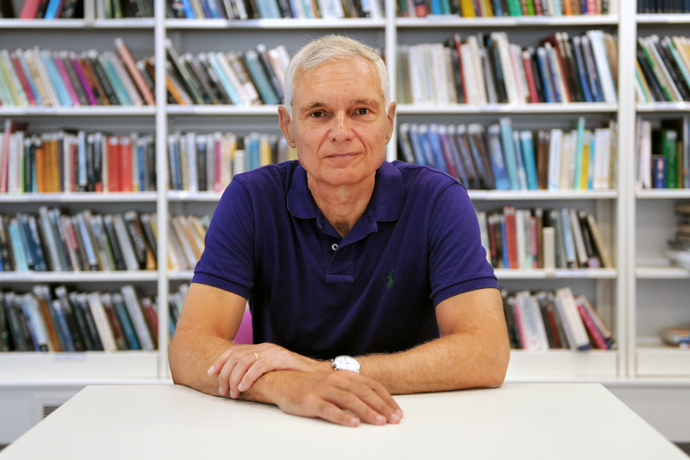
For more than 17 years, Massimo Bonavita has helped advance ECMWF’s operational forecasting systems.
As Principal Scientist and Team Leader for Data Assimilation Methodology, his work focuses on improving the way observations are combined with numerical models to produce the best possible estimate of the current state of the atmosphere – the essential starting point for every forecast.
Today, his attention is on the future. With machine learning reshaping weather prediction, Massimo is helping ensure that these new techniques strengthen the scientific foundations that have underpinned forecasting for decades.
“We're entering a new era,” he says. “The challenge is to make the best use of these new tools while building on the science that has brought us this far.”
Discovering data assimilation
Massimo’s career has spanned physics, software engineering and meteorology. After studying physics at university, he began his career as a software developer before joining the Italian Meteorological Service, an organisational unit of the Italian Air Force responsible for Italy’s national meteorological service.
There, he discovered the practical applications of weather forecasts. During his time in the air force, he spent a year at the Naval Postgraduate School in California, completing a master's degree in meteorology.
It was during that year that he met one of the people who would have the greatest influence on his career: meteorologist Roger Daley, widely recognised as one of the pioneers of modern data assimilation.
“You could say that Roger was the “godfather” of data assimilation,” Massimo reflects.
“I was incredibly fortunate. Roger was willing to spend an hour a week with me, giving me guidance.”
This mentorship sparked Massimo’s lifelong interest in data assimilation, and in 2009 the opportunity to join ECMWF came at exactly the right moment.
“It felt like the stars aligned,” he says. “ECMWF was the place where I could apply my specific knowledge and interests.”
Innovation powered by teamwork
Massimo joined ECMWF as a data assimilation scientist before later leading the Data Assimilation Methodology team as it evolved over time. While he no longer spends most of his time writing code, he continues to play a central role in shaping the strategic direction of the team.
"Fundamentally, my role is to help define a strategic direction for data assimilation, working with colleagues to identify ideas and priorities that can be turned into practical developments."
One achievement he is particularly proud of is his contribution to the development of the Ensemble of Data Assimilations (EDA), which brought uncertainty estimation into ECMWF’s 4D-Variational Data Assimilation (4D-Var) system. The approach has become an integral part of ECMWF's Integrated Forecasting System (IFS) and continues to evolve today.
Throughout his career, however, Massimo is quick to emphasise that scientific and technical progress is never an individual effort.
"We have a large number of talented people at ECMWF," he says. "One of the things I enjoy most is talking with colleagues. Even when we don't agree, that's part of the scientific process. We challenge each other, look at the evidence and end up with better solutions."
Embracing the AI era
Among the biggest changes Massimo has witnessed in his career is the emergence of machine learning.
Rather than seeing it as a replacement for established methods, he believes it offers an opportunity to make existing approaches both faster and more powerful.
“We need to use machine learning tools as force multipliers. It's about integrating these new tools into our workflow so we can make it both more efficient and more effective."
His team is already exploring how machine learning can emulate computationally expensive parts of the data assimilation process, allowing larger ensembles to be generated at a fraction of the computational cost.
For Massimo, maintaining a strong scientific foundation remains essential as forecasting systems continue to evolve.
Bringing communities together
In recent years, Massimo has also helped organise the ECMWF–ESA Workshop on Machine Learning for Earth Observation and Prediction since its launch in 2021.
The fifth edition took place in Bologna, Italy, in April this year, bringing together over 200 participants in person and 258 online.
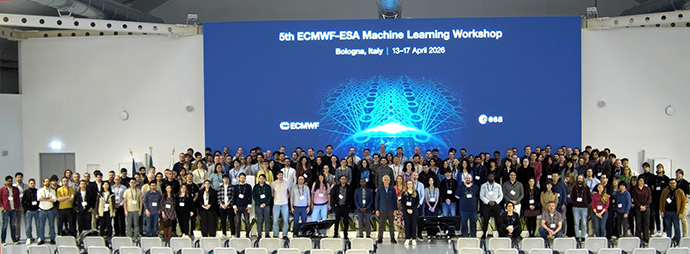
Participants at the 5th ECMWF–ESA Workshop on Machine Learning.
This year’s programme focused on a range of themes, including hybrid AI–physics systems; machine learning (ML) for data assimilation, weather and climate prediction; ML applications for Earth system observations; high-performance and emerging computing technologies; and the use of ML in digital twins of the Earth system.
“This workshop brings together different communities,” he says. “We have experts in numerical weather prediction, climate, Earth observation, high-performance computing and machine learning, all in the same room. It’s a platform for discussion and networking across disciplines.”
The event has grown steadily since its first online edition in 2021 and now attracts hundreds of participants from around the world, reflecting the increasing importance of machine learning across Earth system science.
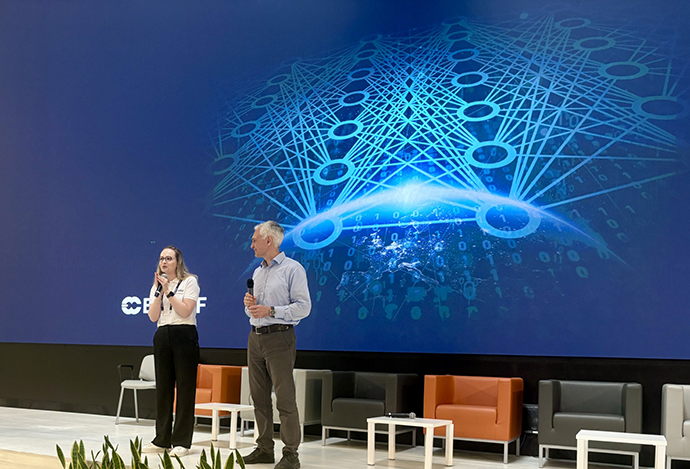
Rochelle Schneider (ESA) and Massimo Bonavita (ECMWF) at the 5th ECMWF–ESA Machine Learning Workshop.
Looking to the future
Although retirement is beginning to appear on the horizon, Massimo's enthusiasm for the future of data assimilation remains undiminished.
He is particularly excited by the next generation of data assimilation methods, by new ways of combining machine learning with established data assimilation techniques.
Looking ahead, he sees major potential in applying advanced forms of 4D-Var to future reanalyses, making even better use of observations to improve our reconstruction of past weather and climate.
“The beauty of 4D-Var is that it’s a system that is able to use, not only past observations, but also observations into the future.”
When retirement eventually arrives, he could see himself spending time teaching and mentoring early-career scientists. For many years, he has helped deliver a data assimilation training course in collaboration with the University of Reading, which attracts strong interest.
“I really enjoy teaching and interacting with young people," he says. "Every year we receive far more applications than we have places, which shows how much enthusiasm there is for this field. I'd like to spend more time sharing that excitement with the next generation.”
Looking back, Massimo credits much of his own career to the generosity of those who shared their knowledge with him. Looking ahead, he hopes to do the same for the next generation.