

At least 95% of Europe experienced above-average annual temperatures in 2025, according to the European State of the Climate (ESOTC) 2025 report published today.
Warming is reducing snow and ice cover, while dangerously high surface air temperatures, drought, and heatwaves, as well as record-high ocean temperatures, are affecting regions across the continent, from the Arctic to the Mediterranean. The result is increasing impacts – from record heatwaves over land and at sea, to devastating wildfires, and accelerating biodiversity loss – with consequences for societies and ecosystems across Europe.
The ESOTC report is produced by the EU’s Copernicus Climate Change Service (C3S), implemented by ECMWF, and the World Meteorological Organization (WMO), and brings together the work of around 100 scientific contributors.
It provides a comprehensive overview of key changes in climate indicators for the world’s fastest-warming continent, including cold environments, marine ecosystems, rivers and lakes, wildfire risk, and more.
ECMWF Director-General Florian Pappenberger said: “Europe is the fastest-warming continent, and the impacts are already severe. Almost the whole region has seen above-average annual temperatures. In 2025, sub-Arctic Norway, Sweden and Finland recorded their worst heatwave on record with 21 straight days and temperatures exceeding 30°C within the Arctic Circle itself. The 2025 report offers clear, actionable insights to support policy decisions and help the public better understand the changing climate we live in.”
WMO Secretary-General Celeste Saulo said: “The WMO State of the Climate has revealed the imbalance of energy on our planet, and the European State of the Climate produced jointly by WMO and ECMWF reflects the impacts for Europe. Our joint effort to produce the ESOTC reflects how climate change is impacting biodiversity and the bold initiatives taken by European policy makers to protect and restore it.”
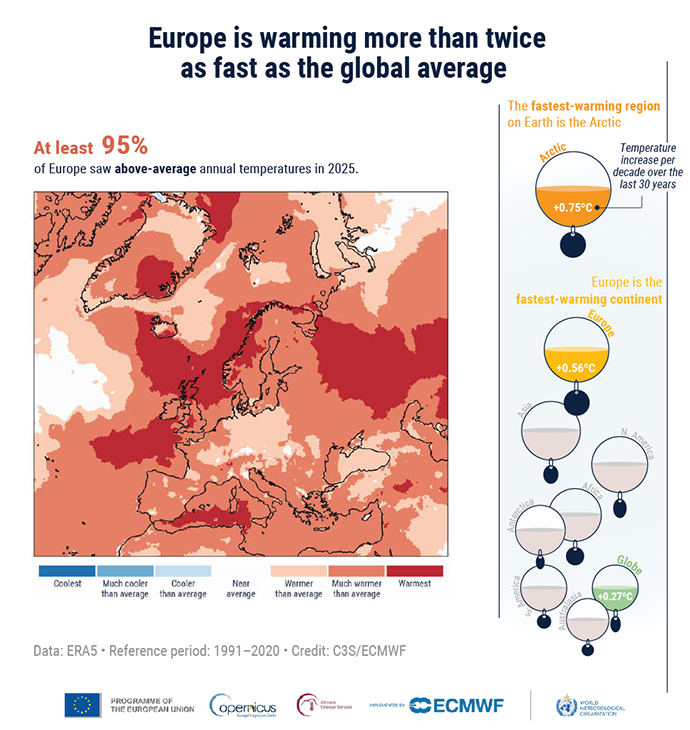
(Left) Anomalies and extremes in annual surface air temperature in 2025. The extreme categories (‘coolest’ and ‘warmest’) are based on rankings for 1979–2025. The other categories describe how the temperatures compare to their distribution during the 1991–2020 reference period. ‘Much cooler/warmer than average’ – cooler/warmer than 90% of temperatures; ‘cooler/warmer than average’ – than 66% of temperatures; ‘near average’ – within the middle 33%. (Right) Visual representation of anomalies in average temperature over the globe, for each continent based on the IPCC regions, and the Arctic. Linear trends are indicated for the last 30 years (1996–2025) for the globe, Europe and the Arctic. Data: ERA5. Credit: C3S/ECMWF
Rapid warming in Europe’s colder regions
The report shows a continuing trend of rapid warming across Europe’s coldest regions, including in the Arctic and the Alps, where snow and ice play a critical role in slowing climate change by reflecting sunlight back into space.
The area of Europe experiencing winter days with freezing temperatures is shrinking. Europe as a whole also experienced a record low number of cold stress days in 2025, with 90% of the continent experiencing fewer days than average with at least ‘strong’ cold stress.
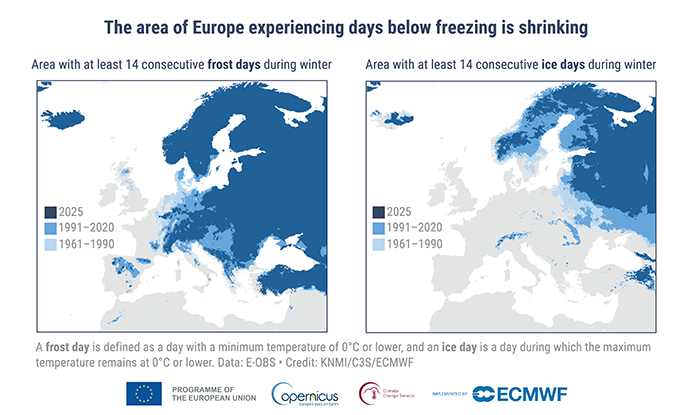
The area of Europe that experienced at least 14 consecutive (left) ‘frost days’ and (right) ‘ice days’ in 2025 (dark blue) compared to the 1991–2020 average (medium blue) and the 1961–1990 average (light blue). A frost day is defined as a day with a minimum temperature of 0°C or lower, and an ice day is a day during which the maximum temperature remains at 0°C or lower. Data: E-OBS. Credit: KNMI/C3S/ECMWF
Above-average temperatures and below-average precipitation led to a significant reduction in snow and ice cover. In March 2025, the snow-covered area in Europe was around 31% below average – the third lowest snow extent since records began in 1983. Glaciers also experienced a net mass loss, with Iceland recording its second-largest glacier mass loss on record. The Greenland Ice Sheet lost 139 gigatonnes (139 billion tonnes) of ice – contributing 0.4 mm to global sea level rise.
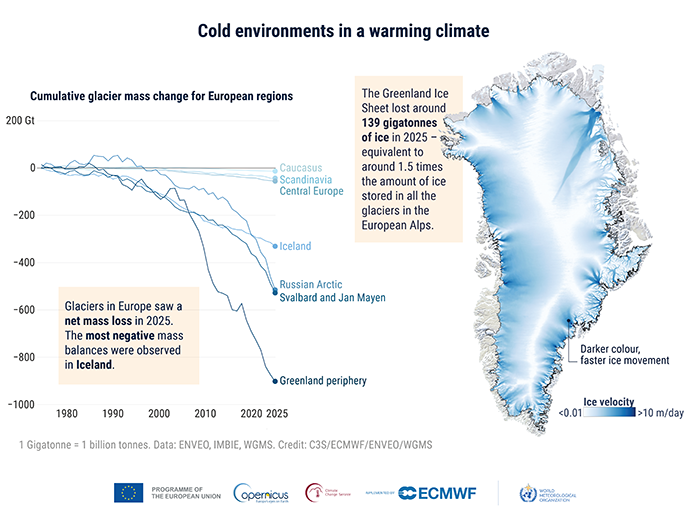
(Left) Cumulative glacier mass change (Gt) for European glacier regions from 1976 to 2025. Gt = gigatonnes = 1 billion tonnes. Data: WGMS. Credit: WGMS/C3S/ECMWF. (Right) Greenland Ice Sheet ice flow velocity for the 2025 hydrological year. Data: IMBIE, ENVEO. Credit: ENVEO/C3S/ECMWF
Above-average summer temperatures and heat stress
Summer temperatures were above average across much of the continent in 2025, with several heatwaves.
July saw Europe’s second most severe heatwave on record, lasting 25 days (7–31 July) and affecting a large part of the continent
In Türkiye, temperatures reached 50°C for the first time, with 50.5°C recorded at Silopi. In Cyprus, temperatures reached 44.7°C, a new record for July.
Sub-Arctic Fennoscandia saw its longest heatwave on record in July, spanning three weeks. During this period, temperatures close to and within the Arctic Circle exceeded 30°C, peaking at 34.9°C in Frosta, Norway.
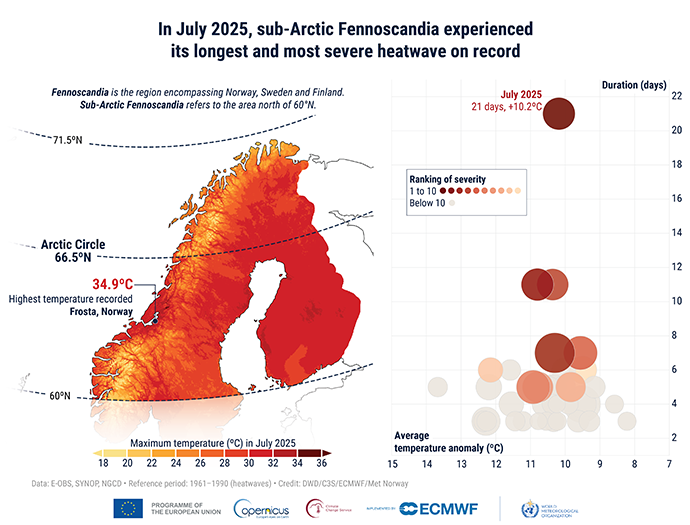
(Left) Maximum temperature in July 2025. Data: NGCD. Credit: Met Norway/C3S/ECMWF. (Right) Heatwaves in sub-Arctic Fennoscandia since 1950. The circle size is proportional to the area affected by the corresponding event. The 10 most severe heatwaves are indicated by darker colours and grey indicates those with a severity ranking below 10. Sub-Arctic Fennoscandia is defined here as mainland Norway, Sweden and Finland north of 60°N (60°–72°N, 4°–32°E). Severity is based on a combination of the average temperature anomaly relative to the 1961–1990 reference period, the duration and the area affected. Data: E-OBS, SYNOP. Credit: DWD/C3S/ECMWF
In 2025, much of Europe (41%) also experienced more days than average with at least ‘strong’ heat stress, with southern and eastern Spain recording up to 50 more days than average with ‘feels-like’ temperatures above 32 ºC.
Samantha Burgess, Strategic Lead for Climate in the Copernicus Climate Change Service (C3S), said: “The ESOTC 2025 paints a stark picture: the pace of climate change demands more urgent action. With rising temperatures, and widespread wildfires and drought, the evidence is unequivocal; climate change is not a future threat, it is our present reality. In confronting the impact on biodiversity loss, we need to match the speed of adaptation happening in the clean energy transition and at the same time, ensure robust science continues to underpin our policies and decisions.”
Record marine heat and ocean warming
The annual average sea-surface temperature (SST) for the European region was the highest on record for the fourth consecutive year. Marine heatwaves affected 86% of the region, with 36% experiencing ‘severe’ or ‘extreme’ conditions – the highest proportion on record.
The entire Mediterranean Sea experienced at least one day with ‘strong’ marine heatwave conditions in each of the past three years. In the Norwegian Sea, ‘severe’ marine heatwave conditions also occurred in 2025.
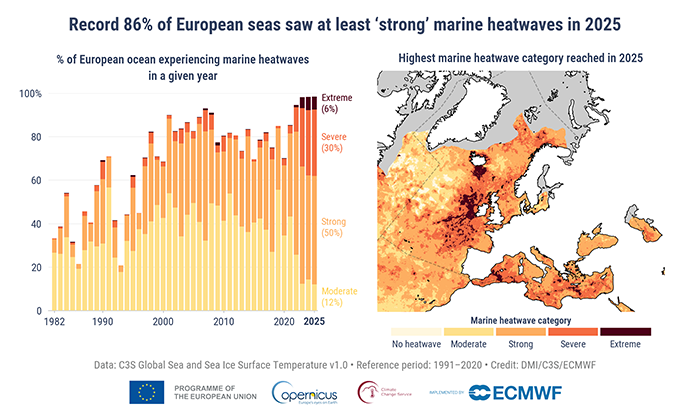
(Left) Percentage of the area of the WMO RA VI (Europe) ocean region experiencing marine heatwave conditions each year from 1982 to 2025, shown for four intensity categories: ‘moderate’ (yellow), ‘strong’ (light orange), ‘severe’ (dark orange) and ‘extreme’ (brown). For each year, the percentage is based on the highest intensity reached at each location within the region. (Right) Map showing the highest marine heatwave category experienced at each location during 2025. Marine heatwaves are defined relative to the 1991–2020 reference period. Data: C3S Global Sea and Sea Ice Surface Temperature v1.0. Credit: DMI/C3S/ECMWF
Drier-than-average conditions across much of Europe in 2025
Much of Europe saw drier-than-average conditions in 2025, but with strong regional contrasts. A large area from northwestern to eastern Europe saw below-average precipitation, and it was one of Europe’s three driest years for soil moisture since 1992. In May, around half of Europe (53%) was affected by drought conditions. Annual river flow was below average in 70% of rivers, and while storms and flooding affected some areas, overall extreme precipitation and flooding were less widespread than in recent years.
Wildfires: burnt area in Europe reached a record level in 2025
A record area of around 1,034,000 hectares burnt across Europe in 2025. The largest contributions came from fires across the Iberian Peninsula in August.
Emissions from fires reached their highest levels on record in 2025, with Spain contributing around half of the total. Spain, Cyprus, the United Kingdom, the Netherlands and Germany all saw record annual high emissions.
Read the report
The European State of the Climate 2025 report is published on the C3S website.