

Image: Bjoern Wylezich / iStock / Getty Images Plus
As world events bring energy security to the fore and climate change continues to drive moves towards a lower-carbon economy, ECMWF is helping to unlock new possibilities in offshore wind-power production.
The Horizon Europe-funded ‘Federated Digital Twins for Wind-Offshore’ (DTWO) project is creating a first-of-its-kind digital twin to address some of the challenges facing the wind energy sector such as siting, wake effects and grid integration of ever taller turbines and more complex systems. For example, the digital twin will allow users to investigate optimal locations of new wind farms, generation potential and the impacts of extreme events like storms and high waves.
Starting in June 2024, the project has recently passed its halfway point with key milestones achieved.
The project brings together expertise from the world’s largest offshore wind turbine manufacturer with research centres, academia, IT, and energy and weather-forecasting institutions, totalling 12 organisations from nine countries.
Clara Ducher, Research Software Engineer, and Antonino Bonanni, Computational Scientist, co-lead the ECMWF section of the project. Clara said: ”Developing a digital twin focused on offshore wind is a fantastic example of putting ECMWF’s Earth system simulations into practice – evidenced not least by the project’s industrial partners. It’s also good to know that our efforts are helping to bring ECMWF data to other weather-sensitive sectors.”
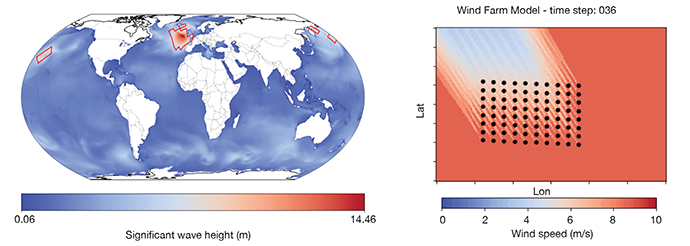
The team at ECMWF have worked on the identification of high-impact weather (such as extreme waves) and the integration of wind farm simulations with ECMWF’s cutting-edge Earth system models.
The DTWO project uses the Digital Twin Engine, being developed under the EU’s Destination Earth (DestinE) initiative, to integrate newly developed DTWO plugins with the DestinE Earth system digital twins.
DestinE is jointly implemented by three entrusted entities: ECMWF, the European Space Agency (ESA), and the European Organisation for the Exploitation of Meteorological Satellites (EUMETSAT), under the leadership of the Director-General for Communications Networks, Content and Technology (DG Connect).
Project modelling capabilities
Modelling capabilities from across the project partners will be combined in five areas:
Earth (led by ECMWF): providing advanced modelling of atmospheric, ocean and wave conditions crucial for offshore wind planning and operating.
Wakes: modelling how wind turbines and wind farms interact with each other – guiding where wind turbines should be located to maximise energy production.
Siting: assessing wind resources, environmental conditions and turbine design to identify the most efficient and cost-effective offshore wind-farm locations.
Turbine: monitoring turbine health and predicting reliability, maintenance needs and component lifetimes to reduce downtime and operational costs.
Grids: analysing grid connectivity, energy markets and storage integration to support investment planning and reliable offshore wind power delivery.
Use cases defined by industrial partners will allow users of the platform to investigate wind farm planning and siting, turbine monitoring and turbine operations.
ECMWF led the Earth module to completion at the end of 2025 and is now working on integrating the Siting and Turbine modules into the DTWO platform, as well as facilitating the use of Destination Earth data.
Plume plugin
The project capitalises on the Plume (plugin mechanism) framework, developed as part of the Digital Twin Engine in DestinE, and gives access to model data as a simulation is running.
Two new plugins have been created as part of the DTWO project. The first highlights extreme events, to identify potentially hazardous weather that could impact offshore wind farms and other infrastructure. The second plugin is for wind farm parametrization which provides power estimates and an assessment of wind impacts.
A Plume entry point in the ECMWF wave model (ecWAM) now allows plugins to process wave model fields. This could be used to detect extreme wave conditions that might prevent turbine maintenance operations.
As the project progresses, ECMWF will be contributing to evaluating the turbine wakes model integrated in a global model, including the investigation of two-way coupling between DTWO plugins and ECMWF’s Integrated Forecasting System (IFS), to dynamically capture how turbine wake effects might impact the wind resource for neighbouring wind farms for example.
On completion, the DTWO project is set to make a real contribution to science-based decision making in the sphere of offshore wind energy, helping to guide the transition to renewable energy across Europe and beyond.