

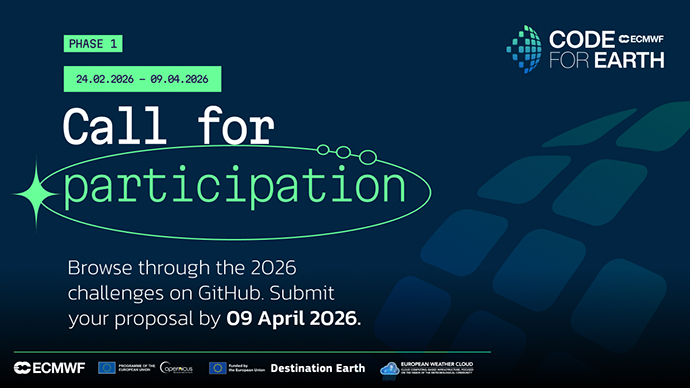
The deadline is fast approaching for applications to the 2026 edition of Code for Earth, ECMWF’s annual innovation programme.
Run every year since 2018, Code for Earth is an opportunity to join a community of experts in Earth sciences, computer science, artificial intelligence and machine learning to develop innovative open-source software.
Innovators are invited to deliver solutions to a range of challenges that aim to improve how Earth science data are used, visualised and interpreted, ultimately addressing today’s most pressing environmental and climate challenges.
Athina Trakas, ECMWF Innovation Actions and Partnerships Specialist and lead of the Code for Earth Coordination Team, said: “We’re waiting with anticipation to assess this year’s proposals.
"Code for Earth provides such a great opportunity to bring together expertise and novel thinking from across the computing, data science and Earth sciences communities. We hope many people will be inspired to propose innovative solutions to the challenges we raise.
"We would also like to remind people to look carefully at the eligibility criteria and the specific skills required for each challenge, which need to be checked for all team members.”
Four challenge streams and a new focus on Africa
This year’s challenges include rapid decision-making during wildfires, analysing global flood-forecast data from 10,000 monitoring stations, and detecting implausible behaviour in machine learning systems.
Challenges are grouped into four steams:
- Data visualisation
- Machine learning
- Software development
- Africa – introduced for 2026, with a focus on joint challenges with African partner organisations
The challenges are organised by ECMWF with support from the Copernicus Climate Change Service (C3S), the Copernicus Atmosphere Monitoring Service (CAMS), Destination Earth (DestinE) and the EU’s Africa Regional Centres of Excellence Programme (ArcX), in line with the EU’s Global Gateway strategy.
What happens next?
Following the submission deadline, proposals will be scrutinised by the challenge mentors drawn from ECMWF and Code for Earth partner organisations. Selected teams will be contacted later in April.
A four-month coding phase runs from May to August when teams work closely with their Code for Earth mentors to bring their projects to life. Project successes are celebrated at a Final Code for Earth Day in September when teams can come together to discuss their results.
All individuals or teams that complete their project successfully will be recognised for their achievements.
Ready to apply?
Applications are welcomed from teams and individuals. Participants are invited to submit proposals for any of the challenges they wish to address using the submission form on the Code for Earth website.
It is vital that participants check the eligibility details and the specific skills required for each challenge. For team submissions, these criteria need to be checked for each team member.
All applicants are encouraged to look carefully at the FAQs page and the Terms and Conditions on the Code for Earth website. The recordings of the Q&A webinars are available on the programme’s YouTube channel.
Applications for Code for Earth 2026 close strictly at 23:59 CEST on 9 April 2026.