


The 2025 edition of our annual forecast evaluation highlights significant improvements, which have been welcomed by representatives of our Member and Co-operating States who sit on ECMWF's Technical Advisory Committee (TAC).
In particular, the report highlighted an increase in ECMWF’s lead over other global weather forecasting centres in terms of the skill of medium-range upper-air forecasts, an important factor in the evolution of mid-latitude storms.
The accuracy of our operational forecasts is continually monitored, and a suite of verification statistics is published on the Centre’s website. Our annual forecast evaluation summarises performance and is presented to ECMWF’s Technical Advisory Committee for their feedback. This is one of the ways we collaborate with our users to improve our forecast services. Other examples include the annual ‘Using ECMWF Forecasts’ event and our Forecast User Portal.
Matthieu Chevallier, Head of Forecast Evaluation at ECMWF, said: “We’re a user-driven organisation, and feedback and assessment from our Member and Co-operating States on ECMWF forecast performance are extremely valuable. Forecast evaluation is hugely enriched by user feedback and is an absolutely vital aspect of what we do and a key driver of our work: delivering high-quality forecast products that meet users’ needs.”
2025 saw the largest improvement in forecast skill in over a decade, thanks to upgrades to the forecasting system introduced at the end of 2024.
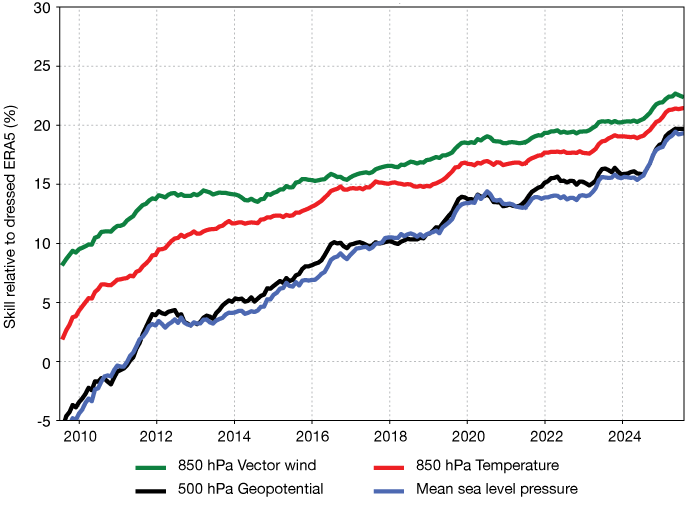
The Integrated Forecasting System (IFS) skill increased significantly when improvements were introduced at the end of 2024. The diagram shows 12-month running mean values of skill for the northern hemisphere extratropics relative to ERA5 reanalysis data.
The TAC noted that ECMWF does not generally lead over other forecasting centres in terms of surface parameters, more so at shorter ranges. However, progress was noted on surface weather parameters. 2 m temperature and 10 m wind speed errors were reduced by 10% in the ensemble forecast. While precipitation forecast skill improved slightly (0.5–1%), scores for 2 m dewpoint temperature and total cloud cover were largely neutral. The next upgrade, IFS Cycle 50r1, scheduled for later in May 2026, is expected to deliver substantial improvements in some of these variables.
The ability of sub-seasonal forecasts to indicate average conditions 2 weeks ahead also showed signs of improvement, though less pronounced in weeks 3 and 4. This remains a very challenging forecasting timescale. Seasonal forecast skill was modest in 2025, in part due to the absence of strong El Niño or La Niña conditions in the tropical Pacific.
In a major development, ECMWF began issuing operational machine-learning-based forecasts in 2025. Current assessments show that the Artificial Intelligence Forecasting System (AIFS) is outperforming the IFS for most surface and upper-air variables, with errors 5 to 15% lower in the medium range (out to 15 days).
AIFS is also substantially better than the IFS at predicting the location and track of tropical cyclones (TC), although it tends to under-predict their intensity.
Looking at precipitation, for example, the AIFS more skilful performance equates to a gain in forecast lead time of up to 1 day.
At present, the AIFS Single and ensemble configuration operate at a lower resolution (31 km) than the physics-based IFS (9 km), which remains indispensable for high-resolution fields and coupled Earth-system processes.
Forecast verification charts are available on ECMWF’s charts page, and a complete set of verification results is available from the publications library.